This time last year, I was in my final semester of college. I was homesick, separated by ~2,982 miles and knew I would not be celebrating Passover with my family. Moping around my apartment, my non-Jewish roommate (and best friend) walked through the door.
“So? What are we doing for Passover?”
I was a little confused at first. I responded “I’m not going home, so nothing?”
What do you mean?” She pressed me. “It’s on Saturday, we have to!”
Cozy Season with Hey Alma. As the days get shorter, Hey Alma is where you can curl up with Jewish culture that's funny, honest, and open to everyone.
Begrudgingly I agreed. She was right, we had to. And just like that I found myself having to plan and host a seder in one week.
As the RSVPs started coming in, I realized only my non-Jewish friends could attend, as my Jewish friends went back home or traveled to see family for seder. I was apprehensive to host a seder for people who had never celebrated Passover before, plagued by the thought that they would find it boring or I wouldn’t explain it well.
At synagogue that week, I explained my dilemma to one of my friends who was going somewhere else for Passover. “I don’t know what to do. Should I just cancel?” A force of reason in my life, she calmly said, “This is actually great. This seder will be more for you than anyone else in attendance.” Her words stuck with me as I took the train back to my place. Without a pre-existing frame of reference my friends were going into this seder with open minds and hearts.
With this in the back of my mind, I began the planning for my seder. I made my own blend of source sheet and haggadah with help from My Jewish Learning and Chabad.org, both keeping the basics to preserve the true essence of the haggadah and tailoring it to the needs of the group. I then created questions and reflections that were relevant to us as a group of young adults approaching graduation and about to enter the “real world.” This was all a part of the greater theme of my source sheet: Growth/Renewal. Passover is often discussed as one of the four Jewish New Years, and coming off the tails of Nowruz (Persian New Year or Spring Equinox) it felt fitting.
And then, it was time for seder. I conducted the seder in English, except for the prayers. After reading each in Hebrew, my friends enthusiastically said “AMEN.” I also taught my friends the niggun to “Kadesh Urchatz” (“The Seder Song”) and “Ma Nishtana” (מה נשתנה).
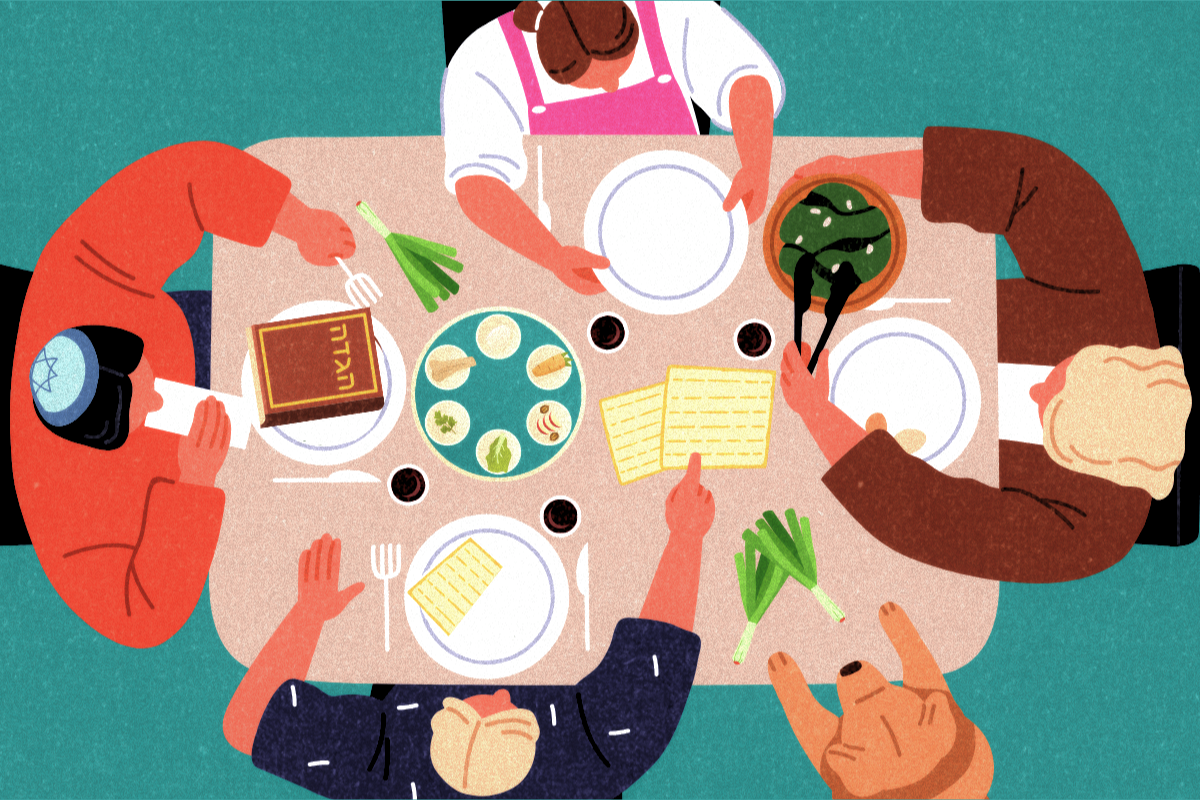
The receptiveness of my friends to the minutiae of Jewish practice, particularly within a diaspora, was so special. As a Mizrahi Jew, the Passover seder my community and I celebrate looks slightly different than those of Ashkenazi Jews. At my seder table, there are beans and rice, kitniyot that Mizrahi and Sephardi Jews consider kosher for Passover. We also have a special tradition of “whipping” each other with green onions during “Dayenu.” (The “whipping” is meant to be a physical reminder of the Jews being whipped as slaves for us to remember in every generation.) As hostess, I got to lead the storytelling, taking time to explain these differences, and answering questions that my guests posed.
I was so touched to see that my friends took the time to honor traditions that mean so much to me. The way they showed up to seder with intention and open minds was extremely special.
Meeting your guests where they are is a big skill in the art of hosting — and it’s so worth it. Being able to openly explain your traditions to a group who is willing and wanting to learn more about you is a religious experience in and of itself.
When planning for a seder with of non-Jews and/or first-time attendees, I would keep in mind that most people have a very limited frame of reference. Making the story of Passover accessible and exciting is a must. Some techniques I used were to make sure everyone read a passage from the haggadah, had the youngest read Ma Nishtana and assigned the roles of the Four Children based on my friends personalities. Above all else, remember to have fun with it.
My favorite parts of the Seder were the retelling of the Four Children, “Dayenu” and the sheer disbelief on my friends’ faces when I told them it is tradition to drink four cups of wine. While my friends were properly briefed – I candidly told them that this might be boring but that it is part of tradition – to my surprise everyone was really engaged and excited to learn. (A couple of my friends already knew the “Dayenu” tradition so they were excited to ambush the other guests.) I was lucky enough to have a group of friends who had no obligation to attend, they just wanted to learn and celebrate with me.
Even a few days after seder, it was still clearly on my friends’ minds. One of my friends sent me this meme posted by Nickelodeon and texted “Spongebob got the parsley! Where is the salt water though?” Another friend insisted that I give her my matzah ball soup recipe so she could make it at home. My roommate and I ate matzah pizza for dinner together. A few more helped me celebrate the end of Passover as well — we all went to Olive Garden and ate unlimited breadsticks until our stomachs hurt.
By no means was this a traditional Passover seder, but it was the first Passover seder I hosted solo. For that reason it will forever hold a special place in my heart. If you are feeling homesick this Passover, just remember that community can be found anywhere, not just within your Jewish circles.