Over the last three years, some of the most high profile pieces of art about the post-October 7 landscape in Israel and Palestine have come from movies.
From “Holding Liat” to “The Voice of Hind Rajab,” these works captured the public’s attention with the horrific stories they lay bare for a wider audience. The latest entry into this catalogue is the Israeli-made documentary film “NAZA,” which made headlines at the 83rd Venice International Film Festival. It has also stirred a great deal of controversy, backlash and praise.
If you need a primer on it all, you’re in the right place. Let’s dig in.
First thing’s first: What is “NAZA”?
“NAZA” is a documentary in which 24 anonymous Israeli Defense Forces soldiers and intelligence officers speak about the systems in Israel which allowed for Palestinian civilians to be killed en masse in military operations. All subjects featured in the documentary were a part of Israel’s campaign in Gaza. The film is named after the acronym used by the IDF which stands for “nezek agavi” (“נזק אגבי”), or “collateral damage” in English.
A Humble Request for the New Year: You can help keep Hey Alma's radically inclusive Jewish community free and open to all. Your gift means someone, somewhere, feels a little less alone this holiday season.
The main claim of the film is that Israeli forces allegedly calculated Palestinian civilian deaths in advance of strikes targeting Hamas — in other words, that deliberately killing Palestinian civilians, a war crime, was a matter of Israeli military policy.
Where has the film been shown?
The film premiered at the 83rd Venice International Film Festival on September 10, 2026. It received a 25-minute standing ovation and won the Special Jury Prize at the festival.
@varietymagazine The Gaza documentary “NAZA” earned a massive 24.5-minute #VeniceFilmFestival ovation as the crowd cheered and waved Palestinian flags. This marks the longest-ever standing ovation at Venice, beating the 22-minute ovation for “The Voice of Hind Rajab” last year, and perhaps the longest at any film festival, period.
Who made it?
It’s written and directed by Israeli Jewish investigative journalists and directors Yuval Abraham and Rachel Szor. The film draws heavily from Yuval Abraham’s reporting in +972 magazine, Local Call and The Guardian. The latter publication co-produced the film with British producer James Wilson. It’s executive produced by British Jewish filmmaker Jonathan Glazer.
You may recognize Abraham and Szor as the Israeli half of the directing team behind Academy Award-winning documentary “No Other Land.” With Palestinian co-directors Basel Adra and Hamden Ballal, Abraham and Szor documented Israeli settler violence, IDF involvement and displacement in the West Bank village of Masafer Yatta.
“No Other Land” received its share of praise and backlash when it came out in 2024 and subsequently won an Oscar for best documentary feature in 2025.
Israeli culture minister Miki Zohar called the movie’s Oscar win a “sad moment for the world of cinema.” He went on, “Freedom of expression is an important value, but turning the defamation of Israel into a tool for international promotion is not art — it is sabotage against the State of Israel, especially in the wake of the October 7th massacre and the ongoing war.” Some accused the filmmakers of creating propaganda for “Pallywood” — a portmanteau of “Palestine” and “Hollywood” which is used to claim that Palestinian people play up their suffering on camera specifically to demonize Israel. Others called the film “one-sided.”
Meanwhile, the Palestinian Campaign for the Academic and Cultural Boycott of Israel stated that the film violated “anti-normalization” guidelines. “Palestinians do not need validation, legitimation or permission from Israelis to narrate our history, our present, our experiences, our dreams, and our resistance,” they wrote.
Even still, there are those who supported the film. Critics called “No Other Land” “a devastating portrait,” “vital” and “concise, powerful and damning.” Mehdi Hasan, the former MSNBC political pundit, lauded the movie on X and Palestinian comedian Mo Amer congratulated Basel Adra on his Oscar win. Artists4Ceasefire, which includes Jewish celebrities Hannah Einbinder, Eva Victor and Ilana Glazer among its membership, praised the film, urging their followers to see it and also to continue to support Palestinian villages against settler attacks.
Back up, where do I know Jonathan Glazer’s name from?
Glazer, a British Jew, won the Academy Award for Best International Feature Film for “The Zone of Interest” in 2024. The movie follows Auschwitz commandant Rudolf Höss and his family as they live their everyday lives next to a Nazi concentration camp.
“All our choices are made to reflect and confront us in the present. Not to say, ‘Look what they did then,’ rather, ‘Look what we do now.’ Our film shows where dehumanization leads at its worst. It shaped all of our past and present,” Glazer said in his acceptance speech at the Oscars. “Right now, we stand here as men who refute their Jewishness and the Holocaust being hijacked by an occupation which has led to conflict for so many innocent people. Whether the victims of October 7th in Israel or the ongoing attack on Gaza, all the victims of this dehumanization — how do we resist?”
As you might expect, Glazer was both applauded and lambasted for his words. You can watch the full acceptance speech here:
How has the IDF responded to “NAZA”?
The IDF has previously denied the film’s thesis. “The IDF outright rejects the claim regarding any policy to kill tens of thousands of people in their homes,” it said in a statement to The Guardian in 2024. Then, they were responding to Yuval Abraham’s investigation into “Lavender,” an AI system he claimed the IDF used to specifically target Palestinian civilians for “assassination.”
Per JTA, “The IDF in April of that year said Hamas embeds its operatives and military assets among civilians, while Israel directs its attacks at military targets and operatives and conducts strikes under the rules of war that include proportionality and taking precautions to avoid civilian deaths.”
The report goes on: “The IDF said every target requires an assessment of the expected military advantage and likely collateral damage, and that the military does not carry out a strike when the anticipated civilian harm would be excessive in relation to the military advantage. The IDF also said intelligence systems described in the film are tools for analysts rather than autonomous target-selection systems and that targets require independent human review before any action is taken.”
But on September 14, the IDF released a statement specifically addressing “NAZA” which relayed, in short, that it “categorically rejects” the film’s findings.
That same day, Israeli army chief of staff Eyal Zamir released his own statement. He denounced “NAZA,” saying it amounted to “blood libels” and a “deliberate distortion of reality.” “‘NAZA,'” he said, “adopts narratives of Israel-haters, defames our soldiers and commanders, and seeks to present the IDF as deliberately acting unlawfully.”
He then called for Military Advocate General Maj. Gen. Itai Ofir to look into legal action against Yuval Abraham, Rachel Szor and “those involved with [the film],” and to “examine security aspects and possible involvement in relation to the leak of classified materials used in the production of the film.” The statement also announced a meeting of senior IDF officials to craft a detailed response to the film’s claims.
How has the Israeli government responded to “NAZA”?
The Israeli government is also none too happy about “NAZA.”
Prime Minister Benjamin Netanyahu took to social media on September 14 to address “NAZA.” “We’re fighting worldwide antisemitic incitement, but when it comes from within us, it’s intolerable,” he said in an approximately one-minute-long video. The Foreign Ministry and other Israeli governmental agencies met on September 14 to discuss their response to the documentary. Part of this response included sending talking points to Israeli diplomats abroad which refute the film as “Hamas propaganda.”
Culture minister Miki Zohar asked the Interior Ministry and Population and Immigration Authority to look into whether they can revoke Yuval Abraham and Rachel Szor’s Israeli citizenship.
“Zohar accused the filmmakers of harming Israel abroad and said officials should examine whether the way material for the film was obtained or published could amount to treason or assisting the enemy during wartime,” JTA reported. Netanyahu went on to publicly back this idea, saying on September 16 he would advance legislation “allowing Israel to revoke the citizenship of people who defame soldiers or the state abroad.” He also announced plans to advance another bill, this one raising the amount of damages in defamation cases against the IDF or the state of Israel to a maximum penalty of NIS 1 million (equivalent to $329,000).
So… can the Israeli government actually do that?
It’s unclear whether Israel has the power to revoke Yuval Abraham and Rachel Szor’s citizenship. “Under current Israeli law, citizenship can be revoked only in narrowly defined cases involving a ‘breach of loyalty,’ such as terrorism, treason or serious espionage, and the process requires court involvement,” JTA reports. This has only happened in rare cases, such as against senior Hamas official Nihad Abu Kishak and Hezbollah operative Qais Obeid in 2002.
“There is no precedent for revoking citizenship over speech or a work of art,” according to JTA. Additionally, the Association for Civil Rights in Israel and The Committee to Protect Journalists have both condemned the proposed legislation.
Israeli President Isaac Herzog has said he thinks the cause of stripping the filmmakers’ citizenship is “completely irrelevant” and has “no chance” of actually happening. He still, however, criticizes the film as “a shame and disgrace.”
Has anyone else criticized “NAZA”?
Yes. On September 14, prominent Israeli investigative journalist Raviv Drucker told Yuval Abraham in an interview that he would not have aired “NAZA” due to a lack of publicly available evidence. (Abraham responded that The Guardian has verified the claims made in “NAZA.”)
There have also been violent threats leveled against Yuval Abraham and Rachel Szor. Former hostage Eliya Cohen accused Abraham and Szor of spreading lies about soldiers and endangering Israelis and Jews globally. “People should spit on them,” he said of the filmmakers. “The blood of our friends, the blood of Diaspora Jews, is on their hands.”
Channel 14 Journalist Yehuda Schlesinger said the pair should be “pursued” or “hunted.” On September 16, right-wing activists (including those linked to Itamar ben Gvir’s Otzama Yehudit political party) held a protest outside the home of Rachel Szor’s parents, with one protester calling for “the death penalty for traitors.” Others called to target Yuval Abraham’s family, such as “a rightwing activist with tens of thousands of followers,” per The Guardian. “We’ll show him ‘collateral damage,'” the post said, which also shared a photo of Abraham’s mother.
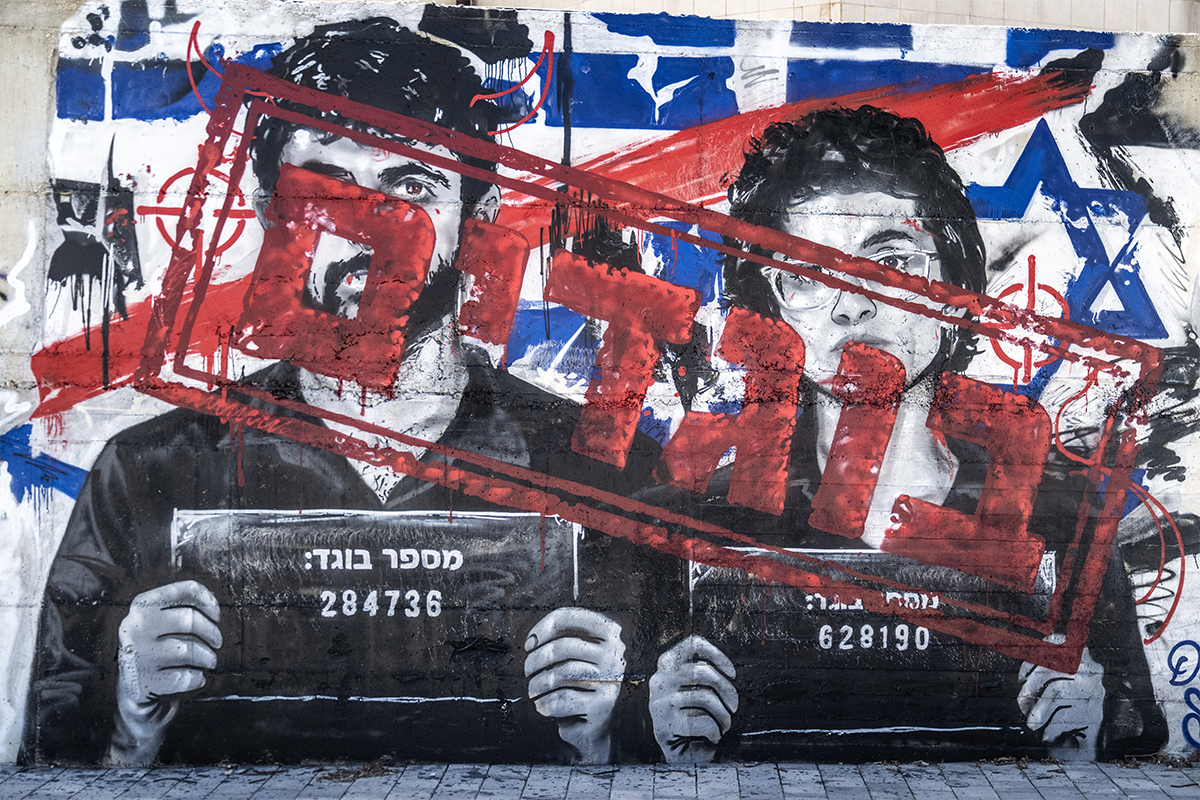
In Ashdod, artist Dudi Shoval painted a mural of horned Yuval Abraham and Rachel Szor holding mugshot letterboards, surrounded by swastikas and crosshairs. The word “traitors” was painted across their faces.
Is there Palestinian and/or left-wing criticism of “NAZA”?
Yes. Some Palestinian pundits and those in the pro-Palestine movement argue that the film doesn’t introduce any new information, valorizes the Jewish Israeli filmmakers for reporting what the Palestinian community has already said to be true, actually allows Abraham and Szor to benefit from the destruction of Gaza and is against BDS anti-normalization guidelines.
Some have also criticized Abraham and Szor for not doing enough for the movement. “We must demand that Yuval Abraham and Rachel Szor immediately release the names of every soldier to whom they granted confidentiality in their documentary NAZA while documenting admissions of war crimes,” Nerdeen Kiswani, founder of Within Our Lifetimes, wrote on X. “There is something fundamentally perverse about creating films and journalism centered on Israeli soldiers confessing to atrocities against Palestinians while simultaneously protecting those soldiers from identification and potential accountability.”
“I call on @yuval_abraham and his colleagues to immediately release ‘NAZA’ online for free for the whole world,” Ali Abunimah, director of Electronic Intifada, added. “I understand that this will exclude it from the Oscars and other awards, but if it’s so urgent to help stop the genocide, that’s the only moral thing they can do, especially as Israelis. Release NAZA online now!”
“[Yuval Abraham and Rachel Szor] should’ve already been in the process of renouncing their citizenship if they were for real about being anti occupation,” writer Sarah Hagi offered on the news of the Israeli government attempting to strip the filmmakers of their citizenship. “what are they gonna do now, fight israel to beg to remain citizens?”
Got it. So, what are supporters saying about “NAZA”?
Those who support the documentary say the filmmakers have unique access to information about the IDF precisely because they are Israeli. Some also say “NAZA” brings important attention to what has been happening in Gaza and could even serve as evidence in the ongoing International Court of Justice case against Israel.
Journalist and notable leftist critic of Israel Peter Beinart analyzed the film in a conversation for his Substack The Beinart Notebook. “It’s a devastating film, and I can’t do it justice, and I would really recommend that people, if they have the opportunity, watch it,” he wrote.
Russian-Israeli independent journalist Andrey X similarly praised “NAZA.” “‘Is the film good?'” he questioned in a thread on X. “Yes. And the vast majority of you will learn something new about the mechanics of the Gaza genocide, even if you’ve been following it closely. And for the people who haven’t been following, who will watch it now because of the festival clout, it may be absolutely eye opening.”
There are those who also support “NAZA” and its makers as a civil rights issue. Following the backlash from the IDF and Israeli government, 2,000 Israeli filmmakers signed their name to a petition defending Yuval Abraham and Rachel Szor. “We, filmmakers, call on all who are still fighting for freedom of expression and creation to join in expressing support and solidarity with Rachel Szor and Yuval Abraham,” the statement read in part. “The central role of art and journalism is to hold a mirror up to the society in which they exist, to create discourse and discussion without assumptions, even when the reality is difficult.”
Meanwhile, 43 Israeli human and civil rights organizations released their own statement of support for the filmmakers, urging authorities “to put an end to the wave of incitement and threats of violence.” The list of organizations involved with the statement includes B’Tselem, Peace Now, Adalah, Physicians for Human Rights Israel and Breaking the Silence.
How has the Israeli public responded?
Israeli journalist Gideon Levy claimed in a Sept. 17 column in Haaretz that Israeli society has been driven to “hysteria” because of “NAZA.” “The Gaza documentary has elicited a nationwide uproar. After years of repression, denial and lies, apathy and indifference, the pus has burst forth in a mighty stream,” his piece is subtitled. “This is a healthy process, even if it includes ugly manifestations.”
He also writes, “The insane anger at Szor and Abraham shows that they have managed to touch the center of the abscess. And that is painful. The intensity of the response shows that Israelis feel something is burning under their feet. Anyone who cries out in such anger understands that something has gone very wrong. A society confident in its righteousness doesn’t respond like that to a film.”
New York Times opinion columnist Michelle Goldberg had a similar take. “It’s hard to tell whether Israelis are enraged by ‘NAZA’ because they think it’s full of lies, or because they know or fear it’s true,” she wrote in a piece entitled, “Why Israel Fears This Searing New Documentary.”
So why did Yuval Abraham and Rachel Szor make “NAZA”?
Per their directors’ statement:
“We made this film out of a sense of obligation to use our position as Israelis to examine the systems behind the mass killing of Palestinian civilians for which our country is responsible. While filming over the past three years, we found ourselves asking the very questions that were asked by our grandparents’ generation and throughout the 20th century: how does one group of people allow the total dehumanisation of another? What do the inner workings of such a system look like?
“Many of the revelations in the film were published almost immediately as we learned of them, in the months following the October 7th attacks, by The Guardian (one of ‘NAZA”s producers), in collaboration with reporting partners +972 Magazine and Local Call. The film lets us explore something deeper than we could in our investigative journalism alone: not only the words being said but also those that are not said, the silence. It is up to all of us to break that silence.”
So what’s the conclusion here?
Sorry, there isn’t one. While the Israeli government and IDF continue to pursue legal action against Yuval Abraham and Rachel Szor, the documentary opens theatrically in the United States on Sept. 30, meaning this story will surely continue to develop.