James Gray’s new film “Paper Tiger” opens with a quote from Aeschylus’ play “Agamemnon” (that’s the one about the daughter-sacrificing general who Benny Safdie played in “The Odyssey”): “Let there be wealth without tears; enough for the wise man who will ask no further.”
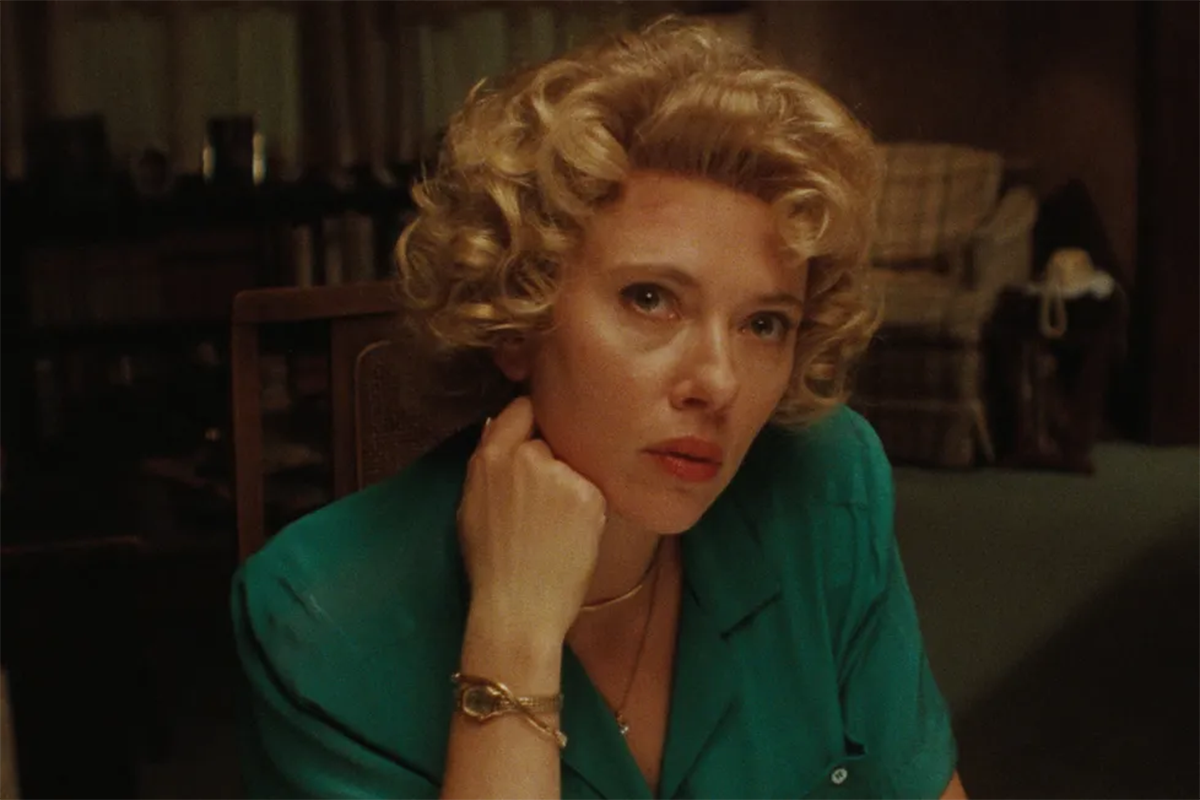
Irwin Pearl (Miles Teller) isn’t as malicious as Agamemnon. He doesn’t kill his kids, Scott (Gavin Goudey) and Ben (Roman Engel), in pursuit of his ambition — but he does put them in grave danger. His wife Hester (Scarlett Johansson), figuring what to do with her final months after the diagnosis of a fatal brain tumor, isn’t responding to the threats against her children in the same way Clytemnestra responded to Agamemnon’s sacrifice, but she has to do something about it.
Irwin’s ambition is not that of “the wise man.” His family has lived a comfortable middle class life, but it’s the “greed is good” 1980s and he wants more. He’s particularly envious of his brother Gary (Adam Driver), an ex-NYPD businessman who drives a Mercedes and treats the family to Peter Luger steak dinners. Gary has connections everywhere, and he invites Irwin to join him for what seems like the perfect money-making opportunity: an engineering consulting firm for some new businesses operating along the Gowanus Canal.
It’s not exactly Irwin’s fault he’s unaware these “new businesses” are part of the Russian mafia. Not even the cops really knew about the Russian mafia in the ‘80s.
Count yourself in. Every hot take, every meme, every unapologetically Jewish essay is reader-funded. Join thousands of readers with a year-end gift. You in?
“Paper Tiger” plays like a classical Greek tragedy, a tightly-focused tale of sympathetic yet hubristic characters reaching for more and finding only pain and destruction. It’s also, according to James Gray, about 90% accurate to his family’s actual story.
Gray’s previous film, 2022’s “Armageddon Time,” was supposedly 99% accurate. That drama was more directly autobiographical, about Gray’s own childhood failures at being the “mensch” his grandfather (Anthony Hopkins) wanted him to be. In that movie, his dad “Irving” was played by Jeremy Strong and his mom “Esther” was played by Anne Hathaway. You can consider “Paper Tiger” a semi-sequel to “Armageddon Time,” this time focused on the parents and taking on a more heightened tone as a crime thriller.
I enjoyed “Paper Tiger” while watching it at the 2026 New York Film Festival. It’s a slow burn that builds suspense as it progresses, peaking with an incredible shoot-out in the tall grass outside LaGuardia Airport. The familial relationships are well-observed, their various combinations of love and betrayal feeling so real (probably because they were real). I then found myself liking the film even more after hearing the director and actors talk about it at the press conference that followed.
Regarding his approach to making mythic connections in a personal story, Gray said, “If you can be specific to your own story […] hopefully a kind of greater mythic idea comes across, but I don’t think you can plan that.” He acknowledged George Lucas as an exception, able to write stories directly as myth, but Gray can’t think that way. Instead, he digs into the “unflinching” details of his experiences as the basis for mythic connection. “I was trying to use my stories to get at something bigger. The whole idea of creating anything, I think, is to be specific to yourself […] but hope that connects to others.” To Gray, “the area that myth begins” is “the extension of our compassion.”
Adam Driver talked about developing his character from the perspective of Sophocles’ treatments of “Philoctetes” and “Ajax,” stories about “people who are betrayed by the institutions that kind of made them.” Gary has a similar internal drive as “someone who not long ago was at the top of his game and had a lot of power and had this found family, disappears for a little bit, has a little bit of a setback, comes back to this same environment and is totally powerless.”
Gray didn’t remember discussing “Philoctetes” with Driver before, but was impressed by that comparison, responding, “The whole idea of ‘Philoctetes,’ which people should read, is that you have such profound sympathy for him as he’s in this cave and wounded and crying out in pain, and it’s the most sympathetic character in maybe all of history and drama.”
It’s that level of compassion, still hitting in stories written 2500 years ago, which Gray hopes to live up to. “Paper Tiger” might not reach that masterpiece status, but it offers a deeply compassionate look back at one messed-up Jewish family from Queens 40 years ago, and its detailed specifics lend power to its universal themes.