Israel
What are the antisemitic tropes about Jews and Israel?
Back to: Hey Alma’s Guide to AntisemitismWelcome to what is probably the most complicated section in this whole guide! Let’s take a deep breath and get into it.
When it comes to Israel and antisemitism — when is it antisemitic to criticize Israel? What’s the line between anti-Zionism and antisemitism? Does protest make Jews less safe? — it’s hard to find definitive answers, because, well… nobody agrees. Not even all Jews.
TL;DR: Disagreement in the Jewish Community / ANTI-ZIONISM / DISCOURSE ON ISRAEL / MORE RESOURCES
Do all Jews agree on anything?
Not really. And definitely not on this.
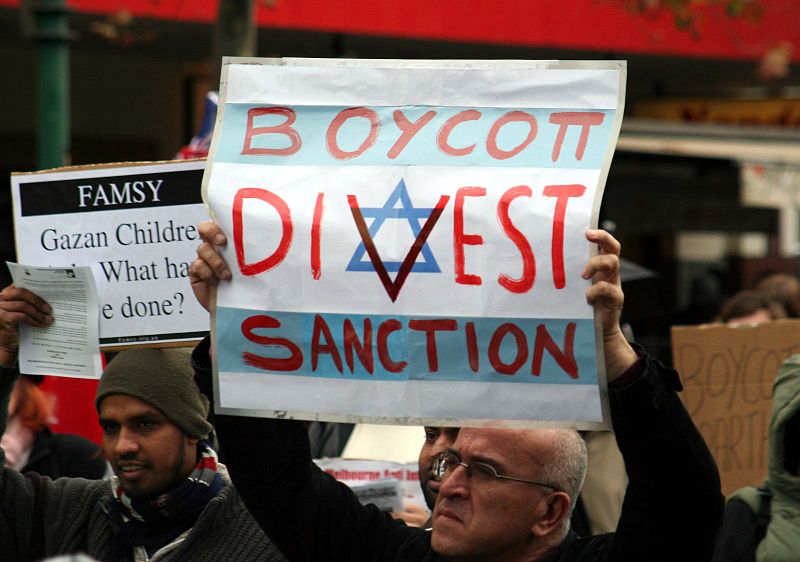
There are strong, often emotional reactions to phrases like “from the river to the sea,” terms like “genocide,” and boycott movements like BDS, all of which have surged in visibility since the start of the Israel-Hamas war in October 2023.
So let’s tackle the big question…
Is anti-Zionism antisemitic?
This is one of the most complicated and emotionally charged questions in Jewish life today.
One widely used definition of antisemitism comes from the International Holocaust Remembrance Alliance (IHRA), which says that “denying the Jewish people their right to self-determination, e.g., by claiming that the existence of a State of Israel is a racist endeavor,” could be antisemitic. This definition has been adopted or endorsed by dozens of governments and institutions, including the U.S. State Department.

Many people — including many Jews — agree with this idea. They argue that, like other ethnic and religious groups, Jews have the right to self-determination. Singling them out as an exception is seen as antisemitic. Others feel that anti-Zionism often involves denying the Jewish people’s religious and historical connection to the land of Israel — and that denying a people’s history and identity can also be a form of bigotry.
For many Jews, Zionism isn’t just about politics — it’s about safety, survival and belonging. That’s part of why this conversation can feel so personal and so fraught.
Other people, including some Jews, reject the idea that anti-Zionism is inherently antisemitic. They argue that the creation of Israel as a Jewish state led to the displacement of Palestinians, and that it’s not antisemitic to oppose a system that gives preference to one group over others. From this perspective, advocating for equal rights for all who live in Israel — or critiquing the idea of a state built around Jewish identity — is an ethical stance, not a bigoted one.
In a recent survey, about 13% of American Jews said the phrase “Israel has no right to exist” was not antisemitic. And some Jewish self-described anti-Zionists argue that while Israel may have the right to exist, it should not do so as a state that privileges Jews over others, and that Palestinians are also entitled to self-determination.
Are there any definitive answers when it comes to antisemitism and discourse around Israel?
Hmmm… Most people, including many Jews, agree that it’s totally possible to criticize the Israeli government or its policies without being antisemitic. At the same time, there are very real ways that Israel-related discourse can veer into antisemitism.

OK, lay it on me: How can you recognize when Israel-related discourse veers into antisemitism?
Criticism of Israel can veer into antisemitism if it:
- Uses classic antisemitic tropes (e.g., Jews control the media, are greedy, or are part of a secret conspiracy)
- Blames individual Jews or all Jewish institutions for the actions of the Israeli government
- Presumes all Jews and Jewish institutions are Zionist, thus collapsing a complex mix of religious, cultural and political identities into one label and making Jews targets for hostility tied to Israel
- Singles out Jews to not have a country or self-determination because they’re Jews
- Charges that Israel’s policies are discriminatory because Jews can’t help but discriminate against others
- Calls for violence against Jews as payback for the Israeli government’s actions
As we mentioned earlier, the International Holocaust Remembrance Alliance (IHRA) definition is one framework people often turn to when trying to draw the line between criticism of Israel and antisemitism. It says that “criticism of Israel similar to that leveled against any other country cannot be regarded as antisemitic.” But it also warns that someone could be engaging in antisemitism if they apply “double standards” to Israel — for example, “requiring of it a behavior not expected or demanded of any other democratic nation.”
That has become increasingly controversial itself, with many on the left arguing that these examples can be used to shut down legitimate criticism or infringe on free speech.
I’ve read through that list, and I’m still not sure if something I’m seeing is antisemitic. What can I do?
We hear you. This is complicated.
In general, if you’re seeing something from a friend or loved one that concerns you, we recommend reaching out, ideally in person or on the phone, and trying to have a more nuanced conversation. Hear where they’re coming from, and share where you’re coming from. Sometimes, avoiding or setting aside big buzzwords like Zionism/anti-Zionism, genocide, apartheid, or insults like self-hating Jew, can help — these words can quickly set someone off or derail the conversation into arguing over semantics instead of the real heart of the issue.
You still may not have clarity at the end of the conversation, or you may have to agree to disagree. Perhaps you will see that their intent was not antisemitic, but they could have worded something better. Perhaps their true colors will show. And perhaps you will find that you actually have a lot more that you agree on than you thought.
At the end of the day, it’s up to you to determine if someone crosses a personal line or boundary, and how you want to handle that.
Are there any more resources you’d recommend for someone wanting to learn more?
First off, not to toot our own horn, but we have an entire guide to the Israeli-Palestinian conflict that offers some necessary context for these discussions.
We also have a few articles on how to have hard conversations about Israel, including with fellow Jews.