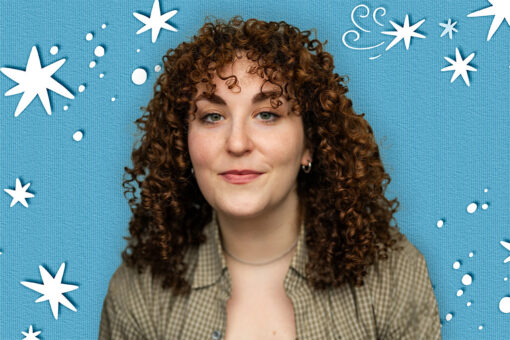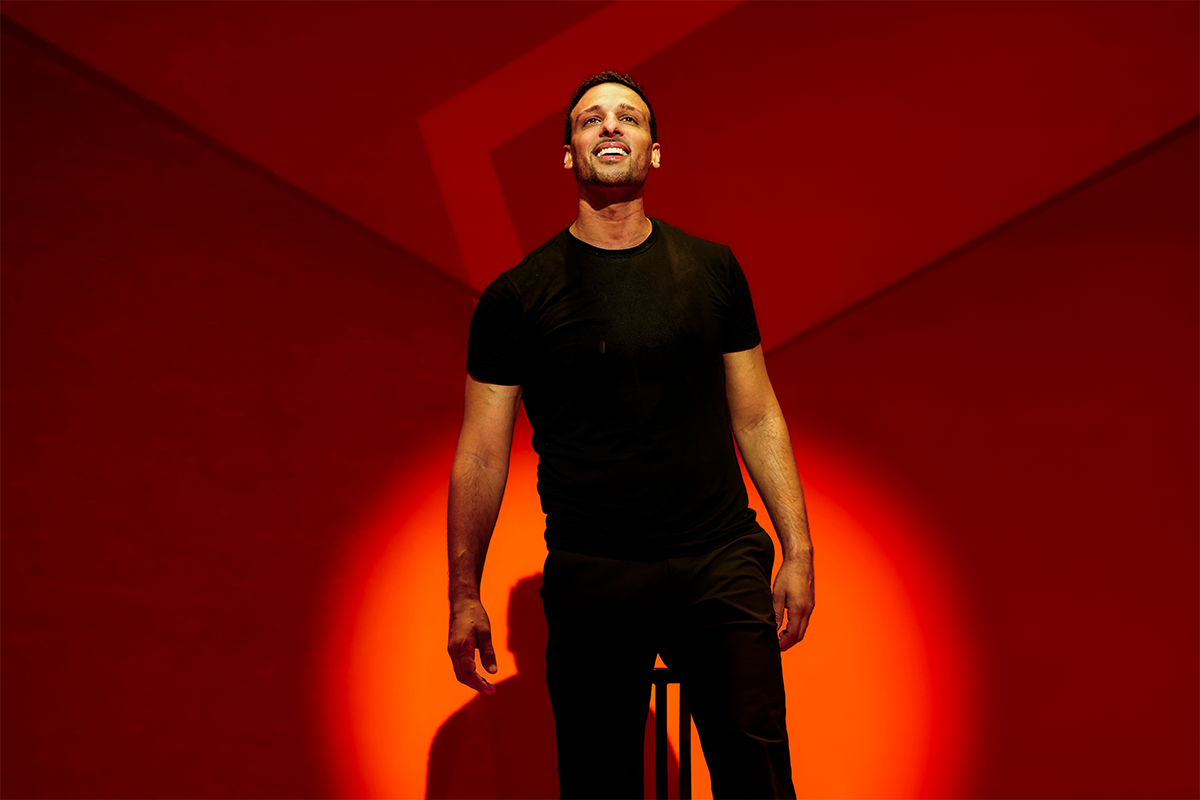
Ari’el Stachel is on a mission.
The 34-year-old Yemenite-Ashkenazi American-Israeli actor uses this word a few times when we speak over Zoom. His mission is to provide others with the tools to talk about their mental health. It’s to counter the stereotype that all Jews are white. It’s to bring together Jews and Muslims, Israelis and Arabs.
From talking to him, you believe that he can do all of it, too.
Ari’el is charming, not unlike Haled, his character in “The Band’s Visit,” for which he won a Tony Award in 2018. He emanates confidence, drive and warmth. It’s a version of himself animated in stark contrast to the Ari’el Stachel of the past, whom the audience gets to know in his one-man Off-Broadway show “Other.”
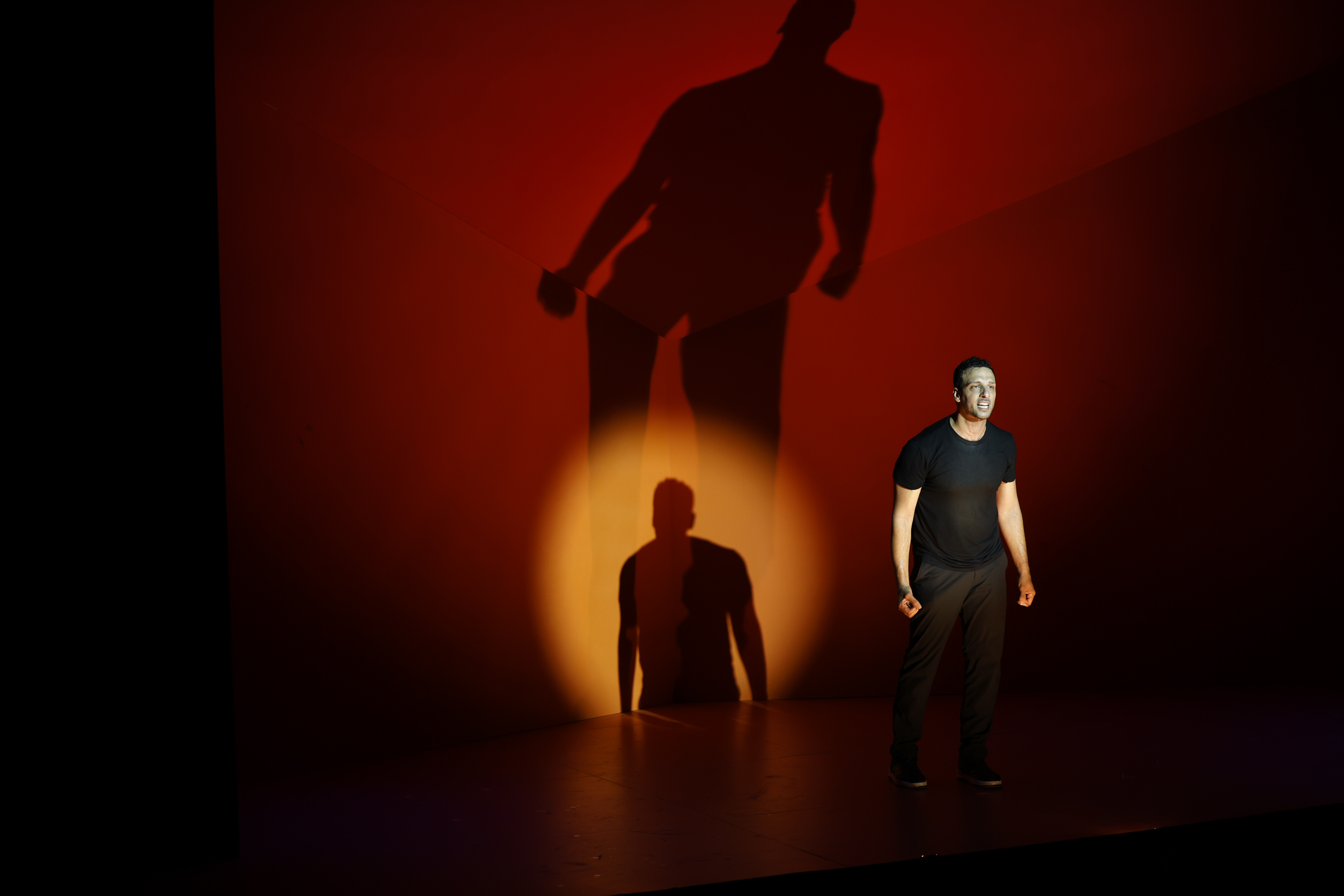
Currently on at the Greenwich House Theater, “Other” is an exploration of how the sources of shame and deep-seated anxiety in Ari’el’s life have become sources of pride for him. He guides us from the moment he won the Tony back and forth in time, using his OCD and anxiety-manifested sweat as a framing device.
We see his Berkeley, California childhood, where America’s anti-Arab sentiment post-9/11 makes him too brown for most settings, including Jewish ones. In response, his OCD compels him to hide his Yemenite Israeli father from friends and classmates; he opts instead to pretend to be Black. (Though not included in the show, Ari’el tells me this even affected his bar mitzvah. Instead of having one in America, his uncle took him to have a quick ceremony at a Yemenite synagogue in Israel.)
Later, at NYU, Ari’el opens up about his Arabness for the first time in his life. He gets involved with Middle Eastern acting groups, but is also pigeonholed into only Arab roles with names like “Terrorist No. 2.” Even playing Haled in “The Band’s Visit,” while gratifying, was part of a pattern in which Ari’el was not seen for Jewish or Israeli roles.
When October 7 happens, Ari’el’s identity is further fractured, and the play reflects that.
When Ari’el caught up with Hey Alma a few weeks ago, we spoke about “Other,” having to “rip open” the play after October 7 and his dreams for the show.
This conversation has been lightly edited and condensed for clarity and length.
Can you talk about how the show came to be?
I’d spent my entire 20s playing a combination of foreign characters and mostly Arab characters. I was never considered for a Jewish role professionally in my life. I think there was this deep feeling, specifically while I was doing “The Band’s Visit,” that I would not see my culture, my Mizrahi-American heritage, ever reflected on the stage unless I wrote it myself. That was the entry point.
You just referred to yourself as Mizrahi-American, but more often on social media I hear you calling yourself an Arab Jew or a Yemenite-Israeli Jew. Why do you feel more resonance with those identifiers than Mizrahi?
I’ve done a lot of research to substantiate my feelings about this. For me, it’s kind of a visceral body connection. When I see other Arab people, when I see other Yemeni people, it’s like, we have the same blood. You feel it. What I found in research I did were theories that Yemeni Jews actually came from southern Arabian tribes that existed long before there was Yemen or even Saudi Arabia. The tribes were just in that area, and when the Jews who were kicked out of Judea traveled south, they mingled with these tribes. A lot of them adopted Judaism thousands and thousands of years ago. My blood, my DNA, is more similar on my dad’s side, at least, to the Yemeni Muslim population than my Ashkenazi side.
That doesn’t negate the fact that Jews in every society that we ever lived in throughout history have had a hard time. But that doesn’t mean that some of us aren’t Arab. I see [calling myself an Arab Jew] as something that feels like a unifying statement. Frankly, there’s this political need for Jews from Middle Eastern countries to not call themselves Arabs. And I, as someone who’s American-born and raised and have spent my entire life playing Arab roles, that’s how I see myself.
I think kind of to your point, the show poses so many questions about who is American? Who is seen as American? Do those questions about being Israeli come up for you in the same way?
As I grew up, I tried 100 different ways of self-identifying. One time I thought, well, maybe if I went to Israel I might feel a certain level of cohesion, of belonging. And I went to Israel, and I spent a month there seeing how it would feel. I realized that I was very much American. I was the son of an Israeli, and I’m deeply connected to the culture, but I’m not Israeli.
That said, I don’t have any qualms with being the son of an Israeli. I’m proud of the fact that my dad’s Israeli and that land and the story that my grandparents have of immigrating from Yemen to Israel. That matters to me. It makes me sad, that it’s an identity that now I feel creates a lot of tension when I share it with people.
That brings me to another question that I had. The first staging of the show was pre-October 7, correct?
Yeah.
How did the show change then?
The play initially concluded with, this is a guy who needs to accept the fact that he’s going to live this fractured identity. Then, I had to rip open this work of art that I’d spent three or four years cultivating. I would say that I’m still working on integrating October 7. I still probably have another version to crack. But this is the third version, and I’m very proud of where we’ve arrived. I think that it made me understand that my identity is always in conversation with the world.
In the show, you call yourself a bridge and you often talk about your position to be able to unify Israelis, Arabs, Jews, Muslims, etc. Does that responsibility in and of itself trigger anxiety for you?
It’s more of a sadness by how extreme our world has become. I always try to lead with my moral compass, and I try to share things that say, listen, I’m not ashamed of being Israeli. I am Israeli and I know what Israel means to my family. I think that the people running [the country] are horrific. I really believe in Palestinian rights. I see Palestinians as my brothers. That is a position that a lot of people seem unable to take. There’s literally either this or that, and I’m not in that space.
[Especially online,] negative, polarizing, hateful stuff is getting so much attention. I’m going to keep putting out goodness. I’m going to keep trying to offer my humanity to, quote unquote, both sides — which I think is a fallacy to begin with.
The show is running until Dec. 6. What are your hopes for “Other” in the long term?
We intend to do a short run on Broadway and I want to tour it. We’ve also partnered with the Jewish Board of Family and Children’s Services. They’re a nonprofit that provides mental health services to kids all over the five boroughs — they’re called the Jewish Board but they serve every kind of person. That’s been really fulfilling. We’ve had talkbacks and they brought a lot of young people, who I think need the show the most. I want the show to have a full, healthy life.
Do you think there will ever be a time when you feel like, like, OK, I have performed the show to the extent that I want to perform it, and you feel ready to let it go?
I think we’re about a year away from that. I have a dream of doing it in Israel, maybe in East Jerusalem, maybe translating some of it to Arabic, some of it to Hebrew. I think once I do that, then I put it to rest — because it’s hard and it’s kicking my ass.
Besides doing this show, what would you say are your dream roles?
I want to do a Yemenite Jewish adaptation of “Fiddler on the Roof.” I want to find someone who can re-orchestrate it and give it that sort of Yemenite music spin. Maybe I need to wait 20 years for me to play Tevye, or maybe I just do it now and cast someone else. I just want to keep creating good stories that are human without flag-waving, that showcase perspectives that we haven’t heard from.