In 1998, “Ragtime” opened at the Lyric Theatre (then the Ford Center for the Performing Arts) on Broadway in New York, New York. And it seemed for some years thereafter, that all the show’s days would be warm and fair.
Unless, of course, you’re Baby Brandon Uranowitz — how the now 39-year-old Tony-winning actor refers to his younger self.
A year earlier, 10-year-old Brandon replaced Paul Dano in the world premiere-production of “Ragtime” in Toronto. The musical adapted E.L. Doctorow’s sweeping 1975 novel of race and class in New York at the beginning of the 20th century. And in it, the young Jewish actor played the Little Boy, a part of the show’s WASPy New Rochelle contingent. Donning crisp white sailor suits and twice-a-week bleached hair and eyebrows, Brandon would perform alongside powerhouses Brian Stokes Mitchell, Marin Mazzie, Audra McDonald, Peter Friedman and even a young Lea Michele. When the show transferred to Broadway, they all went with it — without Brandon. The powers that be did not ask him to originate the role on Broadway.
“The reasons for me being demoted, for lack of a better term, were either I was too Jewish or I wasn’t good enough,” Brandon told the New York Times last year. “Both of those options are deeply shameful for a kid, and for me even now as an actor.”
Cozy Season with Hey Alma. As the days get shorter, Hey Alma is where you can curl up with Jewish culture that's funny, honest, and open to everyone.
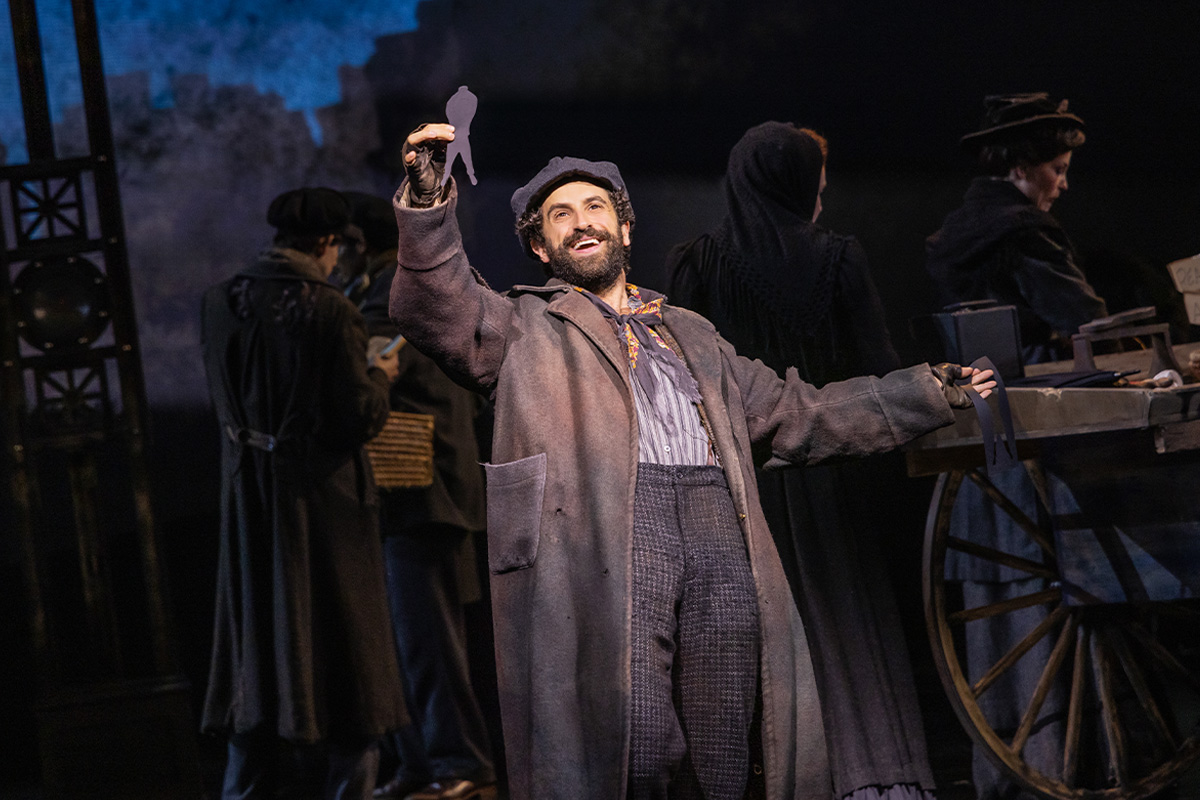
Now, nearly 30 years later, Brandon can finally bring this painful chapter of his life to a close. With Lear DeBessonet’s revival production, he has finally made it to Broadway with “Ragtime.” This time, Brandon plays Tateh, a plucky Jewish immigrant and silhouette-maker who emigrates to the United States to provide a better life for his daughter. His performance is undeniable, swelling with equal parts humor and poignancy.
When Brandon chatted with Hey Alma recently, we discussed the “cosmic” nature of his return to “Ragtime,” what the show has to say about Jewish assimilation and the urgency he feels telling an immigration story during the Trump administration.
This interview has been lightly edited and condensed for clarity.
“Ragtime” was off-Broadway at New York City Center last year during the presidential election. How does it feel to perform it now, compared to then?
It definitely feels more urgent now. I think this speaks to the breadth of ideas and emotions that “Ragtime” portrays. That first week [at City Center], the week before the election, hope was crackling. You could feel this radical optimism that we hadn’t felt in a while. And then that hope very quickly mutated into a deep despair. [Doing the show] was very cathartic. That second week, we were all really grateful to have this show to pour all of those feelings into. I think the audience felt that way too. I mean, that week after the election was one of the most electric experiences I’ve ever had on stage. Everybody was so raw, and there were a lot of unknowns at that time. We had the reference point of Trump’s first term, but we had no idea what was coming.
Now that we’re deep in the thick of it, especially for the immigration storyline, we’re watching hundreds and thousands of people be disappeared on a daily basis. There’s an urgency now to tell this story, because there are actually real-life consequences happening outside of the doors of the theater every day that need to be confronted and dealt with. My hope is that the galvanization of this show gets people to act.
Did the most recent elections, where progressives did very well, add anything to that?
The brilliance and the prescience of “Ragtime” is that it can hold the feeling, the emotions and the politics of any current moment. I’ll only speak personally, but I haven’t felt that kind of hope since Obama 2008. So, for me at least, “Ragtime” was filled with hope that night. I mean, it’s always there. But there are certain things that happen in the show that, depending on the current moment, are amplified or muted depending on where we are. And so that night, the show felt very indicative of the progress that we are able to make as Americans. Mandy Patinkin and his wife came to the show the day after, and they felt that too. They were just sort of beside themselves with how “Ragtime” was able to unlock some of these emotions.
Assimilation is another key part of Tateh’s story. Tateh changes his name, but he changes it to Baron Ashkenazy. He wears finer clothes, but he doesn’t ever give up the accent. There are parts of him that are there. You were last on Broadway in Tom Stoppard’s “Leopoldstadt,” which tells a very different story of assimilation. Are you thinking about these shows in conversation with each other?
I am very much. One of the big arguments in “Leopoldstadt” was the question of whether or not assimilation is a worthy endeavor and whether or not assimilation is ultimately, holistically possible. That was the tension within “Leopoldstadt,” the argument being that no matter your proximity to the dominant culture, you are still a Jew. I think that’s very much in dialogue with how I feel about Tateh’s story. Because what’s interesting about “Ragtime” is he is able to find success. He is able to, in his way, assimilate. And my big question is, OK, well, why is that possible for him and not Coalhouse and Sarah? What about the Jewish immigrant identity allows access to things that Black folks in this country don’t have access to? I also question if “Ragtime” had a sequel, what would Tateh’s future and his success look like? Is that situation fully sustainable?
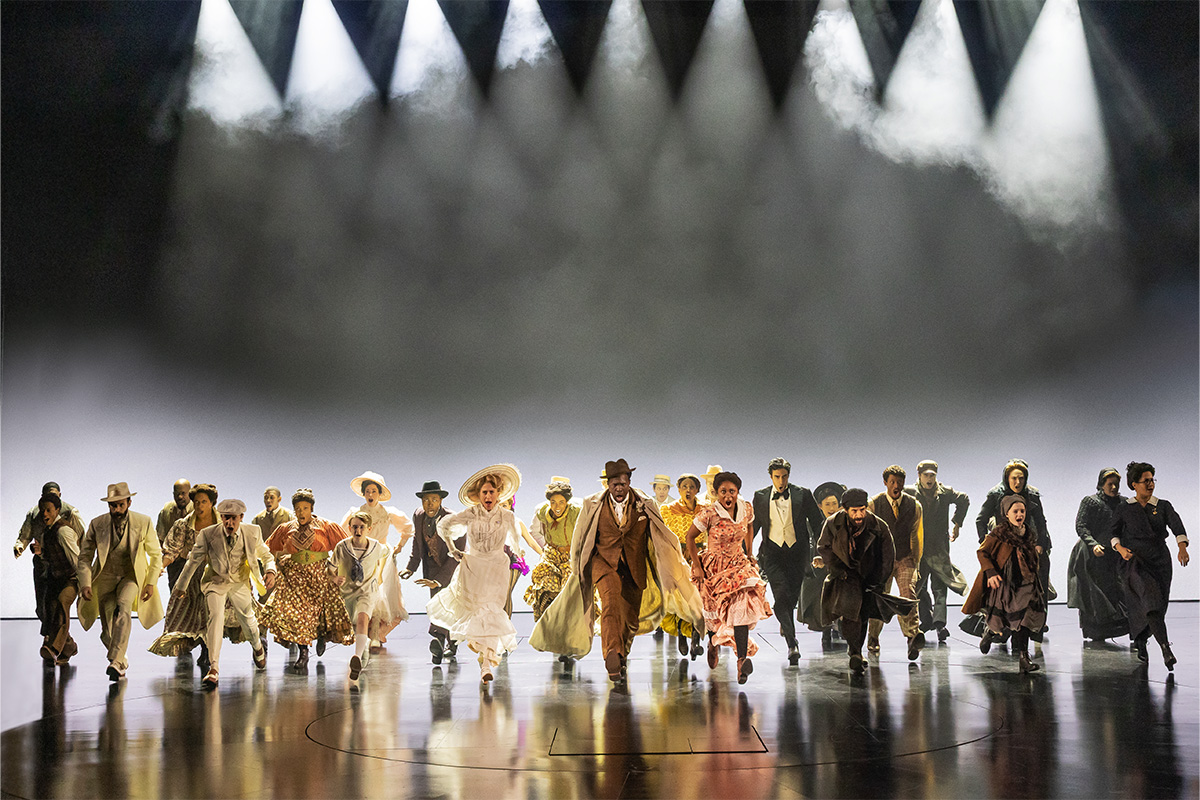
I also wanted to talk about your specific journey with “Ragtime” as a child. You’ve spoken about how it’s been very healing for you to be in the revival. Can you talk about where you are in the healing process now?
I had gotten so close to the dream as a child. As children, our brains are still developing. Emotions are complicated and messy and amplified. So that was a deeply traumatic experience for me. It made me distrustful of this business a little bit. Yes, it thickened my skin. It primed me for the inevitable rejection that comes with being an actor. But being let go from a show right before it went to Broadway, it can make you jaded. For an 11-year-old, that’s tough. I harbored a lot of that cynicism early on in my career as an adult.
So when we did it at City Center, the healing was very emotional. I felt like I was finally able to release some of those feelings about the business as a whole, and what it means to be an actor. City Center was epic and incredible and amazing – but just on a technical basis, we weren’t on Broadway. So for young baby Brandon, the circle hadn’t fully closed yet. Now that we’re on Broadway, rather than feeling emotional about it, I feel very planted on the earth. I’m where I’m supposed to be. There’s a finality to it that feels very relieving. I’m now in this process where I feel a sense of relief, which allows me to be really present with it and enjoy it.
The other thing is it’s taught me about patience and the things in life that you can and cannot control. Those things that you can’t control can drive you absolutely insane. But if you have patience and grace with yourself, things will resolve over time. I was playing a little boy. I mean, I was 11. I was on the cusp of hitting puberty. I was starting to grow hair on my arms and I looked like I was Lea Michele’s twin brother. It was not right [for the role]. And of course I took that personally as a kid. I was like, “Oh, it’s me. Something’s wrong with me.” And now I’m playing a Jewish immigrant, which is half of my family’s story. I feel deeply aligned with this role and this moment. So if I can take a step back and zoom out, it just all feels very cosmic.
Have you had a chance to speak with Peter Friedman about Tateh?
Not really, actually. I’m dying to talk to him about his experience. Although we do have one connection: There’s a moment in “Success” at the very end where Tateh has a breakdown after someone tries to buy the little girl. The lyric is, “Sucker, step up and I’ll cut you out your own guarantee.” And on the word “cut,” I would take the scissors and violently cut up the silhouettes. One night at City Center, I cut right into my thumb. It splayed it open and got blood everywhere. I had to get stitches at intermission in my dressing room, but I finished the show. Word got out that this happened and Peter was doing “Job” at the time. One of my good friends was a stage manager at “Job,” and she was on some group text with Peter. He said the same exact thing happened to him opening night in Toronto.
The show has an unbelievable cast — you, Caissie Levy, Joshua Henry, Nichelle Lewis, Shaina Taub, Ben Levi Ross… What is it like working with them?
It doesn’t get better. First of all, Caissie is one of my closest friends. So to be able to fall in love with her every night is such a gift. And Joshua’s – I mean, the talent speaks for itself. But he’s an impeccable leader. I think we all just feel this collective responsibility and urgency to tell the story right now. It anchors you in the work in a way that I haven’t felt much before. I definitely felt it on “Leopoldstadt” and even on “Falsettos.” But we’re at such an inflection point in our country right now, and this story speaks to that moment with such specificity that you can’t help but feel that responsibility every single night. Every single person in that building does – the company, our stage managers, our crew. We’re all in dialogue with the audience every night about what it means to be an American right now. To me, that is the most important and fulfilling thing.