You may be hard pressed to find a bigger “BoJack Horseman” fan than me.
The first time I turned on the adult animated series back in 2016, none of the show’s critical praise could’ve prepared me for what I was about to see. I stayed up late watching the first season, my eyes wide and alert, practically overwhelmed by how funny and original and full of pathos it was. I was somewhat at a low point, and the show met me exactly where I was, exactly at the time I needed it.
So when Netflix announced they were releasing a new show that reteamed “BoJack” creator Raphael Bob-Waskberg with the show’s designer, Lisa Hanawalt, naturally, I was excited.
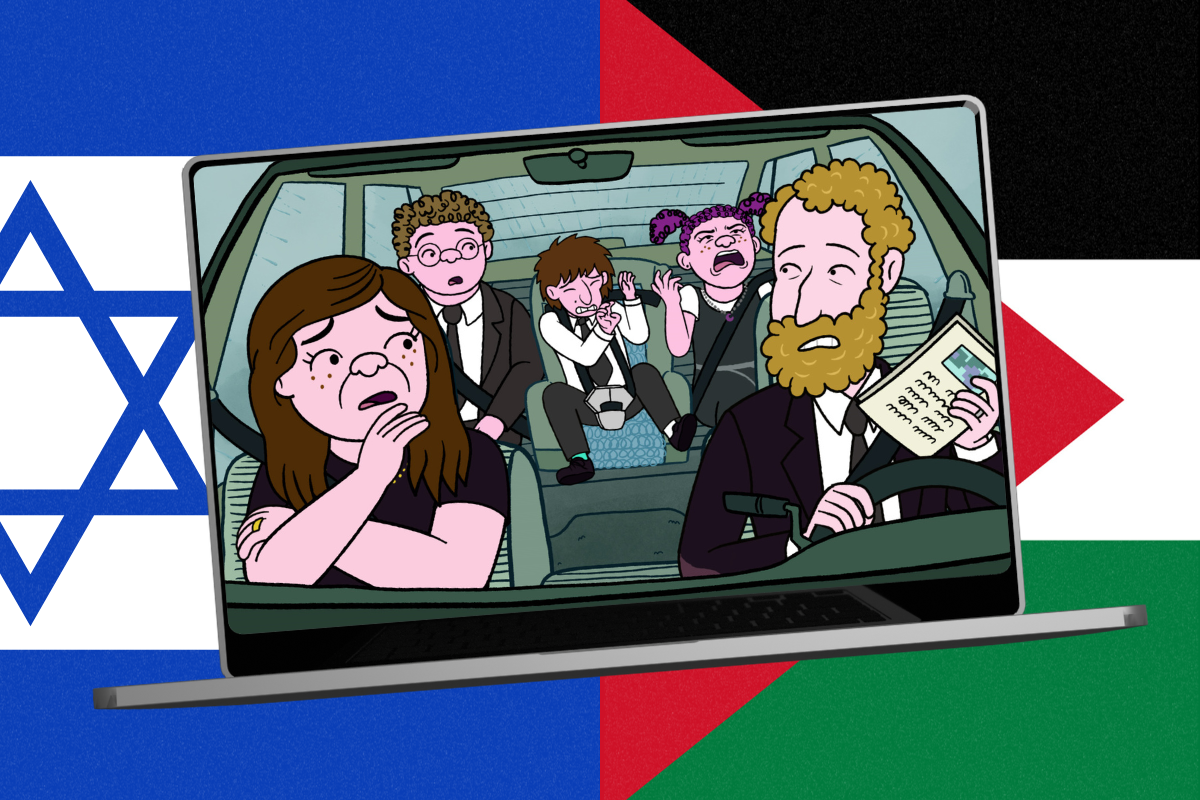
“Long Story Short” follows a Jewish American family, the Schwartz-Coopers (or Schwoopers, as they come to be known), from 1959 to 2022, across different timelines and locations, telling each family member’s story a little bit at a time. In the tradition of “BoJack,” the balance of drama to comedy is exacting and precise, the characters fleshed out and real. Again, not much is taboo. Except, well, one of the most pressing issues of our time, and the cause of a massive fracture in the Jewish community: Israel and Palestine.
This wasn’t a surprise. Prior to the show’s release, Bob-Waksberg, who is Jewish, confirmed narratives around Israel and Palestine would not be part of the first season of “Long Story Short.” In an interview with Vulture, he said, “I don’t want to create any content that is then going to make people want to boycott this show in either direction…We will have to get into that at some point. I want to do it in a way that makes sense for our show, that doesn’t feel didactic, that doesn’t feel like scoring points. I want to do it in a way that is thoughtful, in a context where the show already exists, and people understand these characters.”
It’s understandable Bob-Waksberg would feel this way — particularly when you consider that some may believe any depiction of Zionism to be an endorsement of it or all of Israel’s actions. (To wit: In doing some research for this piece, I saw on Twitter that some believe, due to this scene, that BoJack is Zionist, as if the cartoon horse may any day now turn sentient and guest on Bari Weiss’s podcast.) Plus, the plot points of season one don’t extend past the year 2022, so one could argue that there’s not much to say yet — but that would be pretending that anything worth talking about when it comes to Israel and Palestine began on Oct. 7, 2023, which is simply not true.
“Long Story Short,” a very Jewish show, has a unique opportunity to display the cracks and fissures that Israel and Palestine would most certainly cause the Schwoopers, a very Jewish family. Per that same Vulture article, Bob-Waksberg said, “the Jewish experience is so much more interesting than [Israel and Palestine].” And I don’t disagree with him; I don’t think allowing Israel to gobble up the entire conversation around what it means to be Jewish does a service to anyone, and I don’t think it needs to be the central theme of the show. But ignoring it feels intentional, and it’s distracting. What is not said takes up space, too.
With the trappings of the Schwooper’s Judaism — like references to the Anti-Defamation League and Hadassah — it’s difficult to believe that Israel’s statehood wouldn’t be discussed in their household. When Naomi, the family matriarch, says, yes, there is a “right” way to be Jewish, she describes it as “a progressive egalitarian Conservative Judaism with an emphasis on ritual and community over faith and blind practice — that’s literally the only way it makes sense!” This is a joke and it did make me laugh, partially because despite Naomi’s line here, the show’s actual message is there is no right way to be Jewish, and partially because this is my family’s tradition of Judaism as well, and I imagine it resonates with many of the intended viewers of the show, too.
But it’s difficult to believe that Naomi’s version of the “right” way to practice Judaism wouldn’t also include the “right” way to think about Israel. And from the details we learn about each of the Schwooper children over the course of the first season, I imagine some of the Schwooper clan might have, over time, deviated from their mother’s views on the topic. It seems just as difficult to believe that their life choices, their partnerships and their exposure to life outside the Schwooper bubble wouldn’t have impacted their opinions about Israel, just as much as their mother’s experiences have impacted hers. Watching the show, it almost felt like “Long Story Short” was going far out of its way not to mention Israel, like a curse word the FCC might slap them with a fine for using.
If the show were less afraid of touching the words “Israel” and “Palestine,” we’d be able to see for ourselves how perspectives within the Jewish community have shifted over generations, thanks to its multiple timelines. I would imagine that some characters remain ardent in their support of Israel, other characters taking an apolitical world view, and others still who identify as anti-Zionist, as is the reality in so many Jewish American families today.
I am well-aware that broaching this topic is a minefield, one to be navigated carefully by the “Long Story Short” creative team (which has conflicting beliefs amongst its own cast). I don’t expect the show’s writers to express their own views, stop the violence or offer any answers — but I would expect them to depict multiple perspectives about all aspects of Jewish American life — because they’ve already proven they can do so. If “BoJack” had the capability to change conversations around depression and mental health, maybe “Long Story Short” can open up conversations amongst friends and family members about Israel and Palestine, too.
The reason why “BoJack Horseman” remains one of the best shows of all time was its fearlessness. If it doesn’t hold back, “Long Story Short” has the potential to be the same.