Editorial note: Spoilers ahead for “Marcel on the Train.”
“Etiennette is forgotten.”
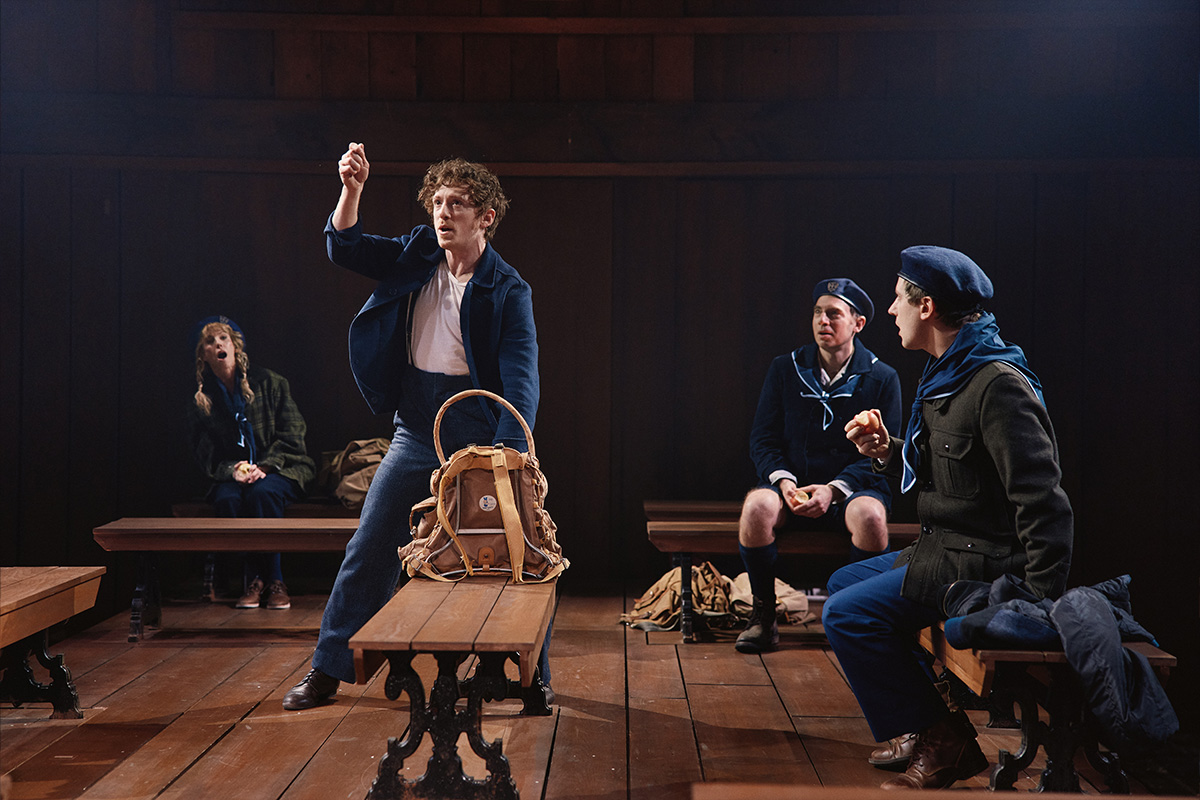
There are almost too many poignant, emotionally-charged moments to count in “Marcel on the Train,” Ethan Slater and Marshall Pailet’s new play about Marcel Marceau‘s work smuggling Jewish orphans out of Nazi-occupied France via train. The show takes place over the course of one such ride, where 20-year-old Marcel (Slater) uses his skills as a natural, playful performer to distract, calm and empower the children as the plan goes awry.
There’s the scene where Marcel’s cousin Georges (Alex Serotsky) fails to rendezvous on the train as planned; when Nazis board the train and subject Marcel and the children Berthe (Tedra Milan), Adolphe (Max Gordon Moore), Henri (Alex Wyse) and Etiennette (Maddie Corman), posing as boy scouts, to a cat-and-mouse-like search; or when Marcel and company must run for their lives through the French Alps towards the Swiss border.
Cozy Season with Hey Alma. As the days get shorter, Hey Alma is where you can curl up with Jewish culture that's funny, honest, and open to everyone.
But none hit me as hard as when those three words unfurl from a sign onstage. We have suddenly flashed forward to Etiennette’s adulthood. I should say here that time is malleable in “Marcel on the Train. The audience is nudged back and forth through the years, the moments that precipitated the train ride and the fates of the children. Adolphe is taken as a prisoner of war in Vietnam. Henri becomes a lauded philosopher. Berthe has an average husband, job and life. Etiennette is forgotten. I think I audibly winced.
In the future, Etiennette, once a painfully shy, traumatized and mute girl, is now an adult. She’s been miming holding a memory at her fingertips, perhaps the memory of the part of the train ride where Marcel helps her smile. He suggests, too, that they make art together when the war is over. “Thank you. We’ve seen enough for today,” a disinterested voice responds to Etiennette. It’s clear now she’s at an audition at L’Ecole Internationale de Mimodrame de Paris Marcel Marceau — and that the school doesn’t want her.
“I KNOW HIM,” she writes on a handheld blackboard, still mute after all these years. Then, with even more urgency she writes, “HE’LL REMEMBER WE WERE SMILING.” Still, she is rejected. Etiennette will never get to tell her story.
Ever since seeing the play a few weeks ago, and, admittedly, taking in more than a few reviews (that run the gamut from laudatory to disinterested, intellectually stimulating to inscrutably cruel), I simply cannot forget Etiennette. For me, she is the show’s poignant raison d’être. This does not discount the play’s steady performances, helmed by Ethan Slater’s virtuosic physical prowess, masterful lighting and scenic design and compelling and largely untold Jewish historical inspiration. Nor does it ameliorate the show’s script, which, though often quick and never overly sentimental, still draws out a few key scenes so long that they wear slightly thin.
But shining a literal spotlight on a forgotten, albeit fictional, child victim of the Holocaust, serves as a reminder of the incalculable forgotten, ignored or totally unknown stories of children who endure violence at the hands of callous governments. It’s an unbelievably worthy endeavor, especially now.
This idea was top of mind for Slater when I had the chance to speak with him at a press event for “Marcel on the Train” in late January. “You know, one of the things I’ve been saying a lot is that this, at it’s heart, is a story of how children have a right to grow up without the fear of being hunted and killed,” he told me. “We started writing the show four years ago. It felt of the moment then, because it always feels a little of the moment. But now we are seeing soldiers, and we are seeing police separating families. Children are in the crosshairs. And it is horrifying. I grew up with the credo ‘Never again’ repeated over and over and over again.”
As he spoke, I couldn’t help but reflect on the names and faces of modern children that, like Anne Frank before them, have become symbols of the violence that affects them but over which they have no control. Liam Ramos in Minneapolis. Ariel and Kfir Bibas in Israel. Hind Rajab in Gaza. How many children in the United States, Israel and Palestine, Iran, Sudan, Ukraine or elsewhere are just like them? How many will die without their stories being told? How many will escape danger, but still be forgotten?
I return to the Jewish wisdom that holds every life as a universe, every life sacred and blooming outward with possibility. This remains true even for those whose names we don’t know, whose voices are dampened or snuffed out because politicians chose not to protect them.
That “Marcel on the Train” evokes our responsibility to these children makes it a midrash for our time. Now how we respond to it, that’s on us.
“Marcel on the Train” runs through March 22, 2026 at the Classic Stage Company in New York City.