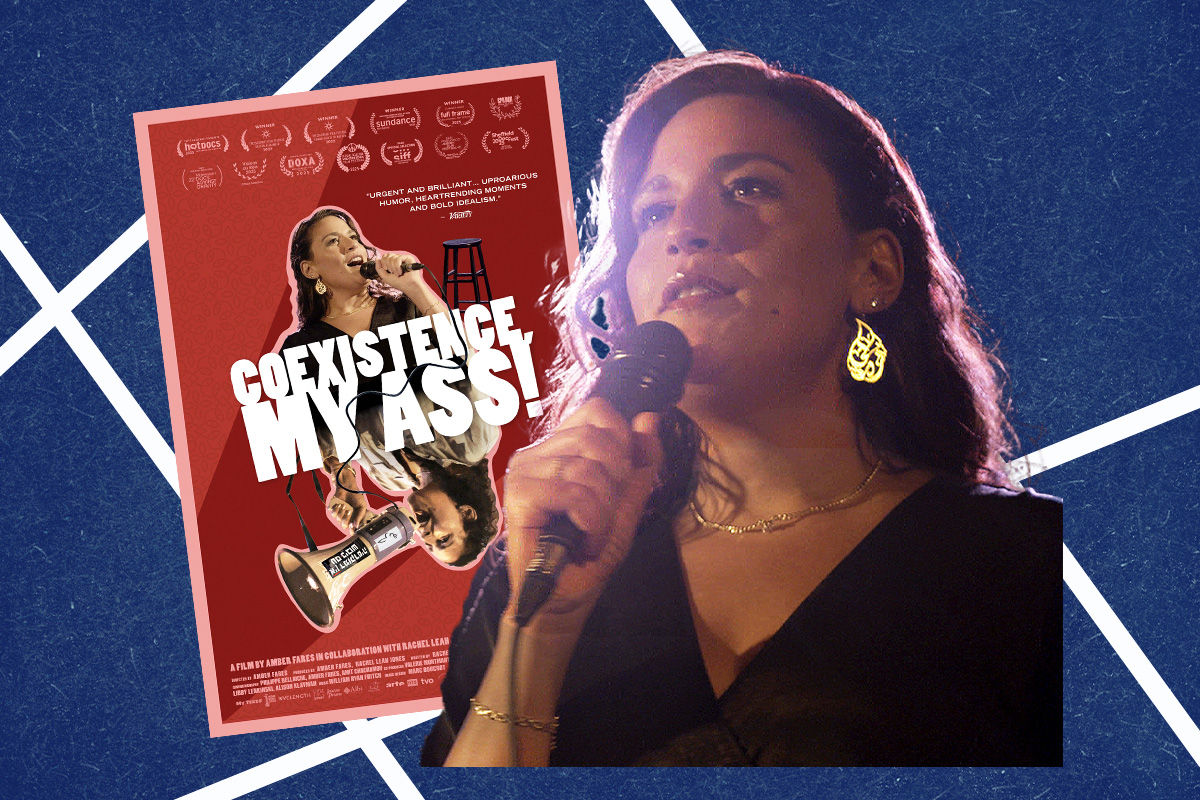
Comedian and activist Noam Shuster-Eliassi grew up in Never Shalom. Or, at least, that’s what her iPhone autocorrects to when she tries to type out “Neve Shalom,” the Hebrew name of the Israeli-Palestinian cooperative village she grew up in. (The village is known in Arabic is Wahat as-Salam. Both Neve Shalom and Wahat as-Salam mean “Oasis of Peace” in English.)
“That’s the name of my next show, ‘Never Shalom,'” she jokes when we met over Zoom earlier this week.
Noam, an Israeli Mizrahi and Asheknazi Jew, grew up living alongside Israelis and Palestinians, a role model of co-existence. In her elementary school, she and her peers learned in Arabic and Hebrew; they received visits from the likes of Hillary Clinton and Jane Fonda. They were primed to be Nobel Peace Prize recipients, she says.
For a while, Noam was on that path. After completing national service in Israel, instead of serving in the army, she studied international relations at Brandeis University. She worked at the United Nations on a program trying to build peace in Israel/Palestine — before, as Noam said in a 2019 interview with Haaretz, “the UN got cold feet and shut down the project.”
A Humble Request: Hey Alma's content is free because we believe everybody deserves to be a part of our radically inclusive Jewish community. Reader donations help us do that. Will you give what you can to keep Hey Alma open to all? (It's a mitzvah, ya know.)
So Noam turned to comedy and activism as a means to achieve peace. “Coexistence, My Ass!” (directed by Amber Fares) follows Noam from 2019 until near present day, and highlights this chapter in her life.
As “Coexistence, My Ass!” is now screening across the United States and the world, Noam chatted with Hey Alma about the film, having tough conversations with family about Israel/Palestine and comedy as resistance.
This conversation has been lightly edited and condensed for clarity and length.
In “Coexistence, My Ass,” you say that you were “the poster child for coexistence.” What would you say you are the poster child for now?
I think there is how people perceive you and there is how you would like to be perceived. So I’m not sure which one to choose to answer your question.
I would be curious to hear both.
I think a lot of people will look at my work and say, this is an example of how coexistence is possible. That is less interesting to me if it doesn’t set a tone for something bigger politically.
I hope I can be the poster child of, look, it’s not that complicated. There is nothing so extraordinary about me. I just happened to get a chance to grow up this way and learn from actual Palestinians. There are some simple truths that we have to practice in order to one day see coexistence, and that includes equality and justice.
What was the first moment that you really realized that the idea of coexistence between Israelis and Palestinians was not enough?
I’m not sure if it’s a moment more than the repetition of patterns that I was seeing around me all the time. And in those patterns, there was always the same asymmetrical situation where Palestinians are fighting for their equal rights, for their basic rights, for their liberation.
Of course, they have Jewish Israeli allies that are showing up and demonstrating and everything. But the framework is: Let’s fight for living together. Let’s stand together with signs, “The Jews and Arabs refuse to be enemies.” I remember thinking, “That’s a given.”
Of course I believe Jews and Arabs are not enemies. Of course I believe that Palestinians and Israelis should have peace. What is the political action for me [to take] as an Israeli Jew that belongs to the powerful side? What is it that I’m doing and taking responsibility for in order to achieve that equality?
I don’t know if you’ve heard of the Israeli Black Panthers…
I have! My colleague Asaf Elia-Shalev wrote a book about them.
I met some of the older Black Panthers, the Mizrahi, Moroccan, Jewish Black Panthers. And I think something about the Mizrahi struggle — my mother was born in Iran — clicked a lot of these issues for me. Those struggles are interconnected.
The film shows the tension between American comedy and Israeli comedy. You talk about how in Israel, at least from what we saw, stand-ups really weren’t talking about politics on-stage. Have things shifted since October 7?
Oh, things have shifted. It’s worse because now people are making fun of starving kids in Gaza and how many Palestinians they killed in the army. They’re making genocide jokes. And it’s not to say that there are no comedians who do anti-government and leftist jokes. But you hardly see comedians who are able to really challenge the system and what is happening here, the brainwashing, the propaganda and the racism. It’s been heartbreaking to see.
I also think it’s part of a pattern. You see in the U.S. there are comedians who specifically contributed to the re-election of Trump. [They] become propaganda machines thinking that they are doing comedy. But the role of comedy and satire is to challenge the status quo, to challenge the power dynamics, to shed light on inequality and injustice.
In the documentary, you say that you’re not trying to unify people with your comedy. You’re voicing resistance. How do you measure the effectiveness of comedy as resistance?
One of the things that gets you stuck in diplomacy and in activism is the thought: “Oh my God, am I moving the needle? How many people am I influencing?”
The relief I felt with comedy is that I have the freedom to influence the hearts and minds of people. I have the freedom to say: This will take time. I’ve realized in these past two years that our work is only beginning. It’s going to take a long time, and I might not see it in my lifetime. But I’m leaving something that is more truthful than what I was doing before.
There are really poignant moments in the documentary of you having hard conversations with your friends and loved ones. I’m thinking particularly of the conversation with your aunt after Oct. 7 when she says she doesn’t want peace or anything to do with Palestinian people anymore. Do you have any advice for young people about having hard conversations with family about Israel/Palestine?
I wish there would be more patience and listening, and also knowing that people can move. My aunt doesn’t speak now like she was speaking when you saw her furious in the film. She’s shifted. She’s seen that I didn’t give up on talking to her.
I mean, I’m very shocked in that scene that my aunt is speaking to me in that way. But I knew that I wasn’t going to let go of my aunt. We don’t choose our family, and some people will say, “I don’t choose my family, so I don’t need to endure this.” But our families are important, and it’s important to have these tough conversations. It’s our responsibility.
Can you expand on what you mean by “it’s our responsibility?”
A lot of what we’re saying in [our] film, Palestinians have been saying already. In every Q&A, I talk about [that] with the audience. If you find it easier hearing it because an Israeli Jewish [person] is telling you this, then you need to treat it as a warning sign and wake-up call to center Palestinians.
Believe Palestinians. Follow Palestinian voices. I do believe that people have their own journey and process and timing in the way that they shift and listen. But if you find it easier hearing [the message in the film] from an Israeli Jew, then go and do your homework to find out why.
The film offers the perspective of an Israeli Jew in Israel advocating for Palestinians. In your view, what is the role or responsibility of Jews in the diaspora at this moment?
I went to Brandeis for undergrad. I was on a very Israeli-centered campus, and there were so many Jewish American students who were so obsessed with Israel and careful to not criticize it. I was like, why are you so protective? Like America, just leave Israel alone.
That has really, really shifted [for me]. Because we are connected. You’re American taxpayers. As Americans, your involvement with Israel is in terms of arms deals. Young people have the right to know what their country is supporting and what they are being made complicit in. The pressure that [Americans] are putting on your elected officials, and the way you are protesting, the way you are speaking up in public — it is shaping the discussion around Israel/Palestine.
I think having nuanced and brave conversations is very, very urgent. Especially because the lines between legitimate criticism towards Israel and antisemitism are blurred right now. If I’m speaking about the crimes that are happening in Gaza, and people are calling me antisemitic, then we have a problem. And when you have MAGA, right-wing people who believe replacement theory and purely antisemitic stuff, and then they go and defend Israel, we have to question: What does it mean to support Israel? What does it mean to criticize Israel? We need clear conversations.