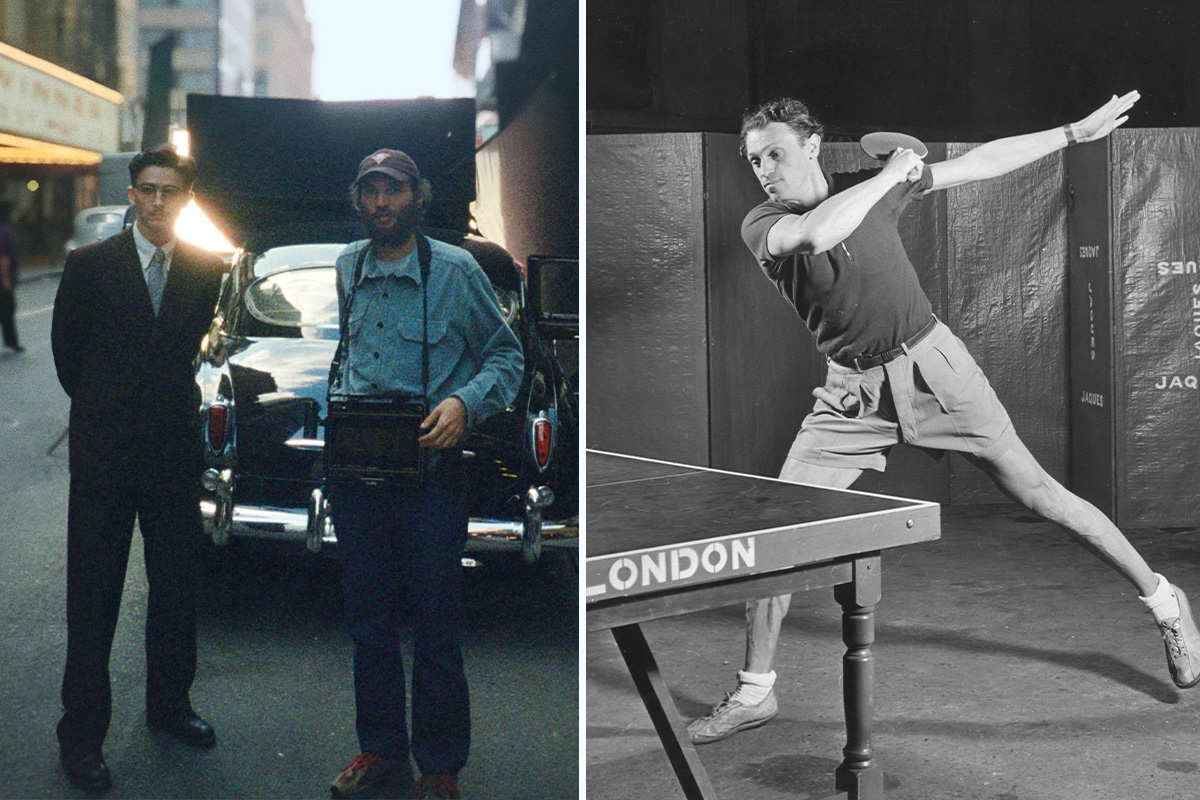
Editorial note: Spoilers ahead for “Marty Supreme.”
Ever since “Marty Supreme” came out last week, one of the most discussed elements of the Josh Safdie film has been, as X user @TheAlexSylvian posed, “you guys all see that holocaust honey thing in marty supreme? what the fuck was that.”
You know, the flashback where we see Marty’s competitor Béla Kletzy as an Auschwitz prisoner? Given the opportunity to leave the camp on bomb disposal missions, Béla returns from one with honey from a beehive smeared all over his body. He then allows his fellow prisoners to lick the honey off his body for sustenance. Yeah, that honey scene.
Plenty of people online have been weighing in with their interpretations of the moment. This includes New Yorker film critic Richard Brody, who calls the moment “Marty’s ‘this is who we are’ story.” For Hey Alma, Reuben Baron wrote, “On one level, Béla’s story can be viewed as the movie in a microcosm, because taking absurd risks for the sake of small victories is what the rest of ‘Marty Supreme’ is about.”
There's always a seat for you here. Hey Alma is here to make sure no one has to be Jewish alone. Your Passover gift keeps our community vibrant, our stories honest, and our space free for everyone.
But in order to understand this segment, audiences have to realize something that I think most do not: the honey scene is based on a true story.
In Marty Reisman‘s autobiography (ICYMI, Marty Reisman is the inspiration for Timothée Chalamet’s Marty Mauser), he writes about his competitor, Polish Jewish table tennis champion Alojzy “Alex” Ehrlich. According to Marty, Alex was arrested and sent to Auschwitz for operating a radio transmitter. He would spend four years there, and was later sent to Dachau. During his time in the camps, Alex received some measure of special treatment from the Nazis because they recognized him as a table tennis champion. (“Some” being a relative term here.) This included a Nazi saving him from the gas chambers and being given the special task of diffusing bombs outside of Auschwitz.
“Alex Ehrlich was a brave man,” Marty wrote. “Once Ehrlich was defusing a bomb when he found a honeycomb nearby. He smeared the honey all over his body and when he got back to camp, inmates licked the honey off his body for nourishment.”
He added, “Ehrlich was tortured by the Nazis, but never let his scars show.”
Josh Safdie was inspired to make “Marty Supreme” after reading Marty Reisman’s autobiography, so it’s not necessarily a surprise he would include this remarkable real-life anecdote from Alex Ehrlich’s life. (It’s doubly less surprising given that Safdie has said the scene in which Marty brings back a piece of the pyramids of Giza for his mother was based upon him and his brother stealing barbed wire from Dachau.) “I learned more about the Holocaust in that little story than from some movies that are only about the Holocaust,” he told The Guardian on Monday.
Alex began playing table tennis at Hasmonea Lwow, the local Jewish sports club in the then-Polish city of Lwow. In 1933, when Alex was 19 years-old, he and Hasmonea Lwow were crowned the team table tennis champions of Poland. From there, Alex’s career blossomed. In 1934, he was named Poland’s 8th most popular athlete. He then became a three-time silver medalist (1936 singles, 1937 singles and 1939 singles) and a three-time bronze medalist (1935 team, 1935 singles and 1936 team) at the Table Tennis World Championships. By 1938, he was ranked world no. 6.
Alex was also known as the “King of Chiselers.” Per The Guardian, “In ping-pong parlance, a chiseler is a monomaniacal defensive player who will never, never attack, and keeps pushing the ball until he can no longer stand on his feet.” In one record-breaking moment at the 1936 World Championships, Alex and his opponent, Romanian Jewish player Paneth Farkas, played the first point of a match for two hours and 12 minutes. According to reports, it was a physical feat that wore on both players and even referee Gabor Diner, who strained his neck. However, Alex eventually won the point. When the next point went to 20 minutes, Paneth “sent the ball and bat together sailing wildly over [Ehrlich’s] head [and]…ran screaming from the court.”
The International Table Tennis Federation later amended the rules so that a point could only be played for 20 minutes. After that, the point would be awarded to the player already in the lead.
Alex continued to play table tennis in the years following the war, though he no longer represented Poland. Instead, he represented France, ranking world no. 9 in 1950. He won a handful of open titles in Ireland, Switzerland, England, Germany and The Netherlands in the ’50s, as well as three bronze medals at the 1961 and 1964 French national championships. Alex eventually retired from the sport and became a coach. He passed away in 1992 in France at the age of 78.
May Alex Ehrlich’s memory be an enduring and oh-so-sweet blessing.