When Sage Cassell-Rosenberg read through the findings of a survey of Jews of Color, one number stood out to them: 88%. As a program manager at queer Jewish advocacy organization Keshet, Sage had devised the groundbreaking survey (“Threads of Identity: LGBTQ+ Jews of Color in the Fabric of Jewish Life”) to document the experiences of LGBTQ+ Jews of Color. It found that a staggering 88% of respondents reported a lack of representation and understanding in the Jewish community.
That revealed “a glaring gap and blind spot in how the true and robust diversity of Jewish life often goes unnoticed, even within our own community,” Sage tells Hey Alma. “It made clear that this absence was not abstract. It was something deeply felt and lived. Seeing that gap, I felt a responsibility to help shift it.”
One way they set out to do that is “Flowers For Our People,” a photo exhibition created in collaboration with fellow Black, queer and Jewish artist Luis Winter.
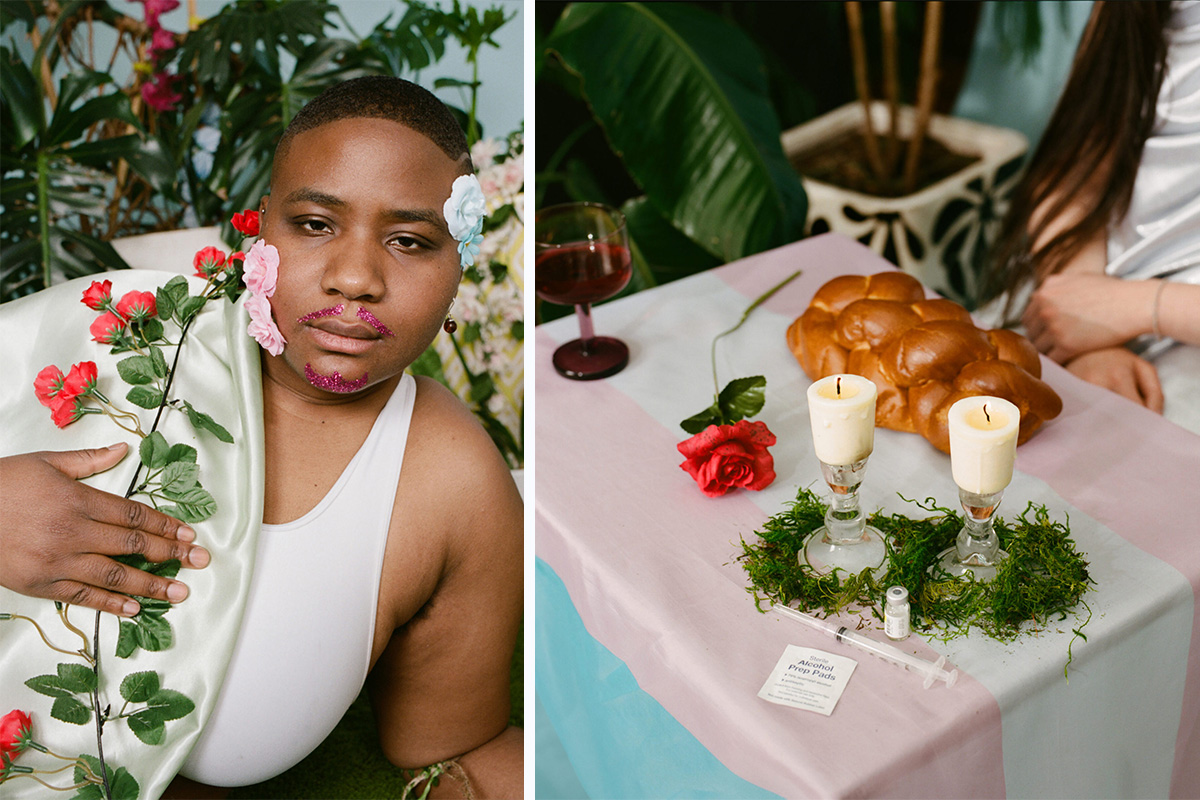
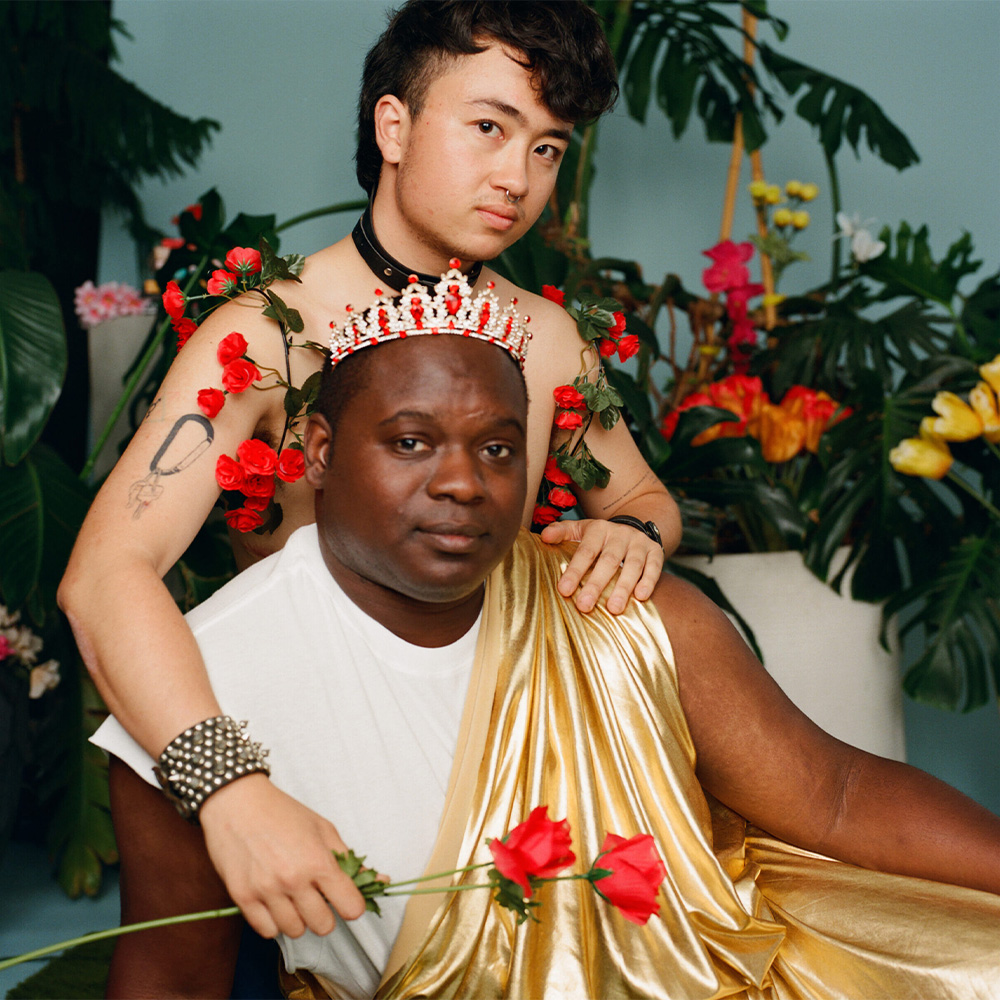
The joyous collection uses real people to depict figures from the Tanakh, the Hebrew bible, whose stories are bursting with queer interpretation. Referencing the rabbinic teaching that the first man was initially created as both man and woman, Adam stares down the camera donning a creamy satin robe, pink and blue flowers and a glittery magenta beard. Naomi and Ruth cover themselves in a sheer pink veil, like brides. King David and Jonathan, adorned in a leather collar and bracelet, embrace. Queen Esther obscures her full identity behind a bouquet of pink and yellow tulips, bringing to mind someone forced into the closet. Joseph, who is said to have been turned from female to male in the womb, sits at a Shabbat table decorated with a trans flag, challah, candles, flowers and a syringe for gender-affirming HRT.
Powerfully, all of the models are queer Jews of Color (QJOCs) in Keshet’s community who cast themselves for each photo.
In honor of Black History Month, Hey Alma spoke to Sage and Luis over email recently to discuss “Flowers For Our People,” what it means to center QJOCs and specifically Black queer Jews in Jewish media and what’s next.
This interview has been lightly edited and condensed for clarity.
The “Flowers For Our People” exhibition opening, which took place a few months ago, looked packed! What was that experience like?
LW: The opening was very fun! This was the closest I have gotten to a solo show. It was very profound to see my work printed so large and displayed in such a beautiful way. I also loved Sage’s choice to use nature to decorate the space, bringing in grass and flowers to frame the images. It made the whole room feel like a little garden, which was really special.
SCR: I think, as a creative, you can be so in love with your concept, but there is always that doubt of whether other people care. And, truthfully, it does not really matter whether other people care, but it feels incredibly meaningful when you create something you care about and then witness how deeply it resonates with others. That night, looking out and seeing this full room of folks who were so excited to celebrate Jewish life and all of its diversity, was incredibly moving.
What’s your personal favorite photo?
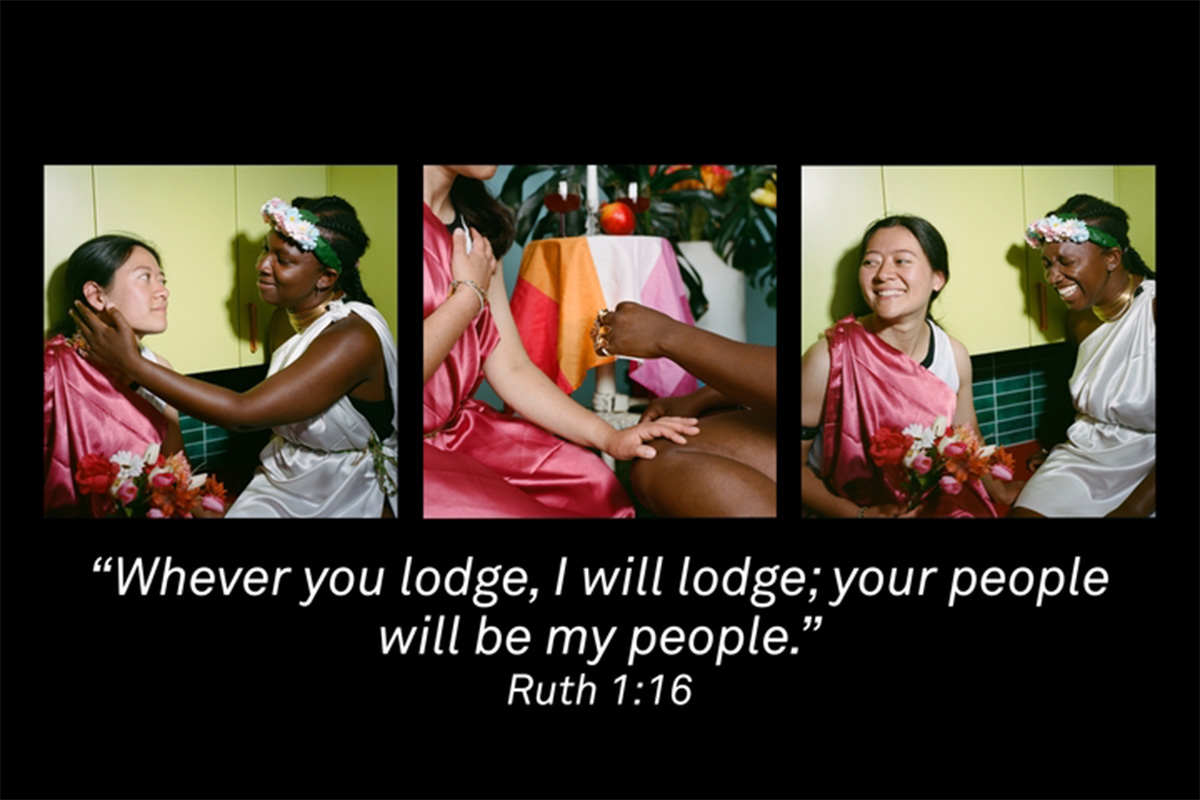
LW: I would say the series that I found most exciting was Naomi and Ruth. And to me, that is one of the most fascinating stories. It feels like an example of sneaking something past a patriarchal censor or redactor. It reads very much like, “here is the patriarchy, I am a woman, and I cannot do anything without a man,” but the subtext, to me, is so brilliant because it is essentially Naomi saying, “We live in a patriarchal world. I want to be with you, and here is how we can do that.”
In particular, I loved this idea of using the patriarchy against itself. Naomi and Ruth could be together in the kitchen because men were not going to come in there, and so it became this safe space for them to express their love. The use of the kitchen is subverting this patriarchal idea that women “belong in the kitchen.” So to take the kitchen and make it a safe space for women, one in which they can be intimate and express their love without fear, to me, that was really beautiful.
Have you heard from QJOCs about what this exhibition means to them?
SCR: I’ve loved watching other QJOCs kvelling over the fact that photos like this exist, images that reflect and celebrate their identities as people of color who are also queer and Jewish. I have had people share that they never imagined something like this could exist. But now that they see it, their response is, “Of course this should exist.” That, to me, is one of the most beautiful parts of this project.
There truly are no words for seeing yourself reflected in media. Oftentimes, as folks who hold historically marginalized identities that are rarely talked about or portrayed, we are raised with this feeling of, “Am I the only one?” So, having this opportunity to create photo work that allows current and future generations to say, “No, I am not alone, and in fact, my presence within the Jewish community is not even a new one; it is a historic one,” continues to be unbelievably beautiful and deeply healing.
What did working on this project mean to you as queer Black Jewish artists? What does it mean to you to center the work of queer Jews of color in Jewish media?
LW: This project was a reclamation for me. In particular, around Jonathan and David, men love to claim that there could not have been a romantic relationship. Yet the text is profoundly intimate. There is a long history of religious artwork. So for me, this project meant I was able to say: I am allowed to play with these stories and to create these images, just as people have done before me.
Centering the work of Black Jews, Jews of Color and queer Jews in Jewish media is important because we live in a racist society. It attempts to erase our voice and history while centering whiteness. I have found that Ashkenazi Judaism is centered in a way that it makes it seem as if there are no other Jews. That’s frustrating to me. I have African and Spanish ancestry, and we are also here. We have been here for thousands of years. Our stories deserve to be uplifted in the same way, especially because they are so often disregarded or censored.
SCR: For me, centering the work of QJOCs in Jewish media is about affirming that we have always been part of Jewish life. It is about creating space for our stories to exist fully and truthfully, not as exceptions, but as an essential part of our collective history and present. Even when others struggle to understand how one person can hold all of these identities, their confusion is not our responsibility. Our responsibility is to live fully, to create and to reflect the truth of who we are.
This work could only have been created by folks like us, in all our Blackness, in all our queerness and in all our Jewishness. For so many of us, we were conditioned to feel shame for parts of who we are, but this project reminds me that our identities are not contradictions. They are our greatest strength.
What’s next for “Flowers For Our People”?
SCR: Well… Taking over the world!
What’s next is really about getting this work into as many Jewish communities and spaces as possible. Organizations from across the country have already started reaching out, asking, “Can we display these photos in our local JCC? Can we host an event that centers this work?” My hope is to see “Flowers For Our People” everywhere: in museums, in Jewish media, in art spaces and in classrooms. I hope it is used as a resource, as inspiration and as a reminder of who we are.
Ultimately, my goal is that this work takes on a life of its own. That it continues to travel, to reach people I may never meet, and to exist in places I may never see.
LW: Amen!