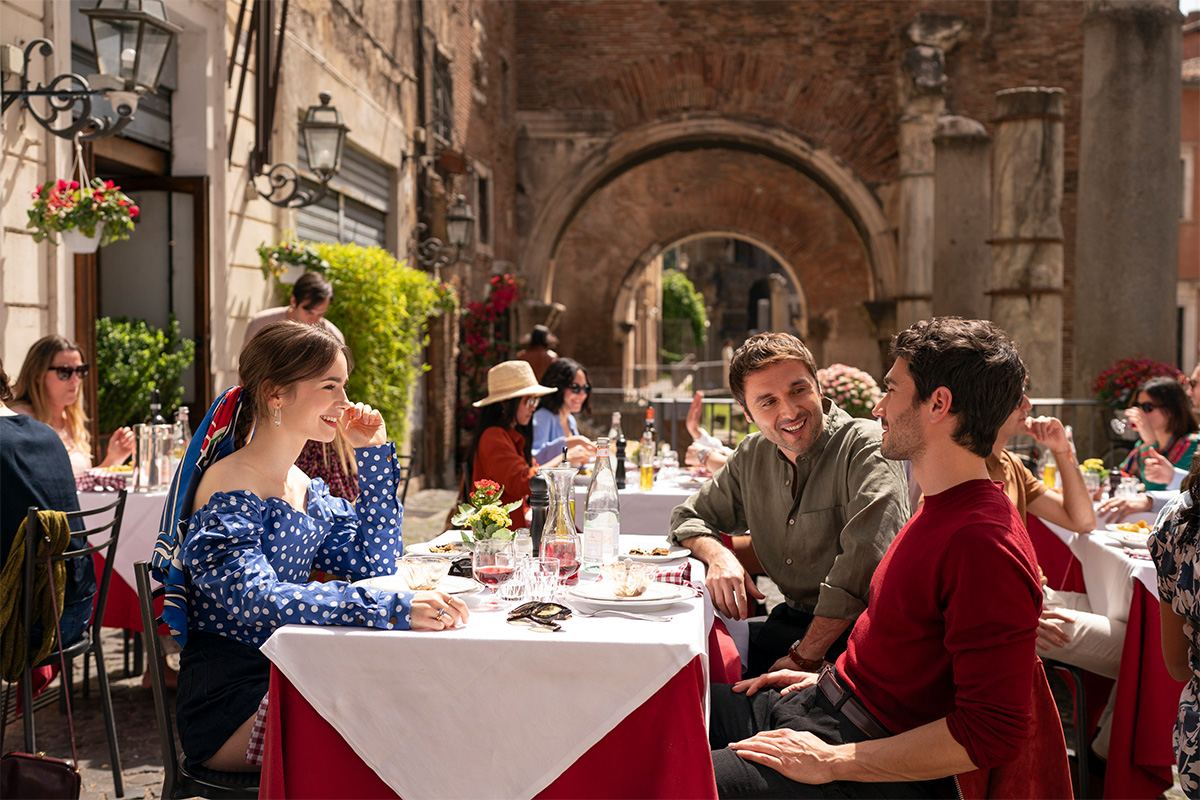
In the most recent seasons of “Emily in Paris,” the titular character left her titular city and spent time in Rome. The fashionista and social media star saw all the classic destinations: the Trevi Fountain, the Spanish Steps, the Colosseum. But there was one location I did not expect to see — on two separate occasions, Emily visited the historic Jewish Ghetto.
In season four, episode nine, she has her first lunch in Rome at Giggetto al Portico D’Ottavia, a Jewish-Roman restaurant located on the main street of the historic neighborhood. In the next episode, Emily strolls down a side street of the Ghetto with her best friend Mindy. They happen upon the Fontana delle Tartarughe, a fountain at the periphery of the neighborhood. Mindy sits at a conveniently located piano and performs her song “Beautiful Ruins” as a crowd forms around her.
It’s no wonder that the producers of “Emily in Paris” thought the Ghetto’s cobblestone streets and vine-covered walls would make the perfect setting for the show. Following its abolishment in 1870, the Ghetto was almost entirely torn down and rebuilt. The narrow streets were widened and in 1904 the small old synagogue was demolished and replaced by an impressive square-domed one. Today, the former Jewish Ghetto is one of the most expensive and trendy neighborhoods in the city. Corners that still exhibit the original cramped conditions are now aesthetic photo ops for tourists, glimpses of a vintage Rome that has been lost to the ages.
Most viewers would not even know that Emily was in the historic Jewish Ghetto, as it was never mentioned and she leaves Rome in season five. But I had spent hours observing the area last summer, and I was shocked to see it featured on TV. Unlike Emily, I was in the Jewish Ghetto because of this history. I was working as an intern for the HUC Jewish Language Project to research Judeo-Romanesco, a dialect of Italian historically spoken by the Jewish community of Rome.
The history of the Ghetto and the language are closely intertwined. Confined to the cramped Ghetto for its 300-year history, Jewish Romans were largely isolated from the rest of the city. As a result, their language developed separately from the rest of Rome, leading to a unique dialect. Like many other Jewish languages, it is syncretic, with a largely Italian base and some Hebrew vocabulary. After the deconstruction of the Ghetto walls in 1888, the gradual integration of the Jewish community with the rest of Rome led to a decline in usage of Judeo-Romanesco. My research goal was to discover the modern domains of the language — when and how does the community speak the dialect today?
I received a hot tip: to find Judeo-Romanesco speakers, spend time in the Ghetto. While many Jewish Romans had been priced out of the area, some elderly community members remained, gathering in the streets each day to chat over espresso. For my research, I would approach them, hoping to hear them converse in dialect. I was disappointed with their responses to my inquiries. Although they were familiar with the language, none of them spoke it. Instead, they cited popular examples of the language, such as a book of Judeo-Romanesco sonnets written by poet Crescenzo del Monte in the early twentieth century. When I met with Judeo-Romance linguist Laura Minervini, she told me that she considers these poems to be inauthentic, not accurately reflecting Judeo-Romanesco’s historical usage.
I was frustrated. All I could find were modern reconstructions of the dialect obscuring the genuine past, just like in the Ghetto itself. I brought these concerns to my supervisor, Dr. Sarah Bunin Benor, director of the Jewish Language Project. She gave me advice that shifted my perspective: lack of data is also data in itself. Reframing my research, I decided to explore how the community engaged with Judeo-Romanesco today, regardless of alleged “authenticity.”
One of the remnants several community members mentioned was the word “davare,” from Hebrew דבר, meaning “speech.” It is a code word used between members of the Jewish community to secretly shush each other when an unwelcome person approaches. This exemplifies how the language changed along with the community; as Jewish Romans began to interact with other Romans unfamiliar with their dialect, what had once been the normal means of communication became a way to encode messages to each other without others understanding.
Another contemporary engagement with Judeo-Romanesco is a theater group that meets to recite scenes in the dialect. In our meeting, Minervini had also cited this as an inauthentic production of the language. But when I observed their performances, I saw elderly audience members inspired to shout out words and phrases that they remembered from their youth, joyfully reminiscing about the past. I met a young actress in the theater group whose parents spoke Judeo-Romanesco as she was growing up. Although she will not pass the dialect on to her children, she enjoyed having the theater group as a space to hear and speak the language.
The gaps I had noticed in dialect usage were not truly empty spaces. While the manifestations of language I had found might not be viewed as authentic from a linguistic perspective, they produced authenticity themselves, giving people spaces and opportunities to engage with their heritage.
The same could be said about the Ghetto itself. Tourists fill the widened streets, trendy restaurants have taken over the old businesses and viewers of “Emily in Paris” simply see an aesthetic neighborhood rather than a historic community. And maybe that’s just fine.
“Emily in Paris” does not set out to educate the masses about Jewish Roman history. Rather, the show is a way for viewers to engage in escapism, to imagine themselves adventuring abroad just like the protagonist. But if you know where to look in the Ghetto, you can still see the historical traces. The elderly community members gossip at the cafe, their grandkids attend the local Jewish school and they attend services together at the new synagogue. Not what it used to be, but authentic just the same.