If you have a therapist like mine, they have probably suggested reading Yiddish sayings to help soothe your anxiety. Maybe print them out and hang them on the wall, or scream them loudly to strangers on the subway. Here are a few calming Yiddish sayings and how they can be practically applied to help the anxious mind.
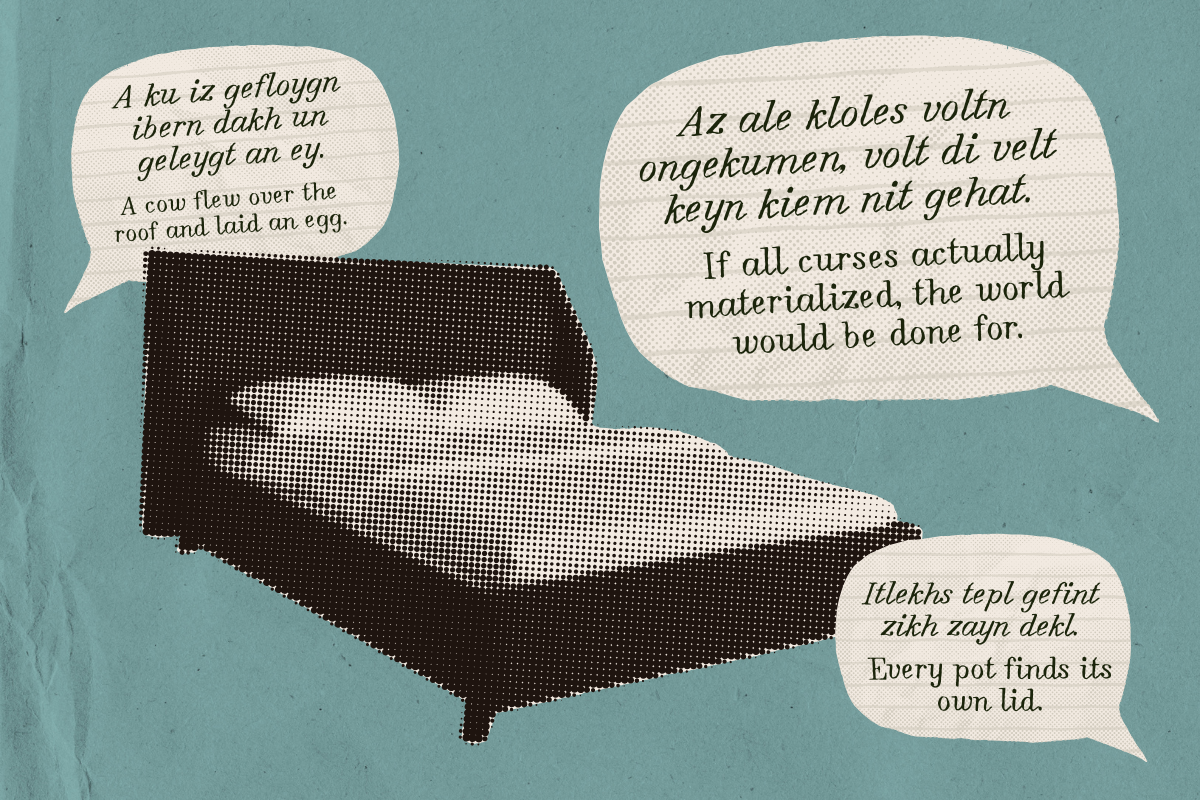
1. A ku iz gefloygn ibern dakh un geleygt an ey.
Translation: A cow flew over the roof and laid an egg.
Conventionally, this was used to communicate that a story being told was outlandish and far-fetched. Kind of like how you’ve convinced yourself that if you don’t flip the pillow over six times before falling asleep, bubbe is going to drop a pot of chicken soup on her big toe. You have OCD and bubbe passed away a decade ago. Go to bed.
2. Deriber geyen di gendz borves un di katshkes in royte shikhelekh.
Translation: Therefore the geese go barefoot and the ducks wear little red shoes.
A Humble Request for the New Year: You can help keep Hey Alma's radically inclusive Jewish community free and open to all. Your gift means someone, somewhere, feels a little less alone this holiday season.
Some use this as a non-sequitur to highlight the absurdity of explaining something that doesn’t need explaining. For example, asking the barista if he was mad at you because you’d convinced yourself that you spent too long hogging the sugar and straw station the previous morning. It’s just that lately unsweetened cold brew has been making you nauseous, and you aren’t sure why, but putting a lot of sugar seems to help, but not too much sugar because that will also make you nauseous. He didn’t need to hear all that. The ducks wear little red shoes. Or were they blue? Either way, the geese were definitely barefoot. Or were they wearing socks? They better have, or they’re going to come down with a cold.
3. Di pave zol nit hobn di sheyne federn, volt zikh keyner af ir nit umgekukt.
Translation: If the peacock didn’t have beautiful feathers, no one would pay any attention to it.
The meaning is pretty obvious here, but it’s a nice reminder that people are not looking at you. In fact, they don’t even think about you. They’re paying attention to the peacock with beautiful feathers. You don’t have beautiful feathers. You have eczema. No, I wasn’t calling you ugly. You’re overthinking this. Has anyone told you that you might have anxiety?
4. Az ale kloles voltn ongekumen, volt di velt keyn kiem nit gehat.
Translation: If all curses actually materialized, the world would be done for.
Rachel isn’t going to die because you called her a bitch over text three years ago.
5. Nit mit sheltn un nit mit lakhn ken men di velt ibermakhn.
Translation: Neither cursing nor laughing can change the world.
So maybe don’t spend all your time scrolling on social media getting outraged by every single thing you read? Or do. The universe doesn’t care either way. We’re all alone on this giant blob hurtling through space or wherever it’s going. Isn’t that comforting? I’m terrible at astronomy. Haha. Or fuck it.
6. Itlekhs tepl gefint zikh zayn dekl.
Translation: Every pot finds its own lid.
Try not to worry so much that you won’t find your bashert. You’ll find someone crazy enough to put up with you. Or someone crazier than you. That’s also an option. Whatever the case, make sure you have a good therapist. If your therapist doesn’t have digestive problems, they’re not a good therapist. Or get a dog to calm you down. Just be prepared for the possibility of your dog ending up on a higher dose of Prozac than you.
7. Ven ale mentshn zoln tsien af eyn zayt, volt zikh di velt ibergekert.
Translation: If everyone pulled in one direction, the world would tip over.
There has to be balance in the world in order for the world to exist. Few things are just black and white. Opposing forces keep us steady, like how after you take your Zoloft with cold brew on an empty stomach, you have to eat an entire loaf of challah, frantically ripping chunks out of it like a wild animal until the whole thing is gone. L’chaim!