Ever since “Maybe Happy Ending” opened on Broadway, Asian fans have lauded the show for its AAPI representation — something they say is severely lacking in the theater industry. Well, that is, fans lauded “Maybe Happy Ending” for its representation until last week.
The musical is set in Seoul, South Korea; it originally opened there. It is co-written by Korean lyricist Hue Park and almost the entire original Broadway company is composed of performers of Asian descent. Notably, Darren Criss, who has Filipino heritage, became the first Asian man to win the Tony Award for Best Lead Actor in a musical for portraying Oliver in the show.
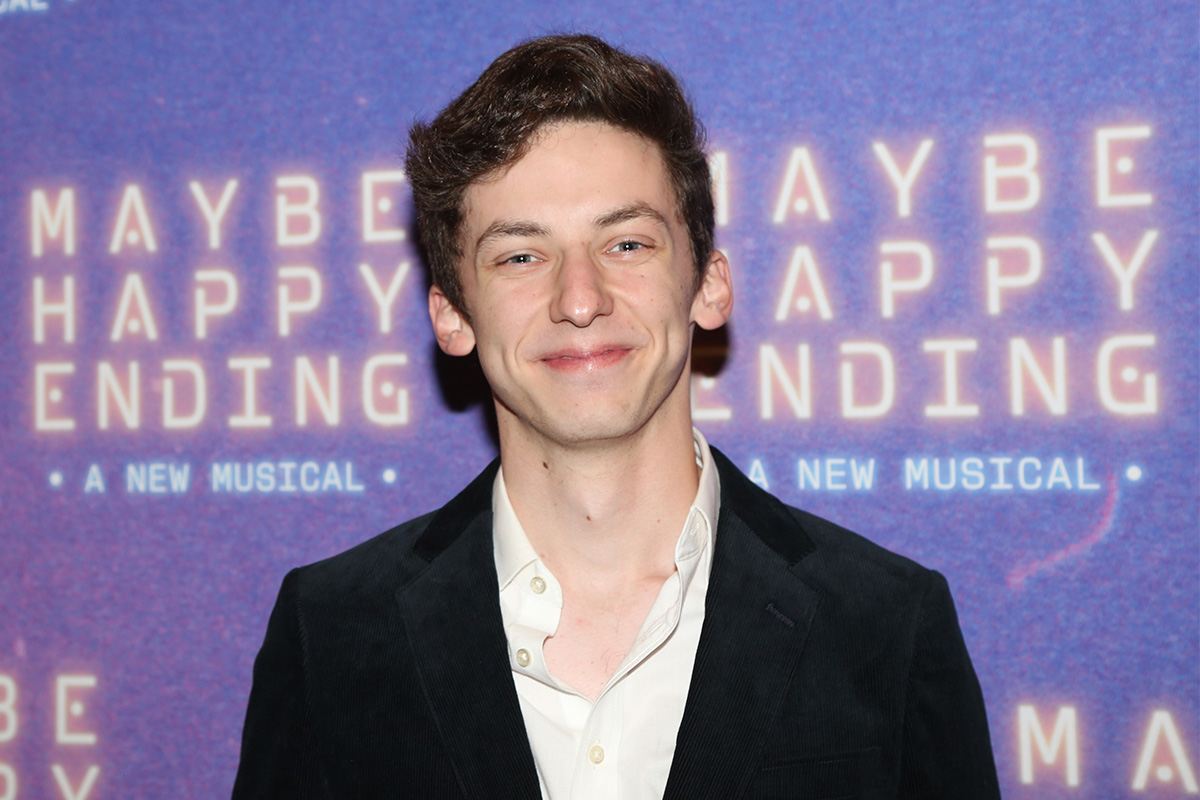
On July 24, the production announced that 23-year-old actor Andrew Barth Feldman would take over the role of Oliver starting in early September. Show co-creators Will Aronson and Hue Park and director Michael Arden told Deadline they first took notice of Feldman for the role of Oliver when he appeared in lead actress Helen J. Shen’s initial audition tape.
Notably, Feldman and Shen are dating.
A Humble Request: Hey Alma's content is free because we believe everybody deserves to be a part of our radically inclusive Jewish community. Reader donations help us do that. Will you give what you can to keep Hey Alma open to all? (It's a mitzvah, ya know.)
Also notably, Feldman is not Asian.
He has predominantly Ashkenazi Jewish ancestry. (Asian and Jewish identity are not mutually exclusive, of course. But the fact remains that Feldman is not Asian.) Thus began a week-long and ongoing public discussion about whether or not Feldman can play a character that is technically not Asian (Oliver is a robot), but is so deeply steeped in Asian culture; whether the “Maybe Happy Ending” creative team was being disingenuous for grounding their Tonys campaign in championing Asian voices; and what the responsibility is of a show to its audience.
@paperpuso it’s not about ABF- it’s a systemic issue that starts from the top. the bottom line: this production could have been key to introducing the industry to MORE asian voices. #maybehappyending #andrewbarthfeldman #darrencriss #musicaltheatre #broadway
Notable critics of the casting decision are the Asian American Performers Action Coalition, “Oh, Mary!” star Conrad Ricamora and Broadway, film and TV star BD Wong, all of whom were featured in a New York Times article about the controversy.
“A different precedent has been set; one that de-emphasizes cultural specificity and the opportunities for a far too often excluded population of actors,” the Asian American Performers Coalition said in a statement. “If the intent has been to show the story’s ‘universality,’ we are reminded that though we have long been expected to view white stories populated by only white actors as ‘universal,’ stories about people who look like us that are populated by people who look like us are rarely considered universal enough.”
So what has Andrew Barth Feldman said of the situation? As of time of publication, nothing. However, when his casting was announced, his statement read, in part: “I am so in love with this show and with Helen J. Shen.”
He went on: “I’ve been a plus-one on this Broadway journey from the beginning, and this brilliant team and beautiful company have already become such a big part of my life. That they trust me with this role, and are giving me the ridiculous gift of sharing it with Helen, is an honor beyond words.”
For their part, Will Aronson and Hue Park responded to the outcry yesterday in a statement on Instagram. “Our dream at the outset was that our allegorical robot show could one day miraculously become part of the American musical theater canon — a modern ‘Fantasticks,’ able to be comfortably performed by anyone, anywhere — yet distinctly set in Korea,” they said in part. “We’re extremely saddened that the show, a decade-long labor of love for us, could ever become a source of confusion, anger or pain.”
Helen J. Shen also commented on the situation yesterday. “I have and continue to be extremely proud to look the way I do and to co-lead this Broadway show. I know the hurt that people feel because growing up, I would have found a beacon of hope in seeing our show on TV on the Tony Awards. A part of me is mourning that along with the community,” she wrote on Instagram. “This has been an immensely challenging moment within my home with Andrew, and in this building filled with A/PI folks to say the least. I don’t know what’s forward, but to have this opportunity to play opposite my favorite actor in the world for 9 weeks, who happens to be PERFECT for the role is a huge moment of joy for me.”
She added: “Every perspective on this situation contains truth. I am excited to champion more A/PI works, the way the community has championed ‘Maybe Happy Ending.'”
The last time a Broadway casting change caused this much controversy, particularly around identity, was when Lea Michele replaced Beanie Feldstein in the “Funny Girl” revival in 2022. (Michele, while having Sephardic heritage, has never publicly claimed a Jewish identity. Meanwhile, Feldstein is a very publicly Jewish actress.) In that case, despite pushback from the Jewish community, the show went on and tickets sold well. And an extremely silver living presented itself in the opportunity for Jewish actress Julie Benko to shine as a replacement Fanny Brice in the interim between Lea Michele taking over the role and Beanie Feldstein leaving the production. Afterwards, Benko became Lea Michele’s replacement and regularly performed in the role.
Will something similar happen for “Maybe Happy Ending”? At this point it’s anyone’s guess.