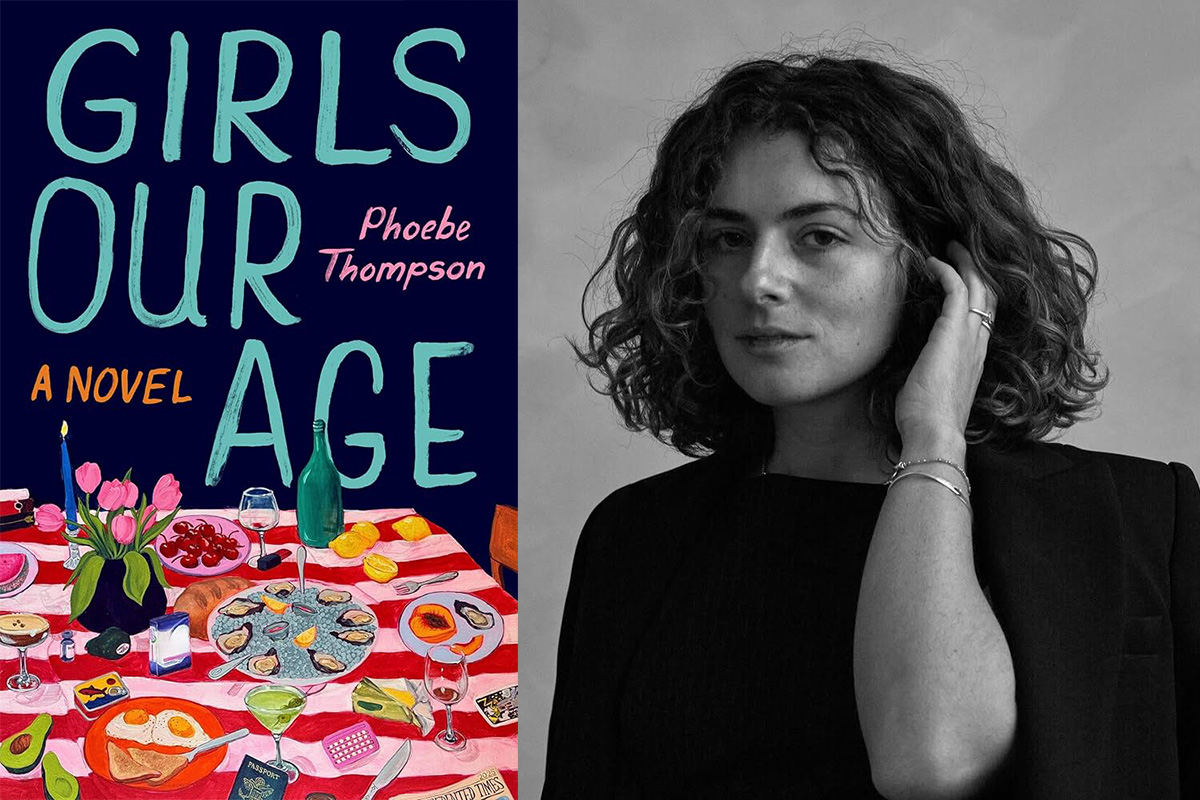
“Husband, Baby, Shell,” the winning short story of Hey Alma’s first-ever short fiction contest in 2023, begins with “a hum somewhere in my lower abdomen,” as writer Phoebe Thompson has her protagonist describe. The hum in question embodies this Jewish woman’s deep-seated and deluded need to find her idealized mate.
A bodily hum is also an apt way to describe what I feel when I encounter good writing. It’s a visceral experience: a sense of euphoria that someone has put words to the truths of the human experience.
I felt that way when I read “Husband, Baby, Shell.” And I felt it again as I read “Girls Our Age,” Thompson’s debut novel.
“Girls Our Age,” out now, follows three college friends figuring out who they are, to themselves and to each other. Lily is getting married to Jack, but gave up her job to follow him to grad school, and her childhood eating disorder has returned. Margot is on track to get a promotion at her powerful marketing agency job, but still hasn’t figured out her sexuality. And Ana has a career she cares about and a boyfriend who’s on the verge of proposing, but she’s starting to feel out of place at her job and in her relationship.
A Humble Request: Hey Alma's content is free because we believe everybody deserves to be a part of our radically inclusive Jewish community. Reader donations help us do that. Will you give what you can to keep Hey Alma open to all? (It's a mitzvah, ya know.)
As these college friends reunite for Lily’s chaotic bachelorette weekend and Jewish wedding, their problems collide, altering their friendship forever.
I chatted with Phoebe about “Girls Our Age,” what advice she has for creating Jewish characters and the special emotional intimacy of female friendships.
This conversation has been lightly edited and condensed for clarity.
What draws you to writing about female friendships?
For “Girls Our Age,” I was observing my life around me. All my friends were starting to get married and as we were going to bachelorette parties, I was obsessed with this tension: Our friendship has been so centered around the femaleness of [it], and suddenly we’re all seeing each other at these events that circulate around men in a strange way.
Generally, I think there’s such a special emotional intimacy to female friendships. There’s a depth of knowing each other and growing up together, and very specifically, friendships with people you become close with when you’re getting to know who you are. For me, that period of time was really 18 to 22. There’s just something about the people who watched you flounder as you transition from child to adult which is really special. That feels like a very grounding life force that keeps me on track with who I am and what I care about.
Among Lily, Ana and Margot, which one do you resonate with most right now?
Lily is who I would have become if I didn’t get a lot of therapy — I used to be a super perfectionist. I used to have an eating disorder when I was much younger than Lily is when she has one. And in a lot of ways, I spent my 20s becoming the opposite of that, learning to be an anti-perfectionist, learning to be really sloppy.
I also wanted to talk about Lily in terms of her Jewishness. It came up very casually through the book, but felt necessary. Why was it important for you to make her Jewish?
I think it’s a cultural touchstone. As a New Yorker, I wanted her to be a New York Jew. There’s such a specific sort of anxiety and striving that exists in New York Judaism that felt important to convey in her character.
To have this character who was so focused on success and achievement and struggling so deeply with anxiety, and yet is so connected with her family, and the way that Judaism brings her family together and exists as a pillar in her family, felt really important to me.
And having the details around her Judaism, like the planning of her future child’s bar mitzvah coming up in a therapy appointment, even though she’s not even married or pregnant, just felt very true to how I think and how I spiral. It felt like an important way to convey the exact brand of anxiety that I personally know deeply.
I really loved Lily’s relationship with Gina, her mom. It speaks to all mother-daughter relationships, but knowing that they’re Jewish, I was thinking about the trope of overbearing Jewish mothers. How did you conceive of that relationship?
I mean, you’re totally right that I was pulling on sort of the trope of the overbearing Jewish mother. In society, sometimes that role can be almost comical. But I really do see that role as being one of deep love and knowing. And it was important to me to convey that as much as Gina can be annoying sometimes, she was actually deeply concerned with the intricacies of Lily’s life and knowing her, and wanting the best for her and how much that overbearingness is just the language of their love.
You said you spent a lot of your 20s learning to be sloppy, to be less of a perfectionist. How has that affected your writing process?
My writing process is so sloppy. The one thing I’m really consistent about is I write 750 words a day. But I don’t reread anything I’ve written. I write very quickly. I write full of typos. For my first book, I didn’t outline it at all. My second book, which I’m working on now, I did actually outline and it’s been helpful. In the day-to-day, I’ll consult the outline and say, “OK, this is the part of the book I’m writing today.” But then I just write it, and I don’t go back and read what I’ve written until I’m at 80,000 words.
To me, writing quickly without thinking about it, really accesses — it sounds very woo woo — a heart space of writing instead of a headspace of writing. That’s the only thing that works for me. If I start thinking too much about what I’m writing, I fall into self doubt, pits and spirals. The only way that I can access the words that I don’t necessarily know are going to come out of me is if I just shut my brain off completely. Sometimes I close my eyes if it feels too hard to look at what I’m writing.
What advice do you have for people who want to write their own Jewish characters?
I think the more that you can pull on the exactness of your own experiences, the better. We all have our individual relationships with Judaism and our own individual traditions. I think sometimes writers get caught up on trying to make sure that what they write is legible to their readers. They might wonder if their very specific tradition of like, instead of hiding the afikoman, maybe they hide a set of car keys and whoever finds it gets a prize that’s a pickle, which is like an old family joke. I totally made that up. That might seem so random, but the more you can lean into the exact specificity of your own family traditions and culture, the more people are willing to go into your world with you. I would say rather than trying to write a Jewish character just write about the Judaism that you know and it will translate.
Besides “Girls Our Age” what have you been up to since winning the first Hey Alma my fiction contest?
Hey Alma published my first story that I was proud of. So this feels really, really full circle for me.
But I run a marketing agency in Brooklyn, so I also work full time. Which I highly recommend [to writers]. It means that I don’t have a lot of time to fret over my writing. I just have to sit down and do it. Which might sound stressful, but honestly, it’s not.
And then also, in the past two years, my husband and I got married and I’m pregnant. We’re expecting in about five weeks. And then we also moved to New York since I graduated from my MFA in Madison, Wisconsin. Those have been the big changes.
You mentioned a second book. Can you tell me what that one is about?
“Dead One Day” is about two best friends in their early thirties; one is going through her last round of IVF before she can no longer afford to keep trying, and the other gets pregnant on a one-night stand — drama ensues. It’ll be out in 2027.