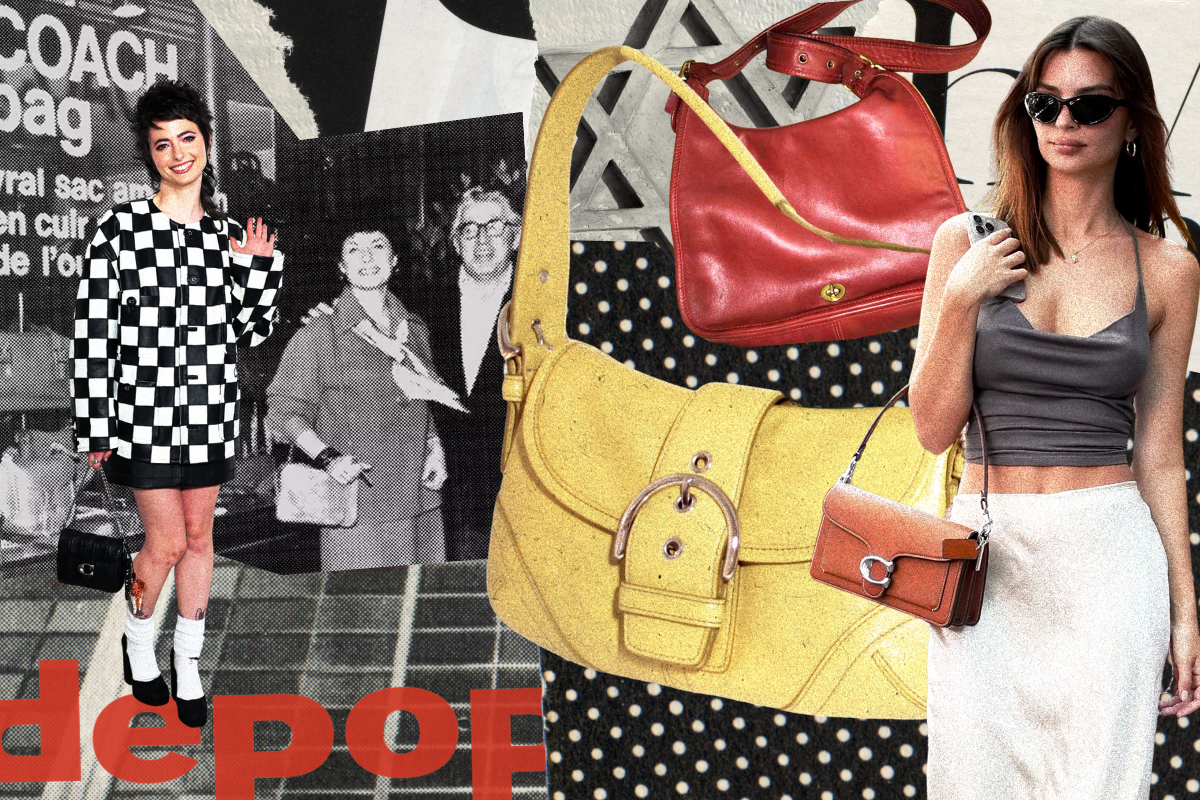
In a world that appears to be gradually imploding, I’ve found myself searching for literal pockets of joy; that is, thrifting vintage Coach handbags. I don’t often purchase them (though a good deal is a good deal). I do it largely for the thrill of the hunt. It’s nostalgic, sustainable, and — as I’ve recently discovered — kind of Jewish.
As children, my sisters and I played a version of dress up with my mother’s discarded pocketbooks, stuffing them with plastic bangles, stickers from the dentist’s office and the occasional rogue graham cracker. I eventually graduated to a floral Limited Too shoulder bag, then a brown Coach wristlet covered in classic monogram Cs, gifted to me by a family friend.
I carried the wristlet to and from bat mitzvah parties, exclusively. Its conspicuous branding felt a little gauche even then, and it was too small to fit much more than a Covergirl lipgloss. While not inexpensive, Coach never qualified as a true luxury brand, and by high school, it had lost whatever cool factor it once had. The wristlet was tossed into a drawer or handed down to a cousin, never to be seen on the floor of my synagogue’s coat closet during a simcha again. Or anywhere, for that matter.
Then, a little over a decade later: The Coach renaissance.
A Humble Request for the New Year: You can help keep Hey Alma's radically inclusive Jewish community free and open to all. Your gift means someone, somewhere, feels a little less alone this holiday season.
In 2019, Coach unveiled the Tabby, a bag inspired by the brand’s archival 1970s silhouette. It was a hit among Gen Z shoppers, and four years later, the brand launched an upcycled line, Coachtopia, aimed at the same audience. Then came the major resurgence of Y2K fashion, and by 2024, British Vogue had declared vintage Coach bags “Gen-Z’s must-have accessory.”
A-listers like Emrata, Charlie XCX and Olivia Rodrigo were photographed clutching an array of vintage models. And just last year, Anne Hathaway was spotted with a vintage Coach briefcase in hand while filming “The Devil Wears Prada 2.”
One day in 2023, I paused my standard doomscroll to watch a TikTokker gush over her latest thrift haul. I’ve been thrifting most of my clothes since my junior year of college, inspired by my smart, gorgeous, vegan best friend and her simultaneous commitment to sustainability and style. The app’s algorithm had clearly caught on, and I watched as the TikTokker held a cherry red leather bag with brass hardware up to the camera like a very chic newborn baby, cooing over its durability and functionality and timelessness. Even without the fashion influencer’s effusive commentary, this bag spoke to my neshama.
Later that same day, I typed, “90s vintage coach legacy crescent red leather saddle bag 9718” into the Depop search bar. A week later, it arrived at my doorstep — a little faded and with a few jagged blue pen stains scattered across the inside flap, but mine nonetheless.
This bag has since braved erratic New York rainstorms and oat milk latte spills, collected compliments in various Trader Joe’s check-out lines. It continues to provide a home for what can only be described as a miniature CVS: Epipens, Albuterol, Advil, bandaids, a sketchbook, two bottles of Purell and at least three different containers of Aquaphor. I even found my bag a sister, just days before my 28th birthday: a small, very reasonably priced baby blue shoulder bag at 2nd Street Dumbo. Up until that point, I had never felt even remotely psychic, but I swear that bag called out to me like a siren from its hiding place amongst piles of fraying scarves and profoundly questionable hats.
You can imagine my delight, then, when I stumbled across a tweet highlighting Coach’s Jewish origins – and why I immediately found myself plummeting down an internet rabbit hole. I learned that Coach was founded in 1941 Manhattan by Miles and Lillian Cahn (née Lenovitz), the children of Russian Jewish and Hungarian Jewish parents, respectively. Lillian had emigrated to the United States during the Great Depression and met her husband while studying acting in the city. In the early 1960s, she convinced him to expand their brand’s offerings (men’s wallets and billfolds) to include women’s handbags, crafted from the thick, flexible cowhide used to make baseball gloves.
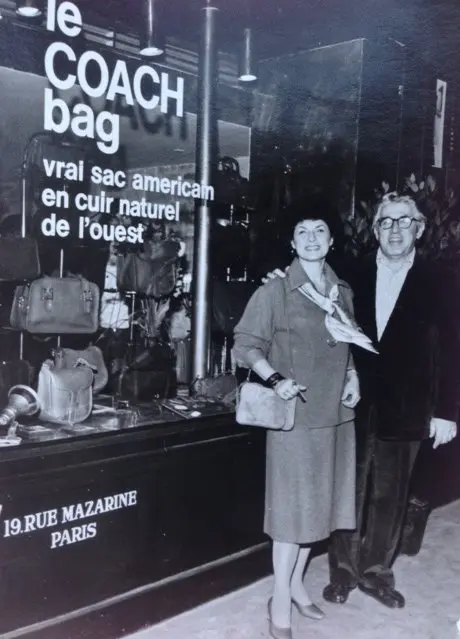
In an interview, Miles shared that he had initially dismissed Lillian’s suggestion. “In New York, there were a lot of handbag companies, and at that time stores were all buying knockoffs of bags made in Europe. But my wife prevailed.” Lillian was the brains behind the bag’s aesthetic, modeling the first successful Coach bag after a type of paper shopping bag she had once used to deliver homemade noodles to customers of her family’s business. She also became the brand’s showroom manager and media agent, marketing these accessories as affordable, functional forms of “everyday luxury.”
By the early 1980s, Coach was selling approximately $20 million in handbags each year, solidifying its place amongst “quintessentially American Jewish brands” like Ralph Lauren and Calvin Klein. Lillian used Coach’s success to launch philanthropic projects benefitting organizations like the Food Bank for New York City and the New York Public Library. And the brand appears to keep Lillian’s legacy of tikkun olam alive; according to their website, since introducing the Coach Foundation in 2008, they have donated more than $82 million to non-profits globally.
My hunt for vintage Coach bags will continue, but they’ll carry (no pun intended) a bit more weight than they did prior to my deep dive. These iconic, famously resilient accessories represent a Jewish woman’s vision and her commitment to said vision. They also provide yet another reminder that immigrants are, unequivocally, the lifeblood of American culture. I’m proud to bring small emblems of Jewish immigrant pride along with me on a daily basis, especially as the granddaughter of a Jewish Iranian immigrant.
And if anyone spots a 1998 Coach Ergo bag in lime green for sale, please contact me immediately.