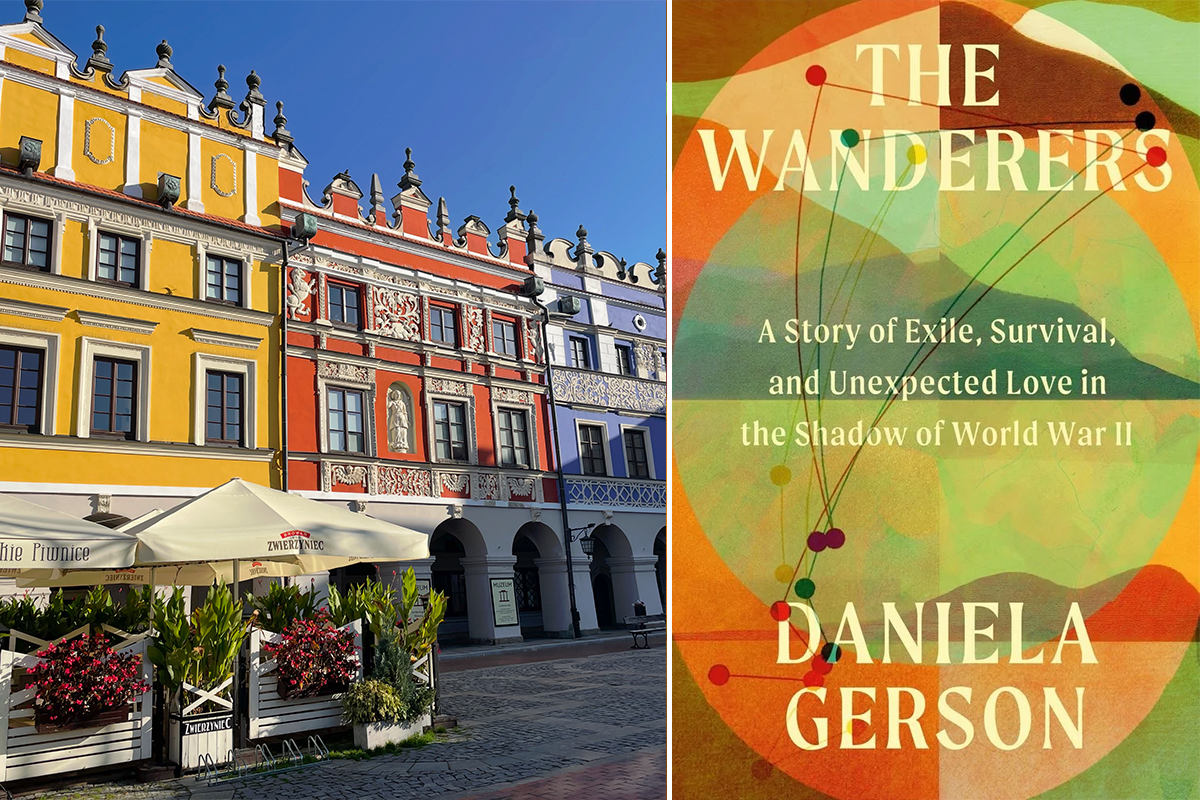
Our kids’ favorite place in Zamość, Poland was what they called the “rainbow square” for its pink town hall and the adjoining row of boldly colorful houses, among them the cornflower blue one where their great-grandmother grew up. The twins, nearly five, had long understood that having two moms was special and readily explained to any kid who voiced confusion that we were a “rainbow family.” I sometimes worried they might feel lacking without a father. But, so far, two moms marked a positive distinction in their eyes.
Now this colorful square, where our grandparents once lived, also seemed part of their unique rainbow heritage. They saw only the bright colors and missed the shadows that took our breath away.
We had come to Poland on a six-week sabbatical to research how my wife, Talia, and I had come together in this world. Our late fathers were both born refugees to parents who had fled Zamość. We wanted to probe our connections to this place, and to trace how our grandparents had survived more than a decade on the run, first from the Nazis and then in Stalin’s treacherous Soviet Union, so we could meet in a park in Los Angeles.
Before we relocated to Warsaw and enrolled our kids in a local preschool, we’d been warned we could face homophobia we’d been shielded from in Los Angeles. Poland was consistently ranked at or near the bottom of European countries for gay rights and Zamość, a town a few hours to its southeast near the Ukrainian border, was in one of the most conservative regions.
A Humble Request: Hey Alma's content is free because we believe everybody deserves to be a part of our radically inclusive Jewish community. Reader donations help us do that. Will you give what you can to keep Hey Alma open to all? (It's a mitzvah, ya know.)
Knowing this, I’d been surprised to discover the Zamość synagogue had recently hosted an LGBTQ movie night. With no Jews left to pray, the building now had a broader community mandate. The former sanctuary was a memorial center and events space, and a group of high school students had asked if they could host the event. Unlike the town’s government-affiliated cultural spaces, the synagogue was independent and free to welcome LGBTQ youth, so it did.
I had asked Daniel Sabacinski, who directed the synagogue for a foundation that maintains sacred spaces in Polish towns lacking Jewish communities, to arrange a meeting with the group. He had guided us in Zamość, and on our final afternoon, he ushered us into the magnificent Renaissance synagogue where for more than three hundred years Zamość Jews had worshipped. With its majestically crafted stucco finishes and gleaming marble floors, I could see why my grandfather always longed for this congregation, packed on High Holidays with worshippers swaying with an unmatched fervor. Now the sanctuary is a sparse memorial space.
Daniel led us into the old women’s section, where my grandmother and Talia’s grandfather’s first wife, the one he never spoke of after the war, likely once prayed. Perhaps they even whispered with each other while their husbands worshipped with the Torah in the adjoining sanctuary.
Almost a century later, five young people all dressed in black shirts awaited us. Some had extensive tattoos and piercings. Others were clean-cut and unadorned. They refused to be photographed or recorded, for fear of repercussions, but did not hold back in telling us what it was like for them to live in Zamość.
“This is the worst place in a terrible country to be LGBTQ,” one said.
“There is no Pride here,” another chimed in.
Talia introduced us as a married couple, and something unfamiliar, but not unwelcome, stirred inside me. The first time I had heard a woman refer to her “wife” was fifteen years earlier when I was living in Germany. With gay marriage not legal in almost all of the United States, I was still becoming accustomed to the idea that two people of the same sex could wed. I never imagined it was a description I would come to use daily for my own relationship.
It took me a long time to even admit that I could be attracted to a woman, to Talia. Initially, when I met her at a picnic, my first thought was that she could be a source, since I was an immigration journalist, and she worked as an attorney representing detainees. Then we discovered our grandparents both had fled Zamość ahead of the Germans in 1939. For months, Talia and I were little more than fast friends, connecting over our shared passions and histories. Our feelings became undeniable and now, seven years married, Talia was unequivocally my wife.
But in the days since we’d touched down in Poland, I’d found myself selectively circumspect, guarded about our relationship. Not here, though. I relished Talia stating in this synagogue that we were married, connecting our story to this group of queer Zamość youth.
“To us, Zamość stopped existing,” Talia said while sharing how marvelous and bizarre it was for us to be in their Polish town.
“Why?!” a shocked chorus greeted her statement.
All younger than twenty-five, their Zamość reality had not begun to exist until the twenty-first century. We tried to explain that in our minds, this place effectively went dark in 1942, when the ghetto was liquidated.
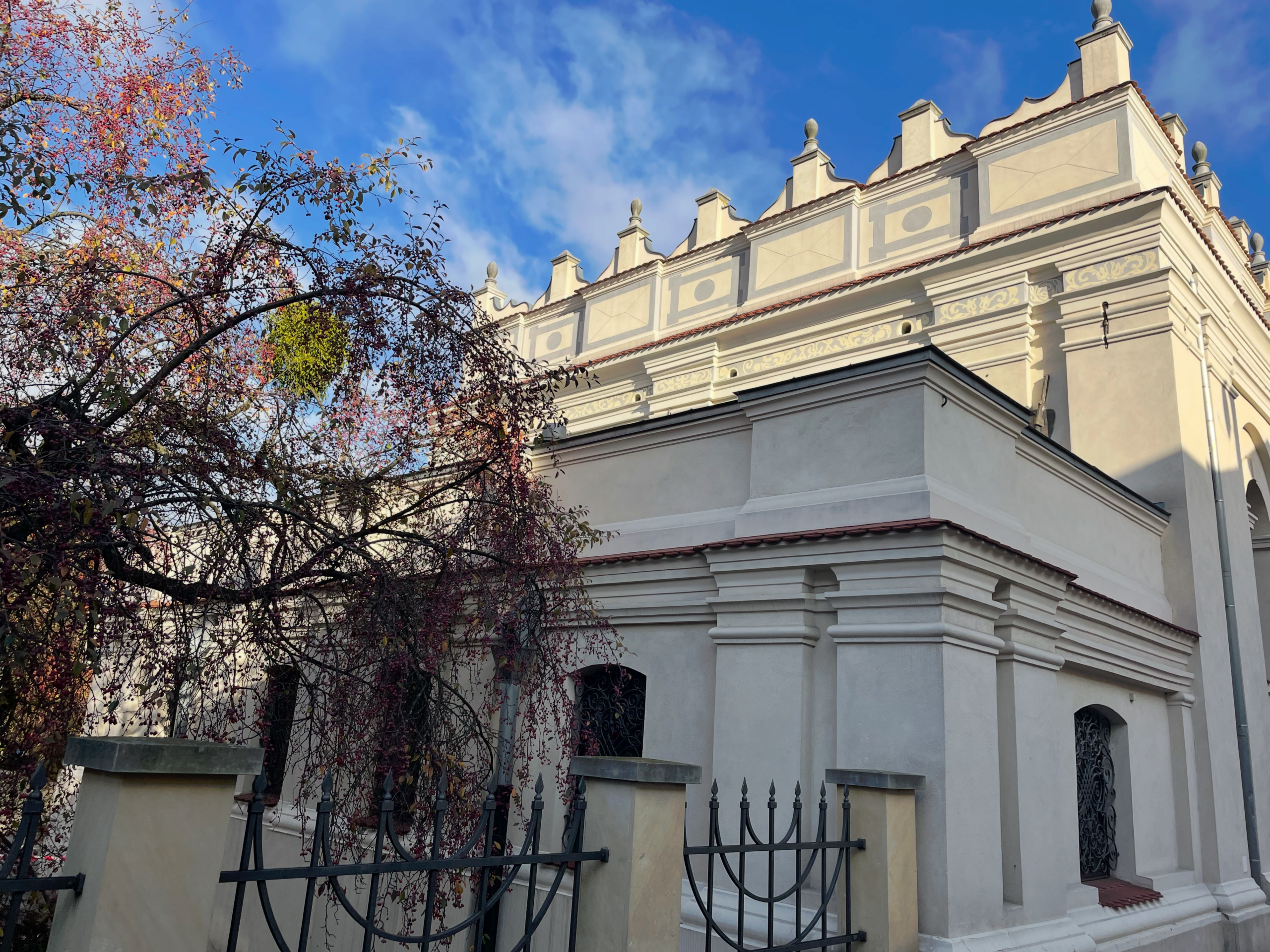
While we were talking, a tourist strolled into the sanctuary, taking in the exhibit of the traditions of the extinguished Jews. In the corner, our kids scribbled furiously on black scratch paper to reveal the rainbow design beneath. I glanced out the synagogue window at the precious café across the plaza. On its patio, facing us, patrons ate tiny pastries, sampled homemade halvah, and sipped macchiatos.
In the crumbling women’s section of the synagogue, Talia transformed into her tenacious attorney self, probing the threats faced by these young adults, who revealed to us they were all trans, and what legal protections they could access in Poland.
Later, Aleksy, the informal leader of the group, told me how the synagogue had played a role in them uniting. He had just begun exploring his trans identity and was eager to meet other queer youth in a safe space when he was invited to the movie night.
He knew the synagogue from the outside but had never entered. He was confused. Why would this house of worship, even if there was no Jewish community in town, open its doors to them?
That night, around thirty people showed up and claimed a space at the synagogue, chatting in groups and then taking chairs into the sanctuary and pulling down a screen next to where the Torah was once read. I had a hard time imagining our grandparents accepting LGBTQ Polish youth adopting their sacred house of worship, but I felt proud that the synagogue had made this space for them. This was not what I expected to discover in Zamość: a place that bridged our families’ intersecting pasts with an unexpected present.
Excerpted from The Wanderers by Daniela Gerson, copyright ©2026 by Daniela Gerson. Used with permission of Grand Central Publishing, a division of Hachette Book Group, Inc.