The fifth time Iris calls, the shower is starting to run cold anyway, so I slither out, wrap myself in his tattered brown robe and clamp the phone against my damp ear.
“Oh, so now you’re answering,” she says.
Already one vodka down, I stand in front of his mirror, waggle my tongue, then reel it back in.
“Look, Ana, I’m sorry to call again, but let me see the eulogy. Please. I can help if—”
“I understand why you’d want that, Iris,” I say, imitating the voice of a normal 42-year-old woman, appropriately sombre. “But what I do is no longer your business. You were his agent, not mine. I’m sorry.”
For a moment, I think maybe it would be a good idea to write something down, work out what I plan to say, but then I end the call (ha!), drop the towel and begin walking naked around his apartment, feeling its textures with my feet — carpet, then wood, then tile. My hands skim surfaces, palms flat. I rub my breasts against a kitchen cupboard to feel its glossy surface, thinking probably no one has ever done that before, then laughing and doing it again.
I understand, now, why people feel love for objects. Objects are reliable. They do not die without warning. They do not fuck you over.
“He’s not in here!” I say as I poke my head into each room, touching everything I can like it’s Hide and Seek. “Nor here either!” I call into the dark broom cupboard.
Maybe now I can truly allow myself to go mad, and no one will judge? It’s interesting, on a thought-experiment level, to consider what a person might be able to get away with in the name of grief. I see that now.
My father had only lived here for a year, but has seeped into every corner. Copies of his most recent book pile up on his desk, and I topple them. “Whoops,” I say as they fall, scattering papers with them everywhere. For good measure, I squat down and rip some in two. I’m tempted to keep going, maybe even do something worse, but then out of the corner of my eye I spy the portrait of my unsmiling Bubbe Sonya, which always moved with him from place to place. I remember how she once made me stand facing the wall when I wouldn’t finish my semolina pudding.
“Hello,” I say to her, “Still miserable? Of course you are, you old cow!” I stab her with some scissors from the pot on his desk. Right in the eye.
There’s his navy coat on the stand, entwined with his red scarf. I throw them on the floor, then trample on their bodies.
There’s a framed photo of Alexei and me at the Kotel. I turn it to the wall. He doesn’t need to see me like this.
There are packets of tea, jars of dried fruits and spiced nuts (leave them, in case I need them later). Dying plants (water them). Pastel-coloured Turkish Delight (throw the disgusting things in the bin!). A dripping tap. Food-splattered Ottolenghi cookbooks. Unopened mail. A half-smoked cigar in an ugly ashtray my mother made in her ceramics phase (smoke the cigar later, keep the ashtray). Finger imprints in orange-blossom soap. His smell.
It’s all too much.
For a moment, I think about getting back into his bed and not going to the levoyah. Just getting in and never getting out. Growing my hair long, long, long (on my chin and underarms, too), surviving on what’s left in here (even Turkish Delight) for as long as I can until they find my body by its putrid, rotting smell. You know the sort of thing.
Daughter of famous writer driven mad by grief!
But then, of course, Iris would speak at the funeral instead. It would be disgusting. “Although he had his detractors,” she’d say, smiling into the friendly crowd of pearl-wearers and fellow luminaries, “that was but a blip when compared to his achievements and the way he spoke for and to Jews everywhere.”
Oh God, no.
Rifling through my suitcase, I pull out my green dress. No underwear, I decide. Who needs it?
I consider having a drink, but I know it is a bad idea. A very bad one. So I have two.
Then, I put on lipstick, lots of it, look into the mirror, nod at myself and open the door.
Holloway is a shithole. I don’t want to walk to the tube in this rain, in this dress, so I am ecstatic when I see that someone or other (Iris) has organised a car to take me to Highgate. A black one, with a driver, who stands there holding a cap, waiting.
I feel so much love for this driver that I almost run and kiss him with my red lips. If this were a film, he’d be sultry like Omar Sharif. He’d look at me in the mirror whilst he drove, then after the funeral, we’d fuck. But no, he is old. White hair. Scrawny. Pictures of grandchildren taped to the dashboard. How typical of my life.
“I’m sorry for your loss, Miss,” he says as we turn onto Archway Road. “I am Marek. I drove your father often. He was a good gentleman.”
I don’t disabuse him, of course. I just say, “Thank you.” I’ll bet my father went on and on to him about fucking Brexit.
Occasionally, I do catch old Marek looking at me in the mirror. Maybe it’s the lipstick. Or the tears. I try to smile but can’t seem to remember how, mostly because I’m turning over and over the question Iris asked me earlier, the one I refused to answer. What will I say about my father?
It’s almost funny to ride along and not know.
As we pass through disgusting Archway, I feel the need for a cigarette.
“Would you mind pulling over here?” I ask Marek, gesturing at a newsagent.
“I’m sorry, Miss, but I was told no stopping until the cemetery.”
“By whom?”
“By the company, Miss. They said strict instruction that even if you asked, I am not to stop.”
Iris, obviously. She wants to ensure I won’t bolt, that I am there and presentable. As soon as the car stops at a traffic light, I open the door.
“Miss!”
I head into a newsagent where I buy a packet of Marlboro lights from a man who doesn’t avert his eyes from his phone for one second.
Marek is waiting outside, indicator flicking. I get back in.
“Sorry, Marek,” I say, winding down the window. “You don’t mind, do you?”
I light the cigarette. On some level I am aware I am behaving like a dick, and I feel sorry. But on another level, I hope Marek might make allowances.
“I hope you don’t mind me saying, Miss,” Marek says, as he pulls away from the curb, “but you seem agitated. I know this is a sad day, of course, but are you OK?”
I think Marek is Polish. I’m good at placing accents. You get that way when you’ve lived in six countries.
“That’s a good question, Marek, my friend,” I say, flicking ash out the window, then inhaling again. “I don’t know the answer, really. But I have to decide quickly because in about 30 minutes, I’ll be standing in front of everyone and speaking.”
I trail off and close my eyes, lean back against the headrest. I think, possibly, the third vodka was not a good idea.
Memories come.
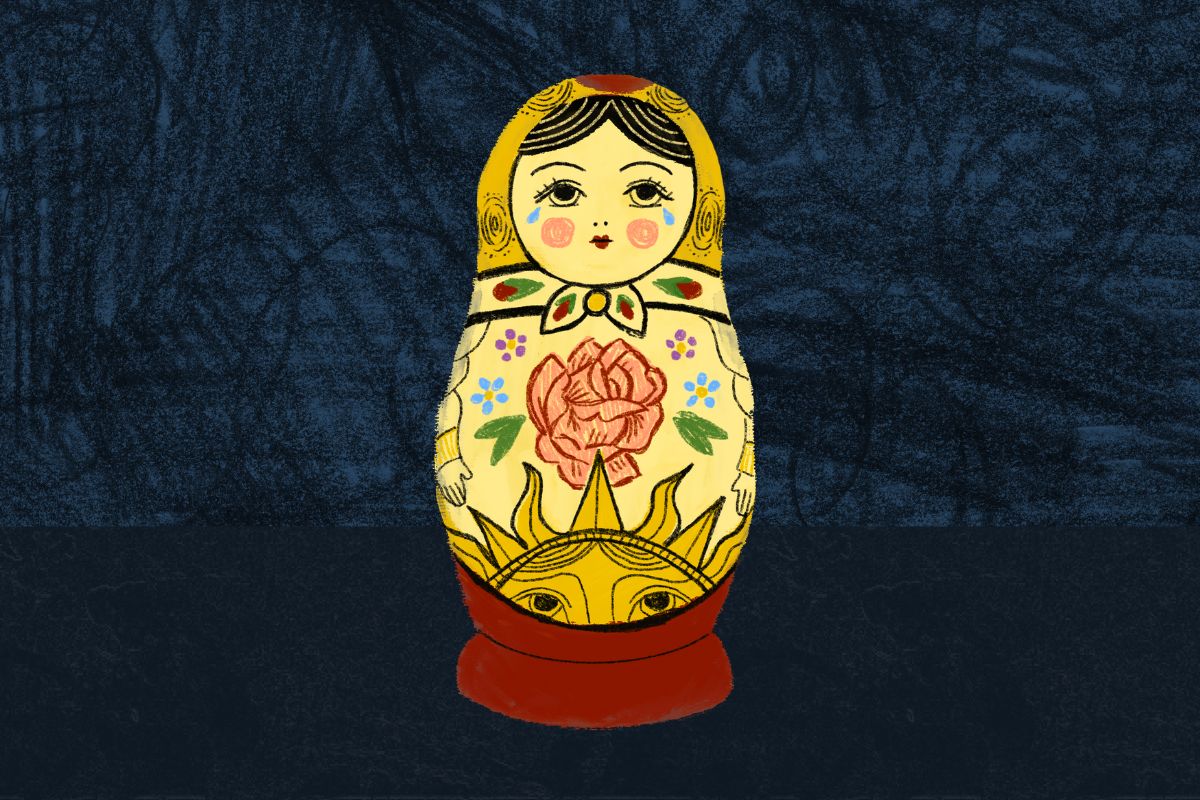
I am 6. We are in the yellow house with purple flowers and the crazy neighbour who fed the birds. My father is going to Russia on tour. My mother cries. Iris waits in the car wearing a fur coat. Alexei and I wave, happy. We get our mother to ourselves and go to the zoo every day. We learn Spanish like we think we might stay this time. My father returns, gives me one of those nested Russian dolls. I only like the tiny empty baby. Alexei gets a jigsaw puzzle.
I open my eyes. We’re stuck in traffic. I think about how, when I tried to look into this tour recently, to understand why, when my father returned, things seemed different between my parents, no record existed. As if it never happened.
I see the hospital that couldn’t save Alexei, and I close my eyes again.
I’m 9. Haifa, the house with the dogs. My father and I on a morning walk. Hot sun. Red shoes. My mother saying, “Please be quick. I’ve got an appointment.” Alexei not there.
My father takes his sandals off. “A quick dip won’t hurt, will it, Anushka?”
My mother will be pacing by now, but I follow him. Spray in my face. The joy of being enveloped. Gulls. Blue sky. We swim out. My body grows tired until eventually we reach a flat rock where I lie, exhausted. I’ve never swum so far. After a while, I sit up, terrified. I can’t see land.
“Papa, I’m frightened, I can’t see the world.”
He laughs. “Little one, I am your world.”
I open my eyes again. We’re still unmoving. It’s raining harder, and people outside are blurred under umbrellas, heads down. When I told my fourth therapist the Haifa story, and how that line (“I am your world”) became a family joke, she didn’t laugh, instead saying seriously, “You do realise, don’t you, Ana, that in most families, it’s the other way around?”
Close eyes. Imagine arguing back with her.
But also, every Sunday since I left home, whenever he could, whenever we were in the same country, my father would take me for pancakes. He would call up and say, “Nu? Where to today?” Or he would come over and make them for me, like when Mischa left or when we got the last bad news about Alexei. The way his mother used to for him. Small and round. Hot in the pan. Sugar and blueberry jam.
I feel myself starting to fall asleep again.
“Miss, we are here.”
I wake with a start. My head leans on the window, squashed and damp. Marek opens the door and I step out onto gravel, where a small stone lodges in my shoe, next to my big toe.
“Thank you,” I say, wishing I could get back into the warm car, ask Marek about his grandchildren, go somewhere else. Get pancakes? Anywhere but here.
Waiting for me in the cemetery hall are the Reform rabbi my father apparently chose, and Iris. My mother will be brought at the last minute by her carer, Bogna, to avoid any scenes. The silence in the empty room is so heavy it makes me want to shout.
There are rows of white chairs with blue sashes, like debutantes attending a dance. White flowers pump out an almost disgustingly sweet scent. At the front, two black and white portraits of my father are elevated. In one, he is young and faces the camera, cigarette dangling. In the second, more recent one, he sits bearded, half in shadow, a cap pulled low. Both are larger than life. Dust-infused sun streams through the colourful windows, hitting each one.
I look at him. Consider him. Who are you?
I imagine him then, sashaying to the front in his confident way, placing papers on the lectern and laughing delightedly to have, once again, an adoring crowd in the palm of his hand. The way he basked in it, as if to say, Oh, what a delightful surprise this all is, was, of course, just part of the charm.
From the corner, Iris spots me and moves as fast as a person can whilst wearing a bodycon dress. She looks like a crow, swooping to raid a carcass. Black hair, black dress, black shoes. We kiss on both cheeks. Peck. Peck.
“How are you, Ana?” She grips my shoulders in jewelled hands. “Wonderful dress! Very bohemian. And your hair! Your make-up! My goodness!”
Her grey eyes, perfectly framed by pencilled eyebrows, are flat pools. She looks older, or rather, like she is trying harder to look young.
“Thank you,” I say, then quickly, before she can ask what I know she wants to ask, I shake off her grasp, feeling one hand grabbing my wrist, but moving fast away.
I walk onwards towards the rabbi, who hovers by the pulpit, purple-clad, fantastic hair, and begin discussing the order of service with her. I am the only speaker. My father’s choice. Then music. Then burial. A hard, cold word. She places one hand on my arm as she says it.
Outside, the sound of people arriving. I wonder for a moment if a black dress might have been more fitting, but walk down the aisle to take my place at the front, knowing that when they see me, all everyone will think about anyway is the famous article.
“That’s her, the daughter,” they’ll whisper. “The troubled one. You know, who was quoted in that article about all the women. The one whose best friend ran off with her father straight after the brother died! Poor thing.”
The journalist made most of the article up. A lot of it, anyway. Horrible man. He plied me with drink and flattered me until I said certain things that were sort-of-true, as much as anything is true, but that doesn’t matter now. It’s all done.
The back door opens and my mother is wheeled in by Bogna. I go to her.
“Mama,” I say, kneeling down and looking into her eyes. There is a fantasy I have that one day she will remember me again and say, “Ana!” But she is as blank as ever.
What should I say, Mama? I ask her in my mind. The truth? For me, for you, for Alexei? What is the truth anyway, Mama? So many things are true all at once. He did love us, right? He did! He loved me. I know it. And yet, maybe he crushed us? Certainly you. He made himself the centre of everything — and then he left.
There is nothing in her eyes. Her neck barely holds up her head, which sags onto her chest. She has dribble on her coral top. She was once so beautiful.
I stand back up. I know I am alone but also that I am not.
The mother I once had holds my hand. She tells me she likes my green dress, and she means it. She plaits my hair neatly, wipes my mouth, hugs me and says, “There, that’s better. You can do anything, my girl. I know you will know what is right.”
Alexei is there, too. He also holds my hand. He says to me, “It doesn’t matter what you say to these people because they don’t matter. Only we do. I remember when he went away, how happy we were. How calm life was. And mother, too. We skipped! Remember? And remember how he would shout when you got bad grades? But also how he could bathe us with sunshine when he wanted? I wasn’t with you in Haifa because I’d stopped trying by then to make him happy, the way you never did. I was somewhere else then, the way I always am now.”
I want to ask him where is that place. I turn to ask him, but he is not there. Only the pressure of his hand remains.
Also, there are the women who said the things about my father. I know they are here, too, even if they are not invited. They stand outside and always will. They make it impossible for anyone to read his books in the same way. They make it hard for me to get everything straight in my mind. One of them is my old best friend. Another the shy au pair I had when I was 7. Another Irina, my father’s earnest translator. Others, too. Adored, then discarded. Many. All lined up. Their dresses brushing mine.
All of them come with me to the pulpit. I feel a sobering as I stand there, facing everyone.
As I ascend, I lock eyes with Iris. We look at one another, and I find that now in this moment, somehow, I understand she too was another planet, orbiting the burning sun. I smile at her, and she smiles back warily.
I think I’ll invite her for a drink later. Maybe we’ll smoke his cigars and drink his wine? Talk?
Then, finally, facing the crowd, I place my hands upon the lectern to steady myself. I still don’t know what I will say. There’s no liturgy for this. But nonetheless, I open my mouth and start, at last, to speak for myself.
To learn more about our fiction contest and this winning story, click here.
Deborah Zafer lives in London with her family and rabbits. Her writing has been published in 3:AM Magazine, Lillith, Jewish Fiction and many other places and can be found at www.deborahzafer.com. She is the Founder and Director of the European Writers Salon (www.saloneurope.org) and is working on her first novel. You can follow her on Instagram and Bluesky.