All due respect to Barbra Streisand, but what version of “Yentl” was I watching?
This thought occurred to me recently as I read Isaac Bashevis Singer’s short story “Yentl, the Yeshiva Boy” for the first time. Like most people, perhaps, I had only ever encountered it through Streisand’s 1983 movie-musical adaption. There, the story of a young woman in turn of the 19th century Poland who so yearns to study ancient Jewish texts that she pretends to be a yeshiva boy becomes a soaring melodrama. It’s carried on the wings of Streisand’s rendition of “Papa, Can You Hear Me?” and Yentl’s forbidden love of Mandy Patinkin’s Avigdor.
And while Streisand didn’t take too many narrative liberties with the film, I found the original short story to be of a completely different timbre. Singer’s story is much darker and wrenching, more like a mystical Jewish folktale. At multiple points, Singer allows his characters to wonder if Anshel (Yentl’s male persona) is a demon, evil for transgressing boundaries of gender and sexuality and concealing this behavior from the people of Bechev. It gets at deeper questions of the soul, being and, unintentionally, queerness.
“Yentl — you have the soul of a man,” her father observes early in the story. When Yentl asks why she was born a woman then, he responds, “Even Heaven makes mistakes.”
Needless to say, I was delighted to learn of Kadimah Yiddish Theatre’s “Yentl,” a production which “reclaims” the original story. Set to make it’s international premiere at London’s Marylebone Theatre after multiple successful runs in Australia, Kadimah’s “Yentl” thrusts the viewer into a world of haunted spirituality.
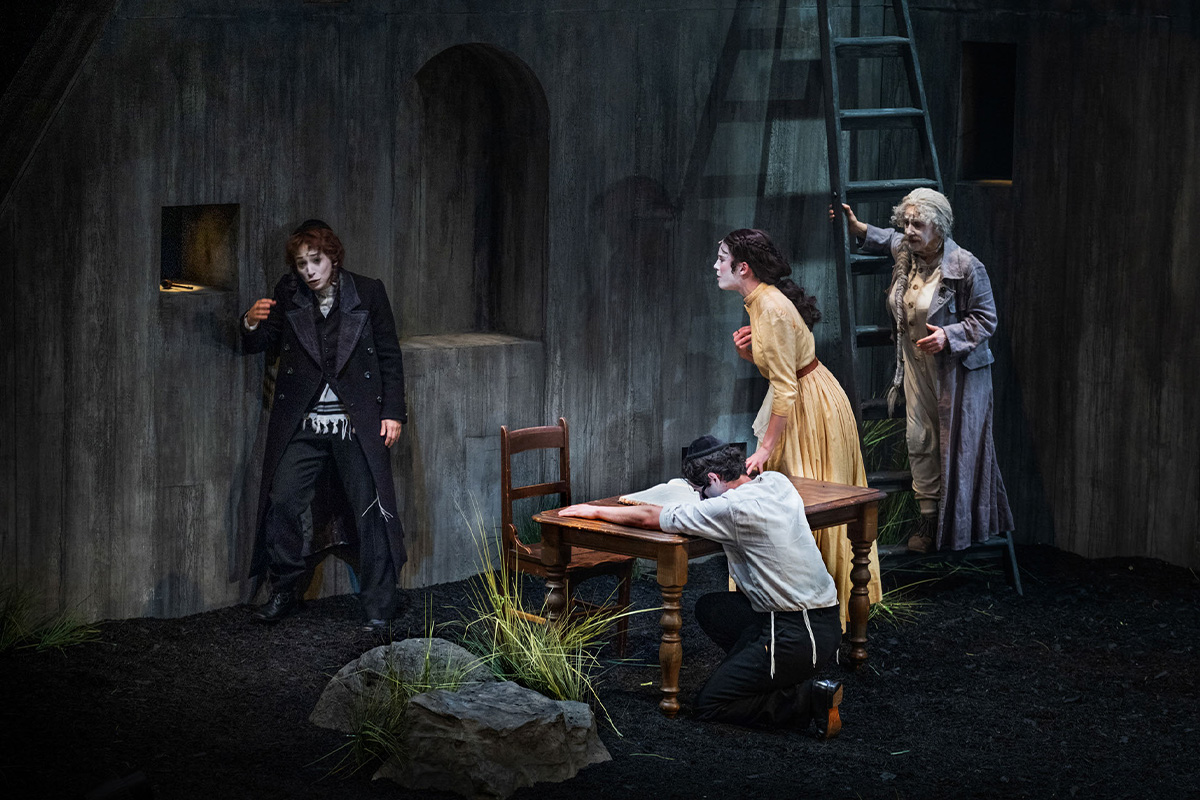
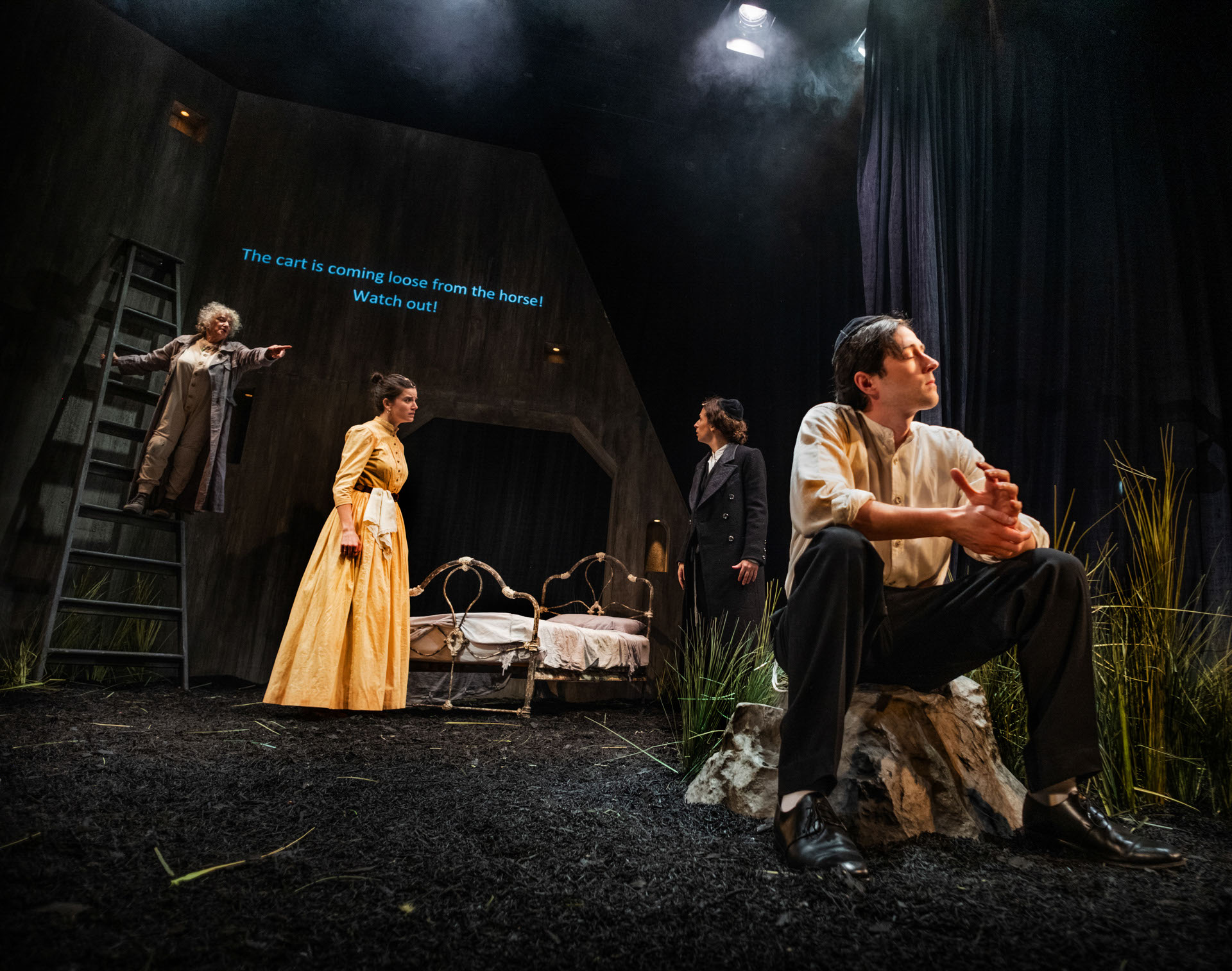
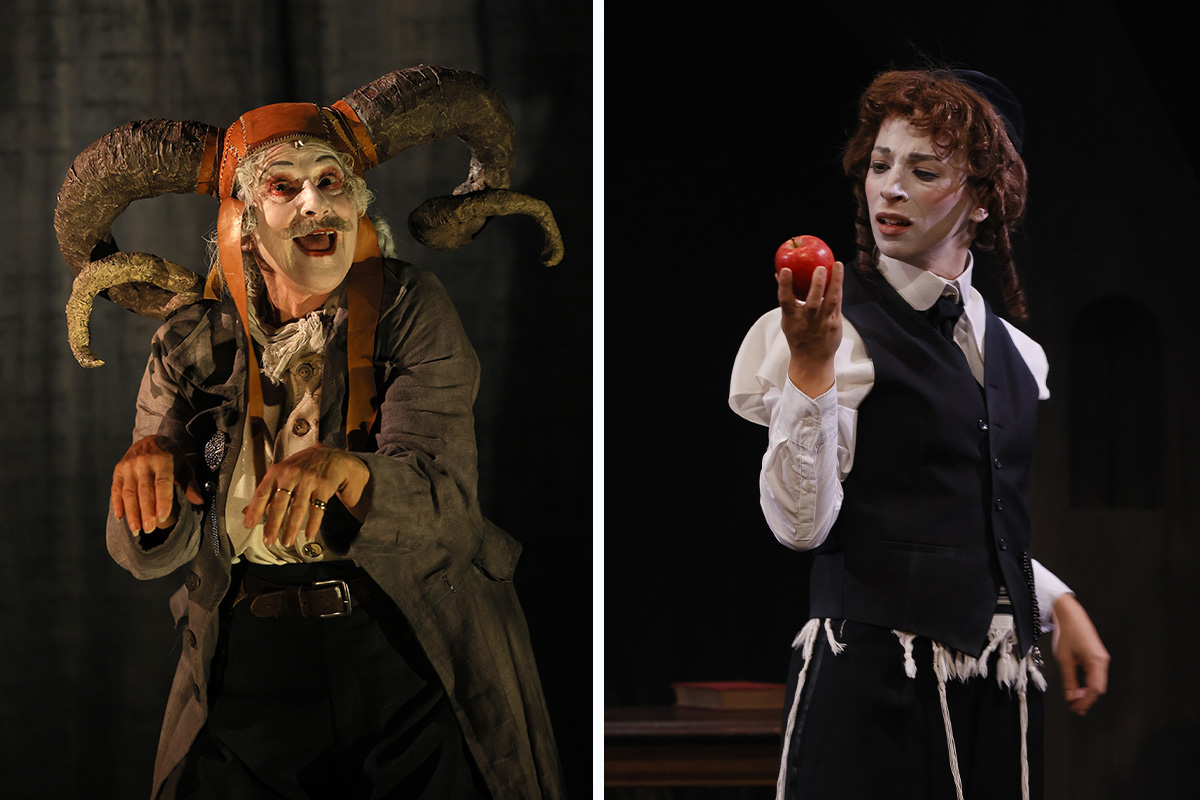
The set conjures up a shtetl and Bechev tied to the natural world: Dirt covers the entirety of the ground, with rocks and patches of tall grass springing up between sparse props like a wooden table or a bed. This shadowy, phantasmagoric realm is bounded by a few dark, brutalist structures — a mere suggestion of order. The characters themselves are the ghosts that haunt this world. At times, Yentl (Amy Hack), Avigdor (Ashley Margolis) and Hodes (Genevieve Kingsford) don thick, pallid make-up on their faces. And a horned, demonic character known as “The Figure” urges Yentl on in Yiddish, becoming her mystical, wicked co-conspirator.
Ahead of the production’s opening, I chatted with Elise Esther Hearst, one of the co-writers who brought this retelling to life.
This conversation has been lightly edited and condensed for clarity.
What resonated with you about “Yentl” that made you want to adapt this with co-writers Gary Abrahams and Galit Klas?
The artistic director of the Kadimah Yiddish theater in Melbourne, Evelyn Krape, who is in the show, had been fascinated by this story. And so I think then it was brought to the company, and there were a series of developments and exploration trying to figure out how to really adapt it – people often confuse it with Streisand’s epic, iconic work. But [Kadimah] wanted to put that to one side and just go back to the original story that was written in Yiddish.
And this is a short story – I think only 12 pages long in the English translation from Isaac Bashevis Singer – but it’s so large in its themes and exploration of identity. And when I came to it, it just struck me as being so contemporary for something that was published in the early 1960s. I think from my understanding of Bashevis Singer’s own upbringing, the things that interested him were the experiences of otherness, someone who doesn’t necessarily conform to the time that he was living in and to aspects of Orthodoxy. It felt like it was speaking to that and much more in terms of how we are thinking today about gender, sexuality, feminism and being a Jew. All of these themes were really strong and it seemed like “Yentl” provided access to have this conversation in a really exciting, dynamic, theatrical way.
I read the short story recently, and I had never read it before. I could not believe how different it is from the movie. I love the movie, too, but in some ways it almost, no offense to Barbara, feels a bit reductive. This story is asking questions of the human soul. It’s asking: Is Anshel a demon? The wickedness of it is so rich and juicy. So I loved what Gary Abrahams said about this show connecting to the more transgressive roots of “Yentl.” Could you talk a little bit more about how it does that?
Evelyn Krape plays a character called The Figure, which serves as kind of a new narrator. “The Figure” is a participant in the world, in the shtetl. She embodies other characters as well, but I would say she really embodies Yentl’s conscience, Yentl’s yetzer hara, the evil inclination, the thing that is really maybe pushing Yentl to transgress. Perhaps the Figure is a dybbuk that is possessing Yentl. It’s kind of all these questions come through the creation of that character, which speaks almost entirely in Yiddish. So it’s a real harkening back to Jewish folklore and Jewish mysticism and mythology that is essentially Yentl’s wrestling with their soul.
And a lot of it is a bit of teenage melodrama. And then in the mix of all of this, you have this other worldly figure that is inserting doubt, humor, cheekiness, sexuality, taboo. Dropping it in like a fairy, and seeing what chaos ensues. It’s quite magical. And that also plays out in the sound, in the set, in the actors – they’re wearing a very pale, ghostly makeup. It suggests to us that they are real, and yet they are not real. It’s an ode to a kind of Gothic vaudevillian style of theater. So I think that you cannot not be transported by the way this story is told and the way it unfolds to another place, to another time.
Do you or any of your co-writers speak Yiddish? How were you able to incorporate that?
None of us are fluent Yiddish speakers. Personally, I just have smatterings of it in my daily life, and from growing up in the Jewish community. So the decision was made to write the piece in English, and then Yiddishist and academic Rivke Margolis did the translation. But then also [the process] was figuring out which parts of it would be in Yiddish. It was felt that those things that happen within the home, within the soul, those conversations Yentl is having are going to be in Yiddish. That felt really important, because that’s where the internal reckoning is happening. Whereas the conversations, for example, that happen between Yentl and Avigdor and those in the yeshiva were going to be in English. It also felt very important that The Figure speak in Yiddish, because of the lyricism and expressiveness of the language. Some of the expressions The Figure uses can only be expressed in Yiddish for their playfulness, for their menacing.
You’ve spoken a bit already about the almost ahead of its time aspect of “Yentl,” and specifically the ways it explores gender and sexuality – even though that’s not really Isaac Bashevis Singer’s aim, nor Barbra Streisand’s. What has this production’s approach to the latent queerness of Yentl been?
We saw this as an open conversation, not a closed conversation. The closed conversation would be that ultimately, the lesson of “Yentl” is that you cannot be this person. You must forever be the Wandering Jew. You are left alone in the desert because there is no place for you. And maybe that is kind of what Bashevis Singer at that time was feeling, there’s like an awareness that the binary does not apply to everyone.
And I guess our view is, OK, how do we open this up a bit more? How do we really lean into the possibilities of a future where there may be a place for Yentl? And I think it was interesting, looking at this theme of gender and then revisiting some of our most ancient sacred texts. And going, OK, well how is gender really explored? And what you quickly discover is that there is no straightforward answer. The creation story is about oneness, a wholeness, the bringing together of the male and the female. So it’s fascinating. Once you start to unravel this idea of the human soul, Yentl sits within that ambiguity.
Jewish biblical texts really are more subversive about gender than I think most contemporary readers give them credit for. There’s a midrash, I believe, that Joseph’s sex was changed in the womb…
The technicolor dreamcoat was no accident.
Yeah, exactly. And that Adam was created as both male and female initially. Yentl feels like an extension of that.
Part of that unraveling and that exploration of the soul really comes down to the desire to have access to knowledge, to the sacred texts, which are forbidden. Again, if you go back to the creation story and the story of Eve’s transgression of eating the apple, there’s kind of this idea that without transgression, without questioning, without really yearning to know more, and to question the status quo, we don’t progress. It’s almost like this idea that we need to actually sometimes break laws, transgress, in order to grow and evolve. And that’s a really interesting concept.
“Yentl” takes all of these ideas and it propels the story in such a rapid, exciting way. It’s really thrilling to see someone do the things that you may never be brave enough to do yourself.
“Yentl” is running at the Marylebone Theatre through April 12, 2026.