Trigger warning: This piece includes mentions of homophobia, suicide, addiction and sexual assault.
For 18 seasons, “RuPaul’s Drag Race” has overflowed with expressions of queerness. It has highlighted queens living with HIV/AIDS, drag queen characters brought to life by trans women, Black, Latinx and Asian queens, and so many more identities that fall under the queer umbrella.
Last week, that representation extended to a gay, Black and Jewish cowboy named Jason.
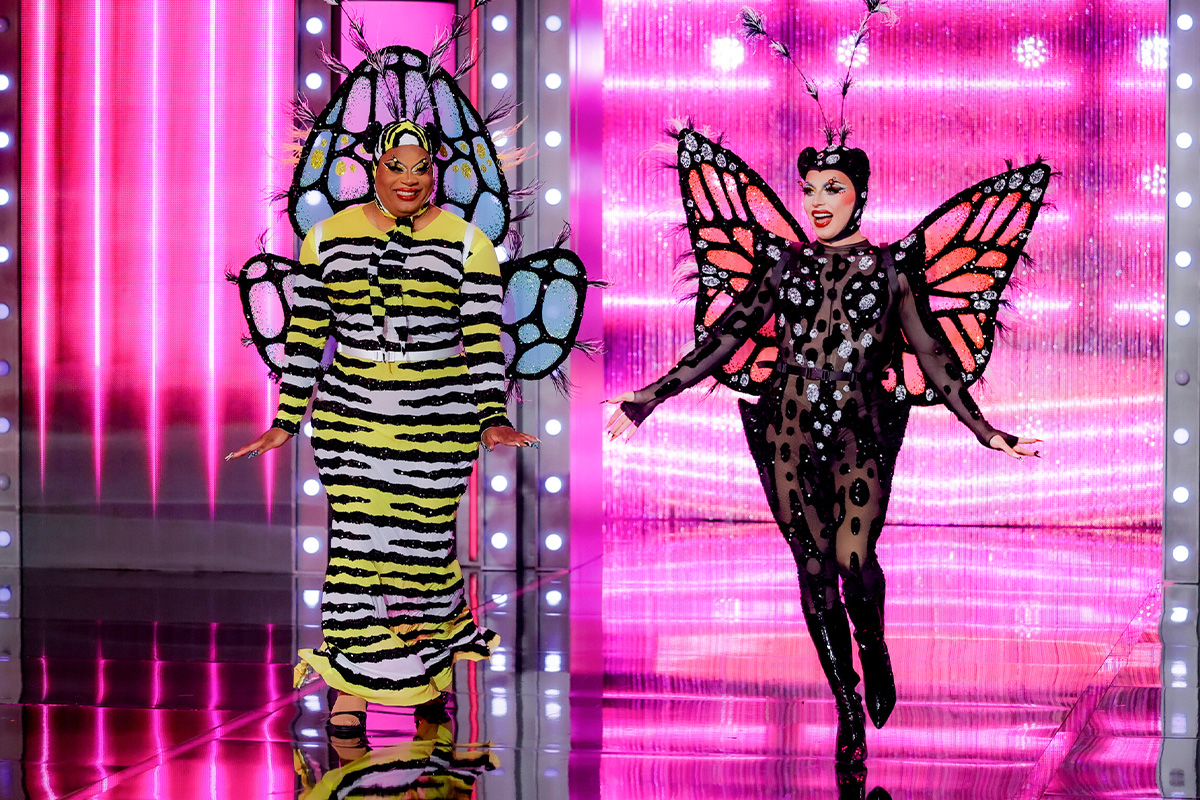
In season 18, episode 12, remaining queens Nini Coco, Jane Don’t, Darlene Mitchell, Discord Addams, Juicy Love Dion and Myki Meeks were each paired with a gay cowboy for the classic makeover challenge. Nini’s cowboy/soon-to-be drag daughter was 46-year-old Jason “Jameson” Simpson, a steer-wrestling veteran who shared some of his trauma from the military and that he was nervous to connect with his feminine side. Nini lovingly transformed Jason into Patsy Coco, a radiant caterpillar to her regal monarch butterfly look.
There's always a seat for you here. Hey Alma is here to make sure no one has to be Jewish alone. Your Passover gift keeps our community vibrant, our stories honest, and our space free for everyone.
Ultimately, the judges weren’t loving the look and Nini had to lip sync for her life against Discord — which she did, successfully. “That queen changed my life,” Jason said backstage after the lip sync. “I’m glad she’s staying.” Discord Addams then said goodbye to her fellow queens and sashayed away, the remaining queens danced it out on stage and the credits rolled.
Except by the end, one story remained untold: That of Jason’s Jewish identity. During the makeover process, Jason donned his rainbow kippah. A dreidel tattoo was visible behind his ear, as was a Magen David tattoo on his hand. “If you know the black gay jewish ex military cowboy who was a guest on ru paul this week pls tell me everything you know about him,” Shoshana Gottlieb-Beker, better known as @jewishmemesonly, wrote on Instagram.
Ask and ye shall receive. I caught up with Jason (whose Hebrew name is Judah Ivri Aaryav, meaning “The lion from the otherside seeks wisdom”) this week via email. We chatted about the parts of his life story that he shared but didn’t make the final cut of “Drag Race,” including the chance encounter that led him to Judaism.
This conversation has been lightly edited and condensed for clarity.
So how did you get cast on “Drag Race?”
From what I understand, the producers reached out to the International Gay Rodeo Association like a year and a half ago asking if anyone would be interested in doing a cowboy makeover. Our Vice President at the time Michael Vrooman (Myki Meeks’ drag daughter Morgan Meeks) was the contact person. He is a member of the Colorado Gay Rodeo Association. He has been a mentor of mine and he reached out to ask if I was interested. I didn’t really know what it was at first, but when they sent me the NDA and I saw “World of Wonder” I kinda got a clue. I hesitated but my fiancé was in the car with me when they called and all he said was “you HAVE to do this.” So I did.
You talked a bit about your life story on the show. But tell us more! What didn’t make the cut?
OOOO, Lord! Where to begin: When I was very young, my parents divorced. My dad wanted to be a rancher in the country and my mom wanted nothing to do with that. He moved to South Dakota and I would spend a few months a year with him and I fell in love with the cowboy lifestyle. I gave it up for much of my 20s and 30s — I had to decide if I was going to be a gay cowboy and risk my life every time I stepped out the door, or ignore that side of me and be a “man” and fit in. Confusion and uncertainty took over. I couldn’t figure out who I was let alone what I wanted. I went away to college and was still so lost. So I left school and joined the army on active duty (without telling my family).
When I left the army, I moved to Chicago to finish school. I met my ex-husband and decided to try living my life openly and authentically. I felt I couldn’t go back to the western lifestyle because the world was still… well… garbage. I went to culinary school and studied Mediterranean cuisine with a focus on kosher cooking. That was my first real introduction to Judaism.
When my ex and I split in 2016, I left the city to go back to the country. It was Texas. I started teaching in a rural community and life was starting to look better. But after a local newspaper picked up an article about the gay rodeo from Austin, in which there was a picture of me preparing to bull dog, I was pulled into the HR office and told I was in violation of their ethics policy. I was immediately terminated. They perp-walked me out of the school right in the middle of third period! Things took a terrible turn for a while and it wasn’t until I met a rabbi in a coffee shop that I found light again.
Tell me about that. What was your conversion experience?
I grew up Christian. I loved church and the choir and boy scouts and all of it. I was a God-fearing man, and did the best I could to co-exist with that and with my queerness. When my ex and I split, I went into a deep depression. Later, I would be diagnosed with Delayed Onset Complex PTSD and Bipolar 1 Disorder. In hindsight, if I would have gotten the help I needed years before instead of white-knuckling it, I might have been able to save my marriage. In the end I hurt a lot of people and I had to reconcile that.
I did as all good Christians do, and reached out to my clergy. He said to me, verbatim: “The reason your marriage fell apart is because it was not ordained by God. It was predestined to fail. What you are experiencing now is your penance for turning away from God and living ‘that’ lifestyle.”
I was destroyed. I went through a year or so of the most destructive behavior one could go through. Substance abuse, alcoholism, risky sexual behavior to pay for said substances. I wanted to die. I made a plan. My very close friends Marty and John literally saved my life by having the fire department kick in the door to my apartment.
I’m so sorry you went through that.
Shortly after that hospital stay, I went to Denver for a rodeo and was sitting in a coffee shop. It was the lowest point of my entire life. A woman walked past me as I was sitting and put her hand on my shoulder. She said, “I don’t know what it is you’re dealing with, but it will be OK. I promise.” We began talking and I told her about being thrown away by my clergy and my suicide attempt, and how because of that I will never be in the good graces of God again. So what’s the point of living? We got to talking about Judaism and being queer and how the two can intersect seamlessly and lovingly. I asked to know more, and she invited me to a Shabbat service at Judaism Your Way in Denver that night. I skipped the rodeo barn dance and went to the service and it was magic. It turns out the woman was Rabbi Caryn Aviv.
In that moment I felt a loosening of the constraints that had been put around my spirituality and my queerness. I kept asking myself if it were possible for the two to co-exist. After the service, she gave me a copy of “Queer Jews.” It was a collection of essays that talked about all kinds of things like gender identity, how to navigate gender-specific rituals, etc. I was fascinated. I thought for the first time… is it possible to LOVE God (not fear them) as a queer person? Moreover, is it possible to LOVE God and be all of me? Black, gay, cowboy, veteran, suicide survivor, ex-addict? The answer I found was a resounding YES.
Fast forward two years to the day of meeting Rabbi Caryn and two years of intensive studying, observing and celebrating, Rabbi Caryn sat on my beit din with our cantor and two other rabbis. They questioned, they blessed and that day I went to the synagogue and enjoyed a naked dunk in the mikvah pool.
And here I am. Healthy, happy, healing… all because a salt-and-pepper curly-haired woman put her hand on my shoulder in a coffee shop over 10 years ago. I’d love to one day bathe in the open waters of the Mediterranean Sea.
And what’s your experience like being a gay, Black Jewish cowboy?
As a gay cowboy, from about 6 to 17 years old, I was constantly defending myself. I really didn’t understand the “gay thing” until well into my teens. I just knew something was different about me and since I couldn’t change it, I had to defend it. I remember being 13 or 14 and going to local buck outs in town and seeing the bronc riders. I wanted to do that. The other teenage/young 20s cowboys just picked on me, threw things at me and dismissed me. One guy, when I was 15 and he was 22, said he would teach me to ride and to come out to his place the next day. I did. He sexually assaulted me, but at the time I was just figuring it all out and thought that’s what cowboys do. Things went on like that for a few months, needless to say he never taught me anything – except maybe how to keep a secret. That, unfortunately, shaped a lot of what I thought cowboys had to be. You’re either the rough and tough one everyone wants to be… or you’re the weak one that gets taken advantage of. I still kind of carry some of that.
As an adult, adding in my Jewishness to the cowboy culture has been difficult but not impossible. Now, I embrace all aspects of who I am. The Gay Rodeo is amazingly welcome and celebrates me for who I am. I was once gifted a kippah with horseshoes on it from a young Jewish boy whose family brought him to the rodeo. When he saw me, he wanted to meet me. He gave me his kippah and I gave him mine, and my cowboy hat. He was beaming… that felt really great. I would love to be a part of the Black Rodeo, but the gay thing gets in the way. I’d love to have been a part of the Professional Rodeo Cowboys Association, but the gay, Jewish and Black thing would get in the way.
But how do you find a mentor to help you grow and improve when you can’t even get your foot in the door? Bigotry has taken so much from me, I’m just happy to live my life with my (soon-to-be) husband and hopefully one day we can own a little ranch somewhere where we can teach young cowboys of all kinds to love themselves and love rodeo. Maybe a summer camp for Jewish kids to come learn about the western lifestyle. That would be cool.
You mentioned your fiancé on the show and now. What’s he like?
I’m not lying when I say Neil is one of the most amazing men I have ever met. He does theater automation-type engineering things. Basically when you see people or set pieces flying around in the air at a show (think: Cirque du Soleil), he is the engineering and tech mind behind that stuff, as well as operating the computers that make it work. He is originally from Denver and has traveled all over the world for his work. He’s the only man I’ve ever met that makes me feel like I don’t have to compartmentalize any part of myself to exist. I am so blessed that he chose me. He is patient, kind, patient, loving, patient, understanding and… did I mention… patient?
He went from city-living with his dog Fisht (that’s an amazing story in and of itself) to go out on the ranch with me and my menagerie of animals. I have two performance horses, Miss Honey and Sir Hickory. I also have seven goats: Patches, Plaid, Archer, Lana, Ceril, Abby-Jean Coco (who was born while I was away filming the show) and Houndstooth (she’s blind so she lives in the house); two kosher sheep: Lambgella and Lamby Davis Jr. (he’s black); 14 chickens, four ducks, three barn cats: Blossom, Bubbles and Buttercup; two house cats: Jenni and Mew; and two mini Aussies: Truffle and Gus. Unfortunately, Fisht passed away last year.
Neil is the man I prayed for when I was sitting in a guard tower in Afghanistan, asking God to send someone that would take me away from all the pain and war and hurt and mess. He’s the man I prayed for when I was at my lowest and just needed someone to lift a little weight so I could find my footing. He’s my person. He’s my hero.
You shared in Shoshana’s comment section about your Jewish tattoos. They’re amazing! What inspired you to get them? Any plans for any more tattoos?
I really love the lines in Deuteronomy: “These commandments that I give you today are to be on your hearts. Impress them on your children. Talk about them when you sit at home and when you walk along the road, when you lie down and when you get up. Tie them as symbols on your hands and bind them on your foreheads. Write them on the doorframes of your houses and on your gates.”
I know that some observant Jews will use the tefillin to observe that part of the Torah, but I chose to literally tie them as symbols on my hands (a Star of David on the right, and Tree of Life on the left) and bound to my forehead-ish (a dreidel behind my ear). It is for me a way to observe in a way I feel authentic. I have the first part of the Shema on my right forearm as well. In the future, I’d like to have the rest of the Shema done, and a map of Kadesh from Exodus, the location where the Jews spent most of their time wandering in the desert. I’m definitely thinking of getting something on my calves or thighs.
How did Nini Coco change your life? How do you feel about your feminine side now?
Whew, Nini Coco. What can I say? We shared so much with each other. There were tears shed all over the place.
I didn’t know she cried in the confessional when talking about me. Nini made sure that I was comfortable with everything that was being done. She gave me a space to be myself but didn’t force me into it. She is one of the only people outside of my fiancé who said to me, “what do YOU want to be?” I spoke about being afraid of being seen as too feminine with my voice shaking like a child. Nini let me let go of all of that on my own terms… to the point where we were late for the runway because she was constantly checking in and pumping me up!
She made it clear that her job was to let everyone see all the parts of me in one package. She made sure the padding was keeping with how a Black woman’s shape would be. She worked for hours getting the shade of makeup correct for my skin tone. She incorporated some Western line dancing in our little dance number (they cut the dancing), and even modified the caterpillar cap so my kippah (and big head) would fit. And it turned out AMAZING! Almost a year of waiting to see how I would look and like she said, all parts of me were on display. I got to see myself from the outside for the first time and I loved what I saw. Do you know what it’s like to see yourself and love yourself for the first time in 46 years? It’s life changing.
I’m not saying that Patsy Coco is now a thing, but I’m not saying she’s not! As far as my feminine side, it doesn’t exist anymore. Neither does my masculine side, or my Jewish-ness, or my Black-ness, or my cowboy-ness. She taught me that all parts of me can co-exist and when they do, something amazing happens. For that, I am grateful and forever in her debt.