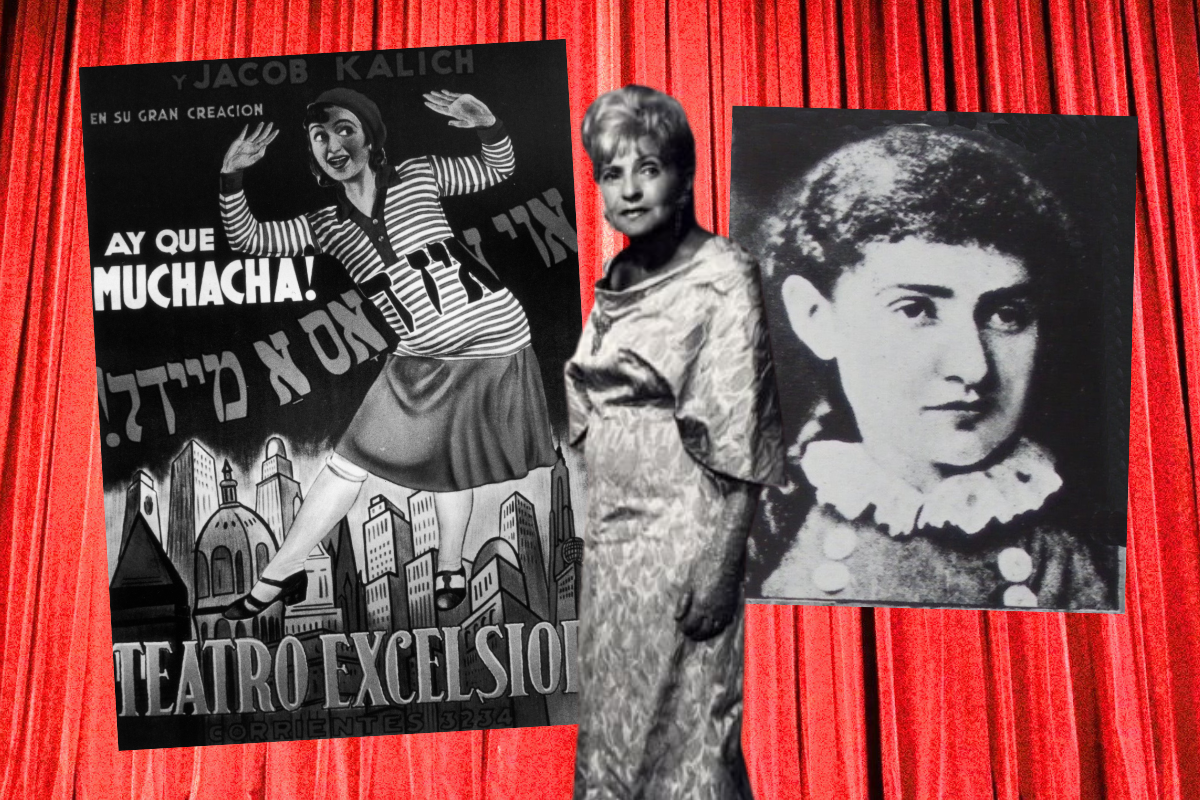
From its origins in Eastern Europe in the mid-1800s to today’s stagings in cities such as Chicago, Montreal and Warsaw, the Yiddish theater scene and women’s history have been intimately intertwined.
Looking back to Yiddish theater’s Golden Age, between the 1890s and 1920s, women were very active participants as actors, playwrights, directors and nearly every facet of the theatrical experience. They, like their male counterparts, were members of Yiddish theater companies in Europe, many which continued to operate up through the Holocaust. So too did they help establish troupes in New York City. These groups put on vibrant productions ranging from plays that dealt with contemporary issues and topics from marital discord to politics, to plays that adapted fairytales, myths and legends and even some children’s theater pieces as well.
But sadly, their contributions and fame have often been downplayed or overlooked in favor of their male counterparts. Optimistically, though, many women in the historic Yiddish theater scene are getting more recognition today.
Possibly the most well-known woman in Yiddish theater was Molly Picon. Modern-day theater and musical enthusiasts probably best know her from her turn as Yente in the film adaptation of “Fiddler on the Roof,” but she starred in numerous stage and film productions. This included the Frank Sinatra film “Come Blow Your Horn” and “Milk and Honey” on Broadway.
A Humble Request: Hey Alma's content is free because we believe everybody deserves to be a part of our radically inclusive Jewish community. Reader donations help us do that. Will you give what you can to keep Hey Alma open to all? (It's a mitzvah, ya know.)
“Her story subverts so many of our expectations of the golden age of Yiddish theater and movies,” notes Yiddish playwright and journalist Rokhl Kafrissen. “She went back to Poland to make her most famous Yiddish movies. Working with her husband and creative partner, Jacob Kalisch, she translated, wrote lyrics and toured the world performing. Throughout her career, Picon’s persona was one that famously pushed at the boundaries of gender and age.”
Rokhl adds, “What I love about her is that, despite the pixie-like persona she cultivated in the first part of her life, she was smart, tough, and remained firmly in charge of her own career. She lived a long life and spent most of it performing. That feels nothing less than miraculous to me.”
While Picon may arguably have the most famous name among Yiddish female theater stars of history, there were many other incredible talents who helped shape and revolutionize the entire industry. Romanian Jewish actress Sophie Karp rose to fame in the Yiddish-speaking theater world when she joined Abraham Goldstein’s Yiddish professional theater troupe in the 1870s. Regarded as the very first Yiddish female stage star in history, Sophie also went on to have a successful career in Russia and Germany before relocating to New York City. There, she helped establish the legendary Grand Theatre.
Bessie Thomashefsky, originally from what is now Ukraine, was an influential force along with her husband in the New York City Yiddish theater community at the turn of the 20th century. Bessie dealt with a large deal of personal heartbreak throughout her career while her husband, leading Yiddish theater star Boris Thomashefsky, carried on a long-term affair.
Bessie eventually separated from him and continued on to be incredibly successful, starring in leading roles in plays like the Yiddish version of “Salome,” and she was a staunch advocate for women’s rights. The People’s Theater was even renamed in her lifetime as the Bessie Thomashefsky People’s Theater. Years later, her grandson Michael Tilson Thomas became the world-renowned conductor of the San Francisco Symphony and produced a concert stage show about Bessie and Boris which aired on PBS.
World-famous Polish actress Ida Kaminska not only was a star of the Yiddish theater scene, but deserves more recognition in her efforts to revive Yiddish theater in post-World War II Europe. Born into a Yiddish theater family, she began acting at 5 and had an incredible career both on stage and films (including “The Shop on Main Street,” considered one of the best Czechoslovak films of all time). After spending most of the 1940s evacuated to Kyrgyzstan, she returned to Poland after the Holocaust and re-established the first Yiddish theater in the country in 1946.
Today, New York City continues to be the global hub of the Yiddish theater scene, and although there are now two full-time Yiddish theater companies compared to the 50 companies in the “golden age” heyday, there are indeed many exciting new developments. According to Rokhl, who caveats her statement by saying she’s wary to label this a “revival,” the last 10-ish years have proved fruitful for younger theater artists getting interested in Yiddish texts and theater history. The Folksbiene company has even seen major mainstream success with their Yiddish-language version of “Fiddler on the Roof,” which ended up as an off-Broadway production in 2019.
Regarding the current status of the New York City Yiddish theater scene and women’s involvement, actress and acting teacher Rachel Botchan says, “Many young people have turned to studying the Yiddish language and, as a result, have also become interested in Yiddish theater. The use of supertitles helps draw in English speaking audience members. There have even been new plays written in Yiddish by young writers in recent years. A new Yiddish play that I performed in and also directed was written by two young women, Melissa Weisz and Malky Goldman, both for whom Yiddish is their first language.”
Outside of New York City, the options are more limited, but a number of cities worldwide have seen premieres of Yiddish-language plays either written, directed or featuring primarily women actresses. There’s no better time than now for any female-identified Yiddish culture enthusiasts, theater lovers, Yiddishists and writers to get involved. Tsu lebn, libe un der bine! (To life, love and the stage!)