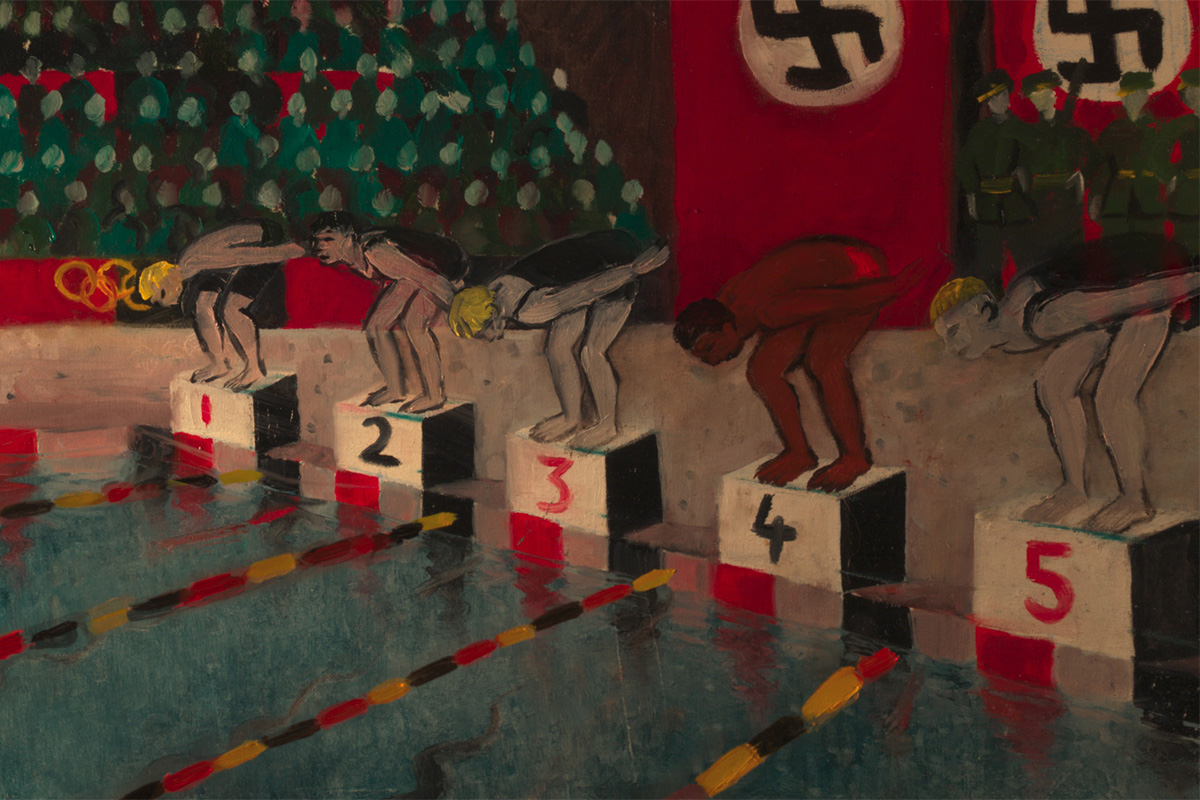
Exactly 81 years ago today, the Red Army marched into Auschwitz, liberating 7,000-some prisoners. Since 2005, the United Nations has recognized January 27 as International Holocaust Remembrance Day. Though it’s separate from Yom HaShoah, which is more widely recognized in the Jewish community, today still offers an important moment of communal reflection and mourning. And this year, I cannot think of a better way to mark it than by watching the Oscar-nominated animated short film “Papillon,” or “Butterfly.”
“Butterfly” is a tender, stunning tribute to the Jewish Olympic swimmer and Holocaust survivor Alfred Nakache, born in 1915 into an Iraqi Jewish family in French colonial Algeria. The film depicts Nakache, a pioneer of the butterfly stroke, on the last swim of his life. As he glides through a rich sea of Prussian blue, he remembers all the water he has touched in his 67 years.
As a child, Alfred, also known as Artem, overcomes his fear of water, light and cerulean. He conquers a turquoise pool, becoming a swimming champion in North Africa. In another pool, he is enamored with the graceful Paule, the woman who would become his wife. She swims artistically in aquamarine waters, which soon transform into teal and sky blue, as Alfred and Paule form a union with their movements.
He’s spurned by a fellow French swimmer in a dark cyan pool as red, black and water bubbles to the surface. Suddenly, Alfred is at the 1936 Berlin Olympics in Nazi Germany, swimming with the French team. Soon, Alfred is barred from public pools with his wife and daughter, Annie, and from swimming competitions.
A Humble Request for the New Year: You can help keep Hey Alma's radically inclusive Jewish community free and open to all. Your gift means someone, somewhere, feels a little less alone this holiday season.
An ocean of cobalt and navy blue churns as he and his family try to escape, and are caught by the Nazis. At Auschwitz, where Alfred is separated from his family, guards taunt him, forcing him to dive into a hazy, gray water retention basin. After his liberation, Alfred learns to swim again and even competes at the 1948 Summer Olympics. But he’s unable to escape the ghosts of his murdered Paule and Annie, desperate to find them in a sea of black, red and yellow. In the end, the waves turn to indigo with the setting sun during Alfred’s last lap. He looks to the ocean floor, sees Paule and Annie and swims to them, rejoining them in death.
Importantly, the 15-minute film stays relatively true to Nakache’s life.
At the 1936 Berlin Olympics, he competed in the 4x200m freestyle event. Though the French team did not make the podium, coming in fourth, they did place ahead of the German team. Perhaps the pinnacle of his career came in 1941 when he broke the world record for the 200m breaststroke. Just two years later, Nakache was banned from competition by the French Swimming Federation due to pressure from the Nazis; in solidarity, many of his competitors at the 1943 French national swimming championships refused to participate. Alfred instead channeled his athletic prowess into training Jewish resistance recruits in Toulouse, France, where he lived.
Sadly, in 1943, he, his wife, Paule, and their 2-year-old daughter were deported to concentration camps. Paule and Annie were subsequently murdered in the gas chambers. While at Auschwitz, Alfred was punished by the Nazis, who forced him to swim in a water retention tank in frigid temperatures. But, as the International Swimming Hall of Fame notes, “It was a chance to swim and to live.”
Nakache was liberated from Buchenwald in 1945. Despite weighing less than 100 pounds when he was freed, Nakache was part of the French team that set the world record in the 3x100m relay in 1946. He would also go on to compete at the 1948 Summer Olympics in London on the French swimming and water polo teams. Although he retired from swimming in the 1950s, Nakache helped train French Olympic swimmer Jean Boiteux, who won a gold medal at the 1952 Helsinki Olympics in 400m freestyle. (Additionally, the pool where French Olympic champion swimmer Léon Marchand first swam is named after Nakache.) Alfred Nakache died in 1983 after suffering a heart attack while swimming in the port in Cerbère, France. He was 67.
In the film, director Florence Miaihle’s gorgeous animated paintings complement Alfred’s moving life story. She achieves this animation by painting on a glass plate, while a camera overhead photographs her work. Then, Miaihle erases it and transforms it. This is repeated thousands of times so that once the photographs are put together, they simulate fluid motion.
“The paint is a fluid material that will gradually transform itself in the same way water transforms itself,” Miaihle explains. “The lines and shapes dissolve in the liquid, one material, one color leading to another.” Her beautiful film is dedicated Paule, Annie, Alfred’s second wife, Marie, his brother, William, who taught Miaihle how to swim, and the director’s father, Jean Miaihle. Jean and Alfred Nakache knew each other from the resistance in Toulouse.
All in all, “Butterfly” is a breathtaking portrait of a Jewish man whose life was defined by fierce love, grief, resilience, and bodily power. If that isn’t deserving of an Academy Award, I don’t know what is.