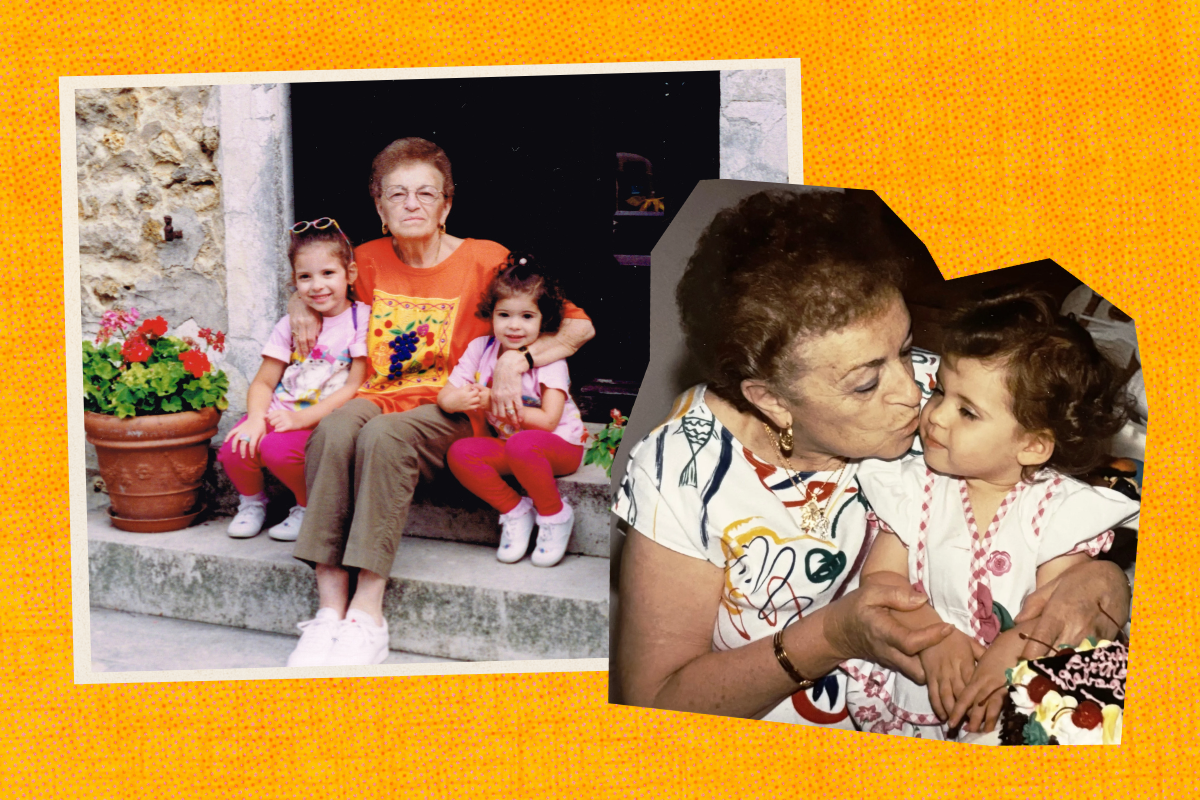
My grandmother — my bubbeleh, puppaleh, ketzeleh, shepseleh, lalka — was, quite simply, the best.
I can’t believe I’m using the past tense to speak about her, because for all my life, up until the very end, she was the most vibrant, alive, seemingly immortal person I’ve ever known. Which was a miracle unto itself considering her circumstances and what she’d overcome.
Born in 1924, my grandmother Paula Beach had what she always called the “ideal” life in cosmopolitan Łódź, Poland. Her parents owned and ran a furniture store, and as the baby of the family, she was raised by her parents and grandmother, along with her two older sisters, Mania and Eva, and older brother, Yitzak. She loved saving up her money to buy chocolates, going shopping for shoes at each new season, helping her grandmother prepare matzah ball soup and crumb cake, figure skating and the new Shirley Temple movies that came over from America. Her life was joyful. Her life was good.
But soon, things were turning and changing across Europe and her life would be no exception; my grandmother and her family were deported to the Łódź Ghetto. There, she deceived the Nazis on numerous occasions — sneaking away from them after being selected to do manual labor; learning about an imminent Nazi inspection and hiding her ill father under the floorboards. Eventually, after his tragic death, she and her sister snuck his body out of the ghetto in order to properly bury him.
There's always a seat for you here. Hey Alma is here to make sure no one has to be Jewish alone. Your Passover gift keeps our community vibrant, our stories honest, and our space free for everyone.
Upon liquidation of the ghetto, my grandmother, along with her mother, two sisters, aunt and cousin, were transported to Auschwitz. When her aunt saw they were separating adults from children, she tasked my grandmother with watching over her young cousin. My grandmother tried desperately to conceal her from the Nazis, but she was snatched from her arms and selected for immediate death, along with my grandmother’s mother, sister and aunt. To the end, she had nightmares about her cousin, whom she vowed to protect, being ripped from her and never seeing her again.
My grandmother and one of her sisters were left alive in the most notorious of the death camps. They were subjected to the most unimaginable conditions — deprived of sleep, food, water, sanitation, everything, in ways that I can’t fully wrap my head around. Eventually, she was selected for death herself and put into a gas chamber. By a confluence of luck and (more aptly) a miracle, a technical malfunction saved her life that day, and she evaded death in the place no one was supposed to survive.
It has always been a massive weight on me, knowing that my existence is an act of my grandmother’s resistance and that, by the laws of nature, I shouldn’t be here. It has colored every moment of my life, every choice I’ve made, every thought I’ve thought, knowing where she’d been and how she got out.
Ultimately, she would survive three concentration and death camps — Auschwitz, Mittelsteine and Mährisch-Weisswasser — before being liberated when she was just 20 years old. By 1945, she’d lost everyone but one sister. She returned home and learned that her old house was overtaken. She wound up in a displaced persons camp, where she met and married my grandfather, Leon, another survivor, and had a beautiful daughter, my aunt.
Throughout it all, she was determined to come to America and live the “American dream.” Once she stood on the deck of the retired U.S. Navy ship transporting her to her new life and saw the Statue of Liberty, she knew she’d officially survived.
They settled in New York City, where my grandfather worked in the garment — schmatta — industry, before they opened a grocery deli where she, once again, proved she was a fighter as she survived an armed robbery that left my grandfather, the toughest person I’ve ever known, stabbed in the head, yet still alive.
But as I grieve and mourn for her now, I think about how, most of all, my grandmother was so much more than the tragedies of her life.
She was the most expressive person I’ve ever met, so full of chutzpah, so sassy, so fierce. She had the most incredible sense of humor and when I would (frequently) ask her who told her she could be so adorable (a word we always used to describe her that she would good-naturedly roll her eyes at, but deep down knew was true), she’d point to herself and say “I did.” She did.
When I think of her now, I think of her plotzing while watching reruns of “I Love Lucy,” “The Nanny,” “Who’s The Boss?” and “Three’s Company.” Waiting to see Meredith Blake pushed into the lake in her favorite movie, “The Parent Trap.” I can still hear her arguing along to a “Judge Judy” case. She adored musicals and I see her conducting the orchestra along with “The Lawrence Welk Show” and singing along to “Edelweiss.” Bopping in the car to “Karma Chameleon.”
She was the most elegant person in the world, never going anywhere without being fully “done,” her hair impeccably in place and her makeup perfect. She’d never tell anyone her age (and would hate that I shared it here!), instead looking you straight in the eye with that perfected poker face and saying “69.” She had a quick wit, and a quicker tongue.
She kept up with the news and politics and pop culture. She loved late night talk shows and I often joked that she should have her own biting segment on them. I don’t think network television could handle her. One of the last things she spoke about was wanting to watch “that movie about the witches” (yes, “Wicked”) because she thought the advertisements looked “real cute.”
A rabbi recently said that the three most important things in her life were family, family, and family, and nothing truer has ever been said. She was devoted to her family, the two daughters that she raised, and the two granddaughters that she raised.
She was the epitome of the notion that sometimes you don’t need to have a “loud” life — with fame and power and influence — to have a meaningful life, and one that has touched every person you have ever met.
The world deserves to know she lived. I used to see the world in technicolor, and now everything is black, but still my world is a better place because I had her in my life. The world will be a better place if it understands the conscious choice she made each day on how to live her life. It will be a better place if others can live theirs the same way, despite the loss and grief that all of us will eventually face.
I volunteer with an organization where I share my grandmother’s story of survival with students from elementary school through college. I start out each presentation with the following testament: “my grandmother is an incredible woman who raised me and is my favorite person in the world.”
To say she was my favorite is the understatement of the century.
I’ve always been connected to her in a way that’s different from anyone else. Everyone who knew me knew of my grandmother. Everyone. She’s always been, as my sister put it, “mine.”
The greatest honor of my lifetime is being her granddaughter.
She was the love of my life. She was the light of my life. She still is. She always will be.