Baz Luhrmann is bringing Elvis Presley back to the big screen. Following the success of his 2022 film “Elvis,” his new concert documentary, “EPiC: Elvis Presley in Concert,” assembles never-before-seen footage pulled from the Warner Bros. archives, buried for decades in Kansas salt mines. It is a reminder that Elvis was not just heard, he was seen. And behind that spectacle stood a Jewish tailor, a creator of the “rhinestone cowboy” look, who dressed icons from Elvis Presley to Elton John and even Ronald Reagan. His name was Nudie Cohn.
Born Nutya Kotlyarenko on December 15, 1902, in Kyiv, Ukraine (then part of the Russian Empire), he grew up in a Jewish family. Although his father was a bootmaker, Nutya began apprenticing with a tailor at the age of 8. By 11, he and his brother Julius were sent to the United States to escape very common anti-Jewish pogroms. Upon arriving at Ellis Island, an immigration official misunderstood and misspelled his name as “Nudie.” Later in life, Cohn would say the agent had done him the greatest favor of his life. And that is how the name that would come to define country music style was born.
It would still take years before Nudie created his famous “Nudie suits.” In his early years, he traveled across the country trying to find himself and earn a living. He worked a variety of jobs: shoeshiner, errand boy for Jewish vaudeville star Eddie Cantor, boxer and negative cutter in Hollywood film production. His travels were often fueled by love and romance. While staying in Mankato, Minnesota, he fell in love with Helen “Bobbie” Barbara Kruger, the daughter of the owner of the boarding house where he stayed. The couple moved to New York City, where Nudie opened Nudie’s for the Ladies, an atelier catering to showgirls and burlesque dancers. There, he created embellished G-strings, tasseled pasties and costumes adorned with fringe and rhinestones.
After the birth of their daughter Barbara, the family moved again, settling in Hollywood in 1940. They began making clothing on a ping pong table in their garage. Since his childhood, Nudie had admired cowboys, Western films and country musicians, and he decided to pursue that path.
Cozy Season with Hey Alma. As the days get shorter, Hey Alma is where you can curl up with Jewish culture that's funny, honest, and open to everyone.
Nudie approached an emerging singer named Tex Williams, who helped launch his business by auctioning a horse to raise money for a new sewing machine. Up-and-coming country star Lefty Frizzell and Williams were Nudie’s first customers. When another young musician named Hank Thompson saw Williams’s suit, he ordered one for himself. Featuring bright, eye-catching embroidery and an abundance of rhinestones, the suits quickly drew attention. Business snowballed, allowing Nudie to move into a larger space and name his shop Nudie’s Rodeo Tailors.
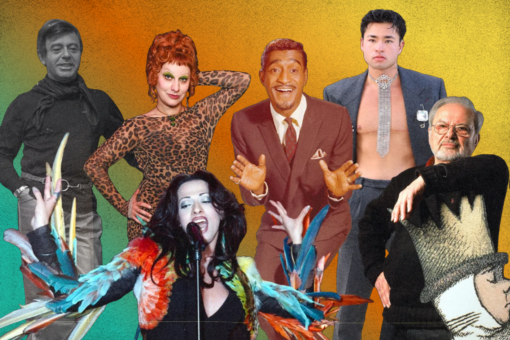
Nudie suits were not only ostentatious and extravagant, but often included witty biographical details about their wearers. For his “walking billboard” Porter Wagoner, Nudie created over 50 suits for hims and his band, most of which featured the wagon wheel motif as a playful reference to Wagoner’s name. When Grand Ole Opry star Jimmy C. Newman scored a hit with “Alligator Man” in 1966, Nudie designed a suit covered in rhinestone crocodiles. For singer T. Texas Tyler, he created one suit featuring a map of Texas and another with embroidered playing cards highlighted with rhinestones, referencing Tyler’s 1948 hit “Deck of Cards.” Webb Pierce’s chart-topper “In the Jailhouse Now” inspired a suit with vivid jailhouse-themed embroidery. Guitarist Hank Snow, who grew up in a fishing village in Nova Scotia, wore suits embellished with nautical motifs. In his autobiography, Snow wrote, “It’s always been my belief that the audience wants to see, and deserves, a little flash by the artist on stage, rather than see him looking like the neighbor next door.”
By the 1970s, Nudie’s influence had spread beyond country music. Rock ’n’ roll artists— including those from across the Atlantic — caught Nudie fever. Among his most famous designs for British musicians were a suit for Keith Richards of the Rolling Stones and Elton John’s iconic look for the cover of his 1972 “Rocket Man” single.
In Hollywood, Nudie’s signature embellished suits became so synonymous with the Western star image that on-screen cowboys wore them as well. In the 1979 film “The Electric Horseman,” Robert Redford appeared in a custom purple Nudie suit. Ronald Reagan, before becoming President of the United States, was a Western film actor himself and once wrote Nudie a letter saying, “I was the guy who messed them up, and Nudie was the guy who dressed them up.”
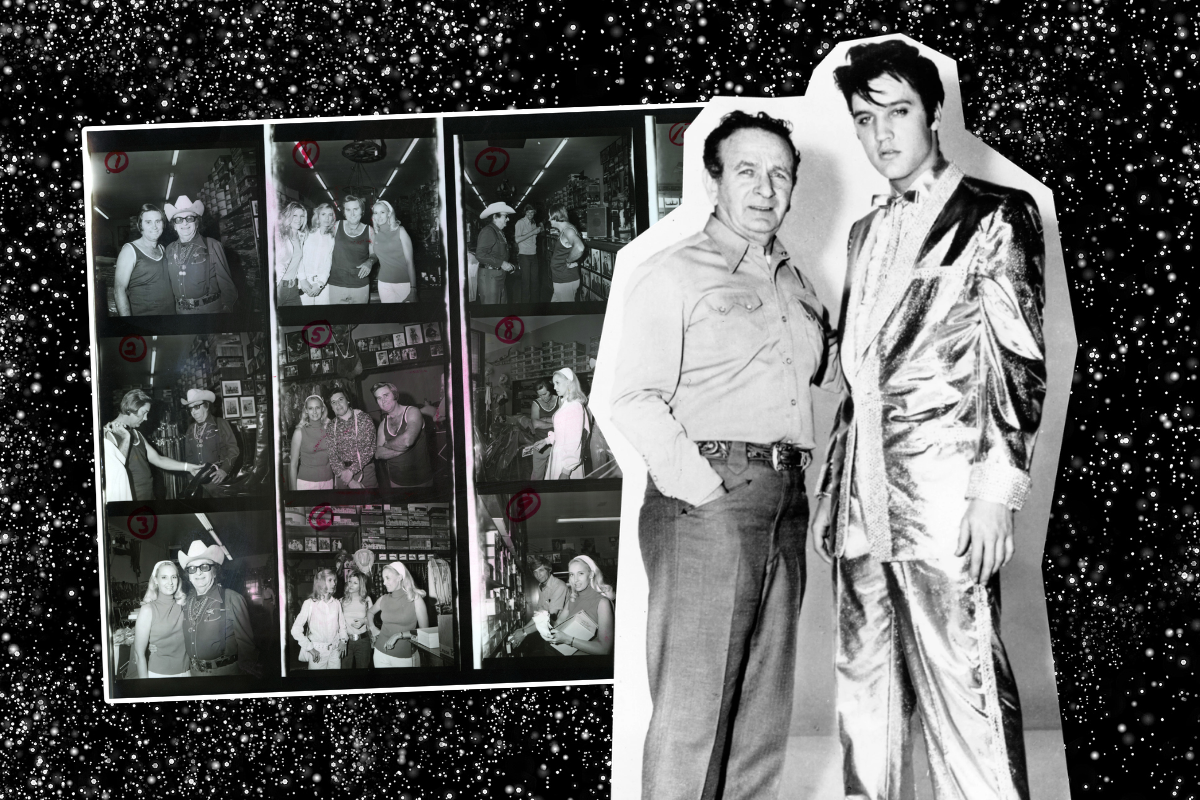
Nudie’s most famous creation, however, was made in 1957 for Colonel Parker’s “golden boy,” the King of Rock ’n’ Roll himself: Elvis Presley. Crafted from 14-karat gold lamé, the suit cost $2,500 to produce, though it was widely publicized as a “$10,000 suit.” Elvis wore it onstage, first in Chicago in 1957, and it graced the cover of his album “50,000,000 Elvis Fans Can’t Be Wrong.” Ironically, despite its legendary status — even the Elvis Barbie wears one — Elvis hated the suit. According to Pamela Clarke Keogh’s book “Elvis Presley: The Man. The Life. The Legend,” Elvis felt “the suit was wearing him — a first for Elvis — and not the other way around.” The suit was also notoriously heavy, featuring over 10,000 hand-set rhinestones, so Elvis often wore only the jacket with black trousers.
Nudie Cohn himself was as flamboyant as his designs, always dressed in bedazzled suits and, notably, mismatched boots. According to his granddaughter Jamie Nudie, he wore mismatched boots to commemorate his humble beginnings as a poor Jewish boy who couldn’t afford a matching pair of shoes. Once successful, however, Nudie became a shameless self-promoter, appearing on television, gracing the cover of Rolling Stone, and driving around Hollywood in his infamous “Nudie Mobile”— a white Cadillac convertible adorned with steer horns, signature embroidery and silver-dollar detailing. For a Jewish immigrant who arrived with nothing, spectacle was a way of taking up space in a country that often preferred Jews to stay invisible.
Although Nudie Cohn passed away on May 9, 1984, at the age of 81, and his business closed in 1994, his legacy remains visible today. It continues to be revived by modern artists such as Post Malone, Diplo and Lil Nas X.
Nudie Cohn defined the look of country music. His suits bore his name and became more than clothing — they were statement pieces and status symbols, priced from $10,000 and up. His influence on country music is as significant as that of the musicians who played the guitars and sang the songs. And even though Elvis didn’t love his golden suit, it remains one of the most unforgettable looks in music history — created by a Ukrainian Jew who once didn’t own a matching pair of shoes.