In a former photography studio in Chelsea, New York, audiences travel to Jewish communities in Iran, Ethiopia, Ukraine and Mexico over two and a half hours and a four course meal. There’s no team of wacky scientists behind this experience, nor a teleportation device. There’s not even a hallucinogenic. It’s the work of the masterminds at the helm of “StoryCourse: Diaspora,” an immersive culinary and theatrical experience from creative producer Charly Jaffe with Broadway veteran Adam Kantor.
When I enter the Midnight Theatricals space on opening night, I am greeted by welcoming faces from the production team and drinks inspired by four different countries. Paper silhouettes foreshadow the four Jewish stories of singer Stephanie June and her mother Yvonne, chef Beejhy Barhany, restaurateurs the Lytvynenko family and chef Fany Gerson; all members of the Jewish diaspora who eventually made New York City their home. My fellow diners and I leave behind a dark and cold night for a tapestried parachute tent filled with warm hues of burgundy, orange, lemon and ocean blue, a floor covered in a collage of rugs (each one more beautiful than the last) and a table fit for royalty. Here, what Rabbi Abraham Joshua Heschel defined as the sacred architecture of time begins to take hold.
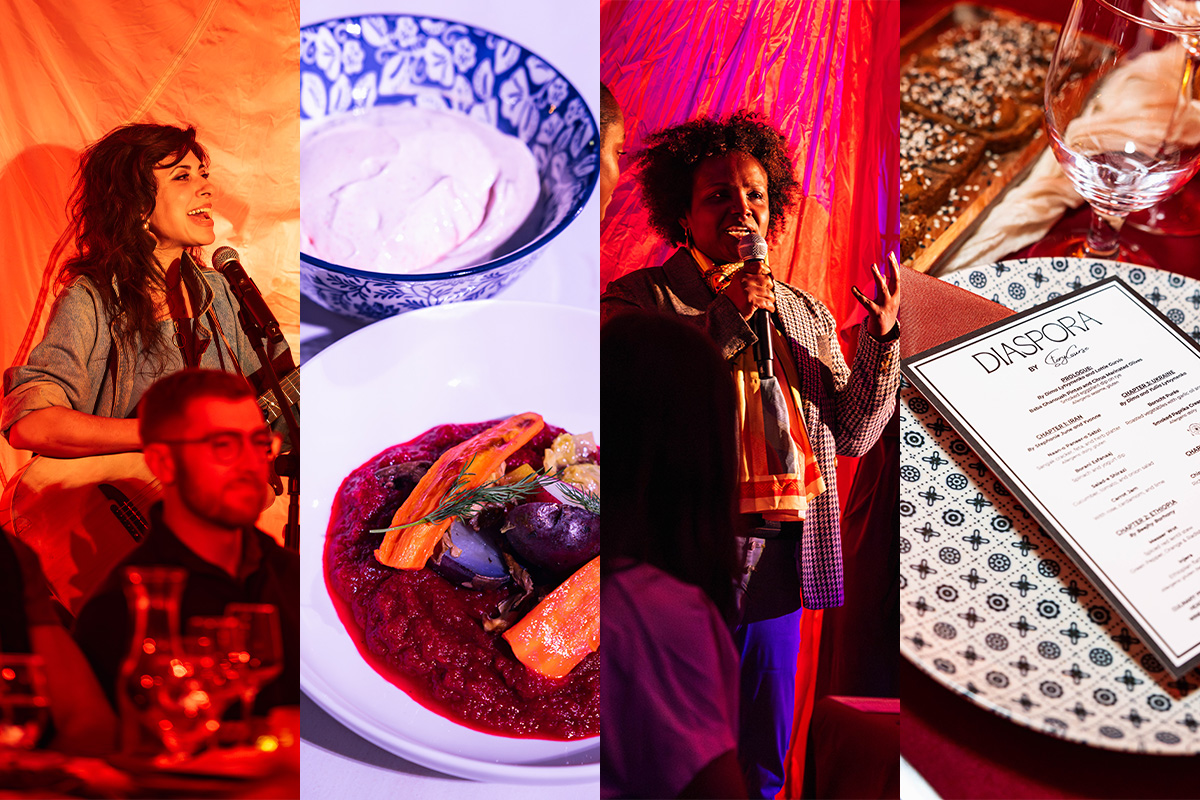
The schmoozing and the kvetching begin immediately over an inviting platter of baba ganoush and marinated olives prepared by Dima Lytvynenko and chef Lottie Gurvis. At some point a guitar strums, the audience comes to a hush and chapter one begins. June’s story of her mother’s life in pre-revolution Iran unfolds in the round — part song, part ensemble-driven story, we learn about June’s yearning to return to this place that she’s never been, that her family was forced to leave behind. “Maybe I can’t quite touch the place my parents came from, but I can touch the foods. They are sacred to me,” June says dreamily near the end of her chapter. Meanwhile, we were served a Shirazi salad (cucumber, tomato and red onions), borani esfanajj (spinach and yogurt dip) and ausheh must (carrot jam).
I can’t help but feel a kinship for her as I think of the many stories my family has told me about their home countries over empanadas, fricassé and rationed sweets from my grandmother’s travels. I’ve yet to visit Brazil, Colombia or Panama, and we still can’t pinpoint exactly where in Eastern Europe my father’s family comes from. But I have the same deep, almost genetic kind of saudade for these places that June has for Iran. These intangible and instructive pieces of our heritage — recipes, music, Shabbat — they’re home. “When we think about our recipes, they don’t exist on their own. They’re anchored in a time and place. They have the ability to time travel and to transport us so I do think they have their own form of sacred architecture,” Charly Jaffe later explains to me.
Cozy Season with Hey Alma. As the days get shorter, Hey Alma is where you can curl up with Jewish culture that's funny, honest, and open to everyone.
This sentiment is inescapable in chapter two. Chef Barhany is played by the energetic Shiro Kihagi. As Barhany, Kihagi eats messer wot, a spice-filled red lentil stew served with an Ethiopian sourdough pancake called injera, which Ethiopian Jews trace back to the story of Jacob and Esau in the Torah. At the same time, her story progresses from the time she is a child in Ethiopia, to a refugee camp in Sudan, to her adulthood in Israel and New York City. While she might not know exactly where she fits in the world after facing discrimination wherever she’s moved, she knows that home is inside the tight hug of injera-wrapped messer wot that she shares with her family.
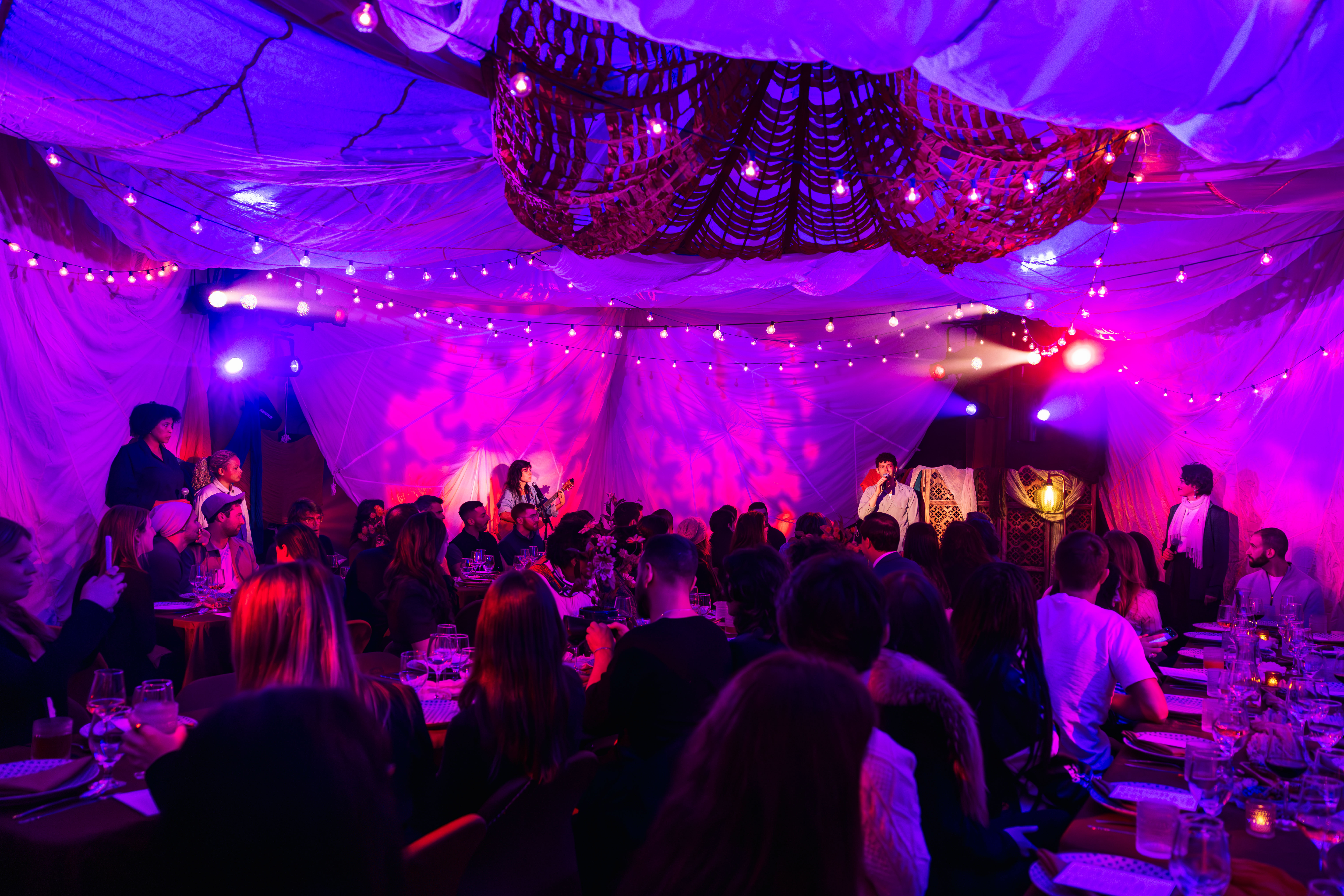
The ensemble of 12 performers move around and through the space constantly, interacting with audience members as performers and servers. Throughout the night the audience is constantly in service to the actors’ movements, darting our eyes and whipping our heads to wherever the actors may land. The actors, of course, act in literal service to the audience, but everything is in service to the food and the story. “When StoryCourse was founded the dream was to marry the world of culinary arts and theater. It began with [the concept of the] the Passover seder and this aha-moment of, ‘Wow, this ancient ritual combines food and story in a way where the food operates as the conceit for the story that’s being told.’” says Adam Kantor.
In chapter three, a documentary about Dima and Yuliia Lytvynenko and their three children, we learn that they were forced to flee Ukraine two years ago after their restaurant, Mama Cassala, was destroyed in a Russian rocket attack. They could not take the doors, the windows, the chairs or the tables of the restaurant with them as they left their home in Ukraine. But they could bring their recipe for borscht, a beet soup that has been in their family for generations, no matter where they call home.
The night ends on a sweet note. Chef Fany Gerson, portrayed by a charismatic Courtney Corso-Casiano, guides her son through the kind of discrimination she faced as a child in Mexico City. Always forging her own path, she was put down by her more religiously and socially conservative family and community members. When her son laments that kids at Hebrew school in New York City tell him he’s not a “real Jew” because of where his family comes from, she tells him to drown out the noise and make his Judaism, and his life, his own practice — just like she has for decades.
By the time Gerson’s desserts are served, a rich chocolate chipotle cake and a guava cream cheese babka, each chapter has sparked more questions about the world than answers, the hallmark of any Jewish event. “So much of what this is doing is building connective tissue,” says Jaffe. “The defiant humanity of showing complexity is what people are so hungry for, which is why people who can’t agree on anything — who are on total opposite sides of the political spectrum — agree that they loved this.”
I exit feeling more connected to global Jewry. It’s not just because I learned about different communities and inevitably met other Jewish people there, but because I feel like I was part of something spiritual. As the goals of the industry have lately trended toward profit and adaptions, it’s an experience that’s becoming more rare and precious in theater. “At the end of the day, [the show is] all ritual,” S. Asher Gelman, movement director for “StoryCourse: Diaspora” says. “Rituals mark time. They follow patterns. They connect us to something larger than ourselves — to community, to the sacred, to comfort. There is an inherent, profound holiness in connecting to those who came before us; through their stories, their traditions, and, of course, their recipes.”