Editorial note: Spoilers ahead for season two of “Nobody Wants This.”
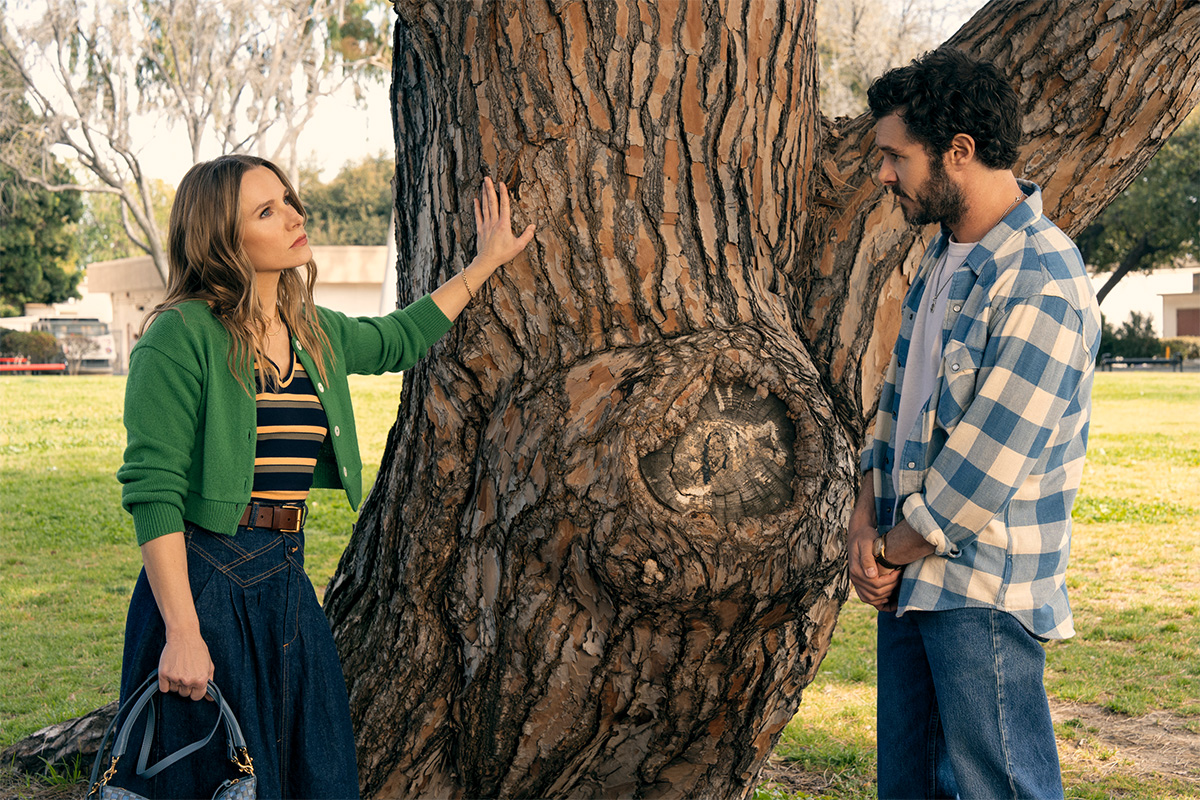
With minutes to go in season one of “Nobody Wants This,” it seems like a future isn’t in the cards for down-to-earth yet traditional rabbi Noah Roklov (Adam Brody) and agnostic sex-and-dating podcaster Joanne (Kristen Bell). Joanne, flustered at the responsibility of being a rabbi’s partner and the pressure to convert, tries to break up with Noah at his niece’s bat mitzvah. But Noah doesn’t let her. The hot and charming rabbi runs after her to say that he doesn’t care about the stakes. He wants to be with her. They share one of their many steamy kisses of the season as the music swells, the potential energy of their relationship – and future seasons – effervescent, crackling off the screen.
Season two of “Nobody Wants This,” out today on Netflix, holds up almost none of this promise.
The show’s sophomore turn opens with Noah and Joanne as their honeymoon phase is over. The pair begin to navigate relationship issues beyond the question of their interfaith status. They host a disastrous first dinner party together. They struggle to coalesce their expectations for holidays like Valentine’s Day. And they have to deal with Morgan’s (Justine Lupe) alarming and potentially illegal — yet played for laughs — romantic relationship with her therapist Dr. Andy (Arian Moayed).
A Humble Request for the New Year: You can help keep Hey Alma's radically inclusive Jewish community free and open to all. Your gift means someone, somewhere, feels a little less alone this holiday season.
Whether or not Joanne will convert still looms large, however. Noah is forced out of Temple Chai because Joanne isn’t Jewish (which I’m pretty sure is against California state employment law). In its place, he finds a job at Temple Ahava, a community that is more progressive but less rigorous in its Judaism. Bina (Tovah Feldshuh) still refuses to accept Joanne and, in an unrealized threat, once again promises to break up the relationship. To add even more stress to Joanne’s decision, her mom Lynn (Stephanie Faracy) realizes that she wants to convert to Judaism and begins the process.
All of this comes to a head when Joanne is suddenly evicted from her apartment (once again, illegal). Noah refuses to ask her to move in with him because her lack of conversion makes him unsure of their relationship, and the hot rabbi breaks up with Joanne at Morgan and Dr. Andy’s engagement party. (Don’t worry, Morgan swiftly breaks up with Dr. Andy, too.) Noah leaves the party only to realize he’s made a terrible mistake. Concurrently, Joanne finally realizes that she want to convert, thanks to a pep talk from Esther (Jackie Tohn) who inexplicably just broke up with Sasha (Timothy Simons). The season ends with Noah and Joanne finding each other at the Urban Light installation by LACMA, sharing a kiss… and we are essentially right back where we started.
There are, to be sure, a lot of issues plaguing this season of “Nobody Wants This.” The writing is disjointed; the narrative swings between a forward momentum driven by perplexing choices and no propulsion at all. The characters of last season feel wholly unrelated to the characters of this season — gone is the Rabbi Noah who is sensitive and self-aware in relationships and so is the Esther who loves herself and her family, but hates Joanne. (Sure, people can change. But Esther, in particular, does so without good cause.) Bina and Ilan are gone period, save a handful of lackluster scenes.
But my biggest qualm is that despite this show hinging on interfaith relationships, season two of “Nobody Wants This” seems to leave behind the authentic Jewishness that gave it soul and specificity.
I want to preface this criticism by saying that I am a Jewish woman who enjoyed season one of “Nobody Wants This.” I was allured by Noah and Joanne’s butterfly-inducing and emotionally intelligent rapport. I appreciated the show’s relatively accurate portrayal of Judaism (yes, I did fact-check all 10 episodes of season one), and the way it naturally wove in all kinds of Jewish culture from summer camp to Yiddish to havdalah to The Book of Ruth to lashon hara.
Others, like critics Esther Zuckerman and Jessica Grose, were put-off by the show’s admittedly stereotype-heavy depiction of Jewish mothers and women. But I felt that, ultimately, “Nobody Wants This” held up a mirror to how the American Jewish community can be and historically has been unwelcoming to the non-Jewish partners of young Jewish people. As the product of an interfaith household, which laid the groundwork for the strong Jewish practice I have today, and as the partner of a Jew whose non-Jewish mother shares some aspect of Joanne’s experience, season one’s narrative felt urgent to me. I could live with some unflattering representation of my community, so long as it was based in the truth of creator Erin Foster’s experience.
But in season two, the portrayal of Judaism backslides from careful and correct to a shallow and clumsy near after-thought. Jewish culture and ritual barely comes up in the first half of the season, beyond Noah being mistreated by Temple Chai, a quick Shabbat dinner scene and Noah talking about “The Golden Rule” on Joanne and Morgan’s podcast.
When Judaism does get more airtime, it’s riddled with mistakes and misinterpretations. At a brit bat, or baby-naming, in episode five, signage at the party misspells the Hebrew version of baby Afternoon’s name. (“צָהֳרַיִם” is spelled as “צָהֳרַיִים”.) In episode six, Purim is explained to Joanne as a day when she might finally feel ready to convert. “The idea is that anything can happen, and what’s hidden might become revealed,” Noah teaches. “Sometimes people feel more themselves on Purim or more connected to Judaism. Sometimes people even discover Judaism within themselves for the very first time.” Earlier, he tells Joanne that she could dress up for a Purim party as her “shadow self, that’s the part of you that’s not visible most of the time.”
I grant that Queen Esther did initially hide her Jewish identity from King Ahasuerus, only to reveal herself as Jew to save her people from Haman’s plot. I will also grant that Noah does give Joanne that explanation of Purim. But the rest of what Noah says about Purim feels like extrapolation — even as a child, I understood Purim as a day where Jewish wisdom compelled people to get so drunk they shouldn’t be able to tell the difference between Mordechai and Haman. I’ve never once encountered Purim celebrations as a time for serious meditation on one’s Jewish identity, and certainly not as something in conversation with one’s “shadow self.”
Later in the episode, Noah goes to interview for the senior rabbi position at Temple Ahava, a progressive shul helmed by Rabbi Neil (Seth Rogen) and Rabbi Cami (Kate Berlant). As Noah and Neil chat, Neil reveals that he’s fangirling a bit. “I saw your Tu Bishvat sermon,” Neil tells Noah. “It changed the way I mourn.” Um… what? Mourning on the joyous birthday of the trees? I have to believe that the writers mistook Tu Bishvat for Tisha B’Av, the saddest day on the Jewish calendar which includes commemorating the destruction of the First and Second Temples, fasting and communal mourning.
But that’s only the tip of the iceberg with Ahava. While the synagogue is more than OK with Noah being a rabbi in an interfaith relationship, that’s because Neil, Cami and their congregation hold a disdain for Judaism that is all but said out loud. “I love the words [of the Torah]. But it doesn’t mean we gotta be weird about ‘em,” Neil tells Noah when they first meet. On other occasions, Neil and Cami suggest that Noah should take off his kippah. The pair teach their religious school students that it’s OK to skip Shabbat for a movie premiere, regift b-mitzvah presents and watch Mel Gibson movies. And when Lynn comes to Ahava to inquire about conversion classes, Cami tells her they have a 6-month conversion class that is “painless.”
With the only other synagogue in the show being Temple Chai, “Nobody Wants This” creates a false dichotomy in Judaism. In this universe, the options for practicing Judaism are with a community that observes Jewish ritual and law “the right way,” excluding interfaith couples, or with a community that does it “the wrong way,” but includes interfaith relationships. On one hand, Conservative Judaism is esoteric and painful. On the other, progressive Judaism is fun, but invalid to the point that it’s not even Judaism at all.
Understandably, neither of those versions of Judaism are appealing to Joanne. But the real kicker is that her decision to convert in the finale is spurred on by a speech about Jewish culture from Esther that at its heart, actually says nothing specific about Judaism. After Noah breaks up with her, Joanne bemoans that she will miss Shabbat and being superstitious. In response, Esther tells Joanne that she is basically Jewish already because she’s warm and cozy, loves to chat and get in peoples’ business, is obsessed with her crazy family and eats challah before she’s supposed to. Take away the words Shabbat and challah, and Esther’s speech could describe almost any other cultural group. What about tikkun olam? Pikuach nefesh? B’tzelem elohim? Hello, anyone?
All of this begs the question: Does “Nobody Wants This” even like Judaism? Vulture critic Fran Hoepfner asked just this in her essay about season one: “Is ‘Nobody Wants This’ Mildly Antisemitic?” “No one in the show itself seems all that fond of being Jewish in the first place and how it dictates that people live their lives,” she noted at the time. “Judaism, per this comedic universe, is awful: It is a religion that consists of nagging women and lazy men, driven by archaic rules that don’t allow for Reform rabbis to have shiksa girlfriends but do allow said Reform rabbis to play in an amateur basketball league on Saturday mornings.”
She adds, “It’d be one thing if the Jewish life that Noah’s family partakes in was singular to their experience, with maybe a little backstory explaining why and how they’re so rigid and inconsistent in their beliefs. Instead, however, the show traffics in tired stereotypes about modern Jews.”
Last year, I found this assessment to be slightly harsh. But now in season two, “Nobody Wants This” has chosen to crystallize its Judaism into just what Hoepfner describes — not a religion to be explored with genuine curiosity and care, but one to be dealt with, maneuvered around, generalized and laughed at.
When Erin Foster defended her show from criticism, specifically from fellow Jews, back in August, she instructed, “To have a lighthearted, sweet, happy show that reminds people how beautiful Judaism is — don’t find something wrong with it! Take the win, you know?” But when “Nobody Wants This” season two has managed to make Rabbi Noah unlikable and concoct a specter of Judaism that is so detestable I’d honestly prefer the show not take place in a Jewish context, I’m not quite sure where there’s a win to be found.