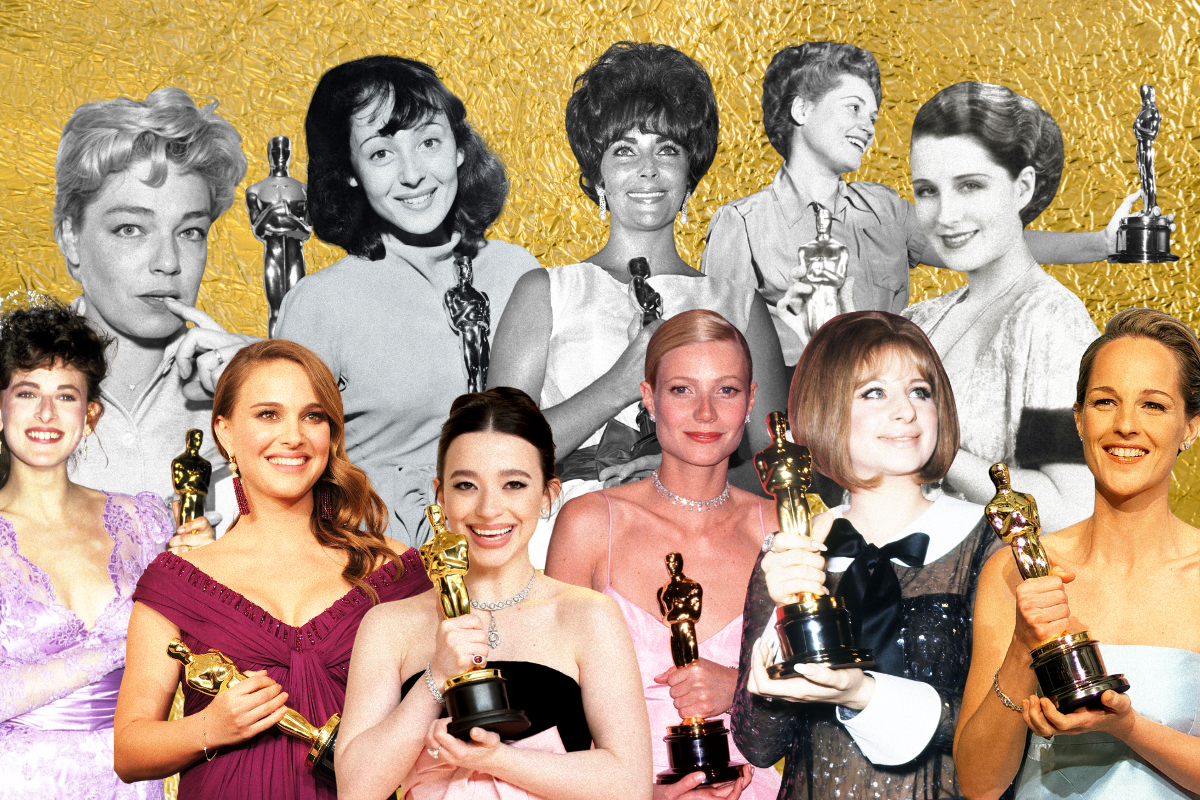
Jewish actresses have been shining brightly for nearly a century of Academy Awards history. Whether born Jewish or converts, they were boundary-pushing figures — at once embodiments of feminine stereotypes and powerful cultural barometers of their time.
Norma Shearer
“The Divorcee” (1930)
The first-ever Jewish Best Actress winner was Norma Shearer, who received her statuette at the 3rd Academy Awards in November 1930 for her role in “The Divorcee.”
Born in Montreal, Shearer dreamed of the stage and screen from the age of 9. She began as an extra in films and gradually rose through the ranks, eventually catching the attention of MGM’s chief producer, the legendary “Boy Wonder” Irving G. Thalberg.
In 1927, Shearer converted to Judaism and married Thalberg in a Jewish ceremony. Nicknamed “the First Lady of MGM,” she initially played virtuous, demure characters, but later persuaded her husband to reimagine her screen image as sensuous and confident. Her role in “The Divorcee” not only earned her a prestigious award but also established her as a feminist pioneer.
A Humble Request for the New Year: You can help keep Hey Alma's radically inclusive Jewish community free and open to all. Your gift means someone, somewhere, feels a little less alone this holiday season.
Shearer was nominated six times for Best Actress and was the earliest performer to receive five nominations.
Luise Rainer
“The Great Ziegfeld” (1936) and “The Good Earth” (1937)
Luise Rainer was born in 1910 in Germany into an upper-middle-class Jewish family. She pursued acting against her father’s wishes, and trained in Europe before Adolf Hitler became Chancellor in 1933. Rainer soon realized her Jewish background posed a threat despite not being raised religious.
In 1934, she was discovered by an MGM scout in Vienna and moved to Hollywood, where she rebranded herself as “Viennese” amid rising anti-German sentiment. Her second Hollywood film, “The Great Ziegfeld,” cast her as Polish-born Jewish showgirl Anna Held — a role that earned her an Academy Award.
In 1937, she became the first performer to win two consecutive Best Actress Oscars, this time for portraying a Chinese peasant farmer’s wife in “The Good Earth.” The role reflected Hollywood’s deeply problematic Production Code and anti-miscegenation laws, which barred Chinese actresses from playing opposite white men. Rainer refused to wear a prosthetic mask but appeared in yellowface makeup.
She died in 2014 at the age of 104, the longest-lived Oscar winner.
Judy Holliday
“Born Yesterday” (1950)
Born Judith Tuvim in Queens, New York, in 1921, Judy Holliday was of Russian-Jewish descent. Her stage name derived from the Hebrew phrase yamim tovim, which literally translates as “good days,” referring to Jewish holidays. She rose to fame on Broadway, where the hit 1946 production of “Born Yesterday” led to a Hollywood adaptation in which she reprised her role as the archetypal “dumb blonde.” The performance earned her both a Golden Globe and an Academy Award in 1951 — despite Columbia Pictures head Harry Cohn dismissively referring to her as “that fat Jewish broad.”
Holliday’s story exemplifies Hollywood’s systemic antisemitic misogyny. Despite the fact that major studios were founded by Jewish immigrant men, Jewish women were pressured to assimilate — masking their Jewishness through appearance and Americanized stage names.
Elizabeth Taylor
“BUtterfield 8” (1960) and “Who’s Afraid of Virginia Woolf?” (1966)
A year before winning her first Oscar for “BUtterfield 8,” Elizabeth Taylor converted to Judaism, taking the name Elisheba Rachel. By the time she received the award, she had already appeared in 30 films. Though many claimed she converted solely for her fourth marriage to singer Eddie Fisher, whom she married in a Jewish ceremony, Taylor insisted she found genuine solace in Judaism after the tragic death of her third husband, Mike Todd and had long felt an affinity with the faith. A committed supporter of Israel, she remained Jewish until her death in 2011 and was buried in a Jewish ceremony.
Simone Signoret
“Room at the Top” (1959)
French actress Simone Signoret was born as Simone Kaminker in Germany and raised in France, to a Jewish father and French Catholic mother. Even though she was not raised observing Judaism, she identified herself as Jewish and supported Jewish causes in cinema and art as well as Zionism and Soviet Jewry movement. She was active in political left-wing causes, which almost denied her visa to enter America. However, her victory of the Best Actress Oscar for the film “Room at the Top” was a sign that conservative era of McCarthyism and blacklisting in Hollywood was now in the past.
Barbra Streisand
“Funny Girl” (1968)
The 1969 Academy Awards made history with an unprecedented tie for Best Actress: veteran Katharine Hepburn, who did not attend, and 27-year-old Barbra Streisand, for her debut screen performance as Fanny Brice in “Funny Girl.” Though not the first Jewish winner, Streisand was the first who refused to conceal her Jewishness. She proudly kept her nose, her Brooklyn accent and her identity. During the production of “Funny Girl,” she faced backlash — and even death threats — for supporting Israel during the 1967 Arab-Israeli War. The film was ultimately banned in the Arab world because Omar Sharif, an Egyptian actor, portrayed a Jew who kissed a Jewish woman onscreen.
Her victory catapulted her into global superstardom. She later collected another Oscar for Best Original Song (“A Star Is Born”) and became the first woman to write, produce, direct and star in a major studio film, “Yentl” (1983).
Marlee Matlin
“Children of a Lesser God” (1986)
Marlee Matlin’s win was historic on multiple fronts. Deaf since 18 months old due to illness, Matlin was born to a Reform Jewish family near Chicago and trained at the Children’s Theatre for the Deaf.At 19, she delivered a career-defining performance as Sarah Norman, a proud campus janitor, in “Children of a Lesser God” (1986). At the 1987 Academy Awards, she became the youngest Best Actress winner ever — at 21 years and 218 days, a record she still holds.
Matlin later focused largely on television (earning an Emmy nomination for her guest role on “Seinfeld”), advocacy for deaf representation and received a star on the Hollywood Walk of Fame in 2009. Notably, she starred in “CODA” (2021) — the first film featuring predominantly deaf cast to win The Best Picture in 2022.
Helen Hunt
“As Good as It Gets” (1997)
All-American actress Helen Hunt has English and German-Jewish roots. Hunt has previously called herself “a quarter Jewish,” and she was particularly interested in discovering the story of her Jewish paternal great-grandmother, Florence Rothenberg on a 2012 episode of genealogical show “Who Do You Think You Are?”
Hunt began her career as a child television actress in the late 1970s, appearing in numerous shows and films, before rising to nationwide prominence with the sitcom “Mad About You” in the 1990s. In 1997 she starred alongside Jack Nicholson in the romantic dramedy “As Good as It Gets,” playing a single-mother waitress who develops an unlikely romance with a misogynistic, obsessive-compulsive writer portrayed by Nicholson. That year took home the Academy Award wearing a blue Gucci dress designed by American designer Tom Ford.
Gwyneth Paltrow
“Shakespeare in Love” (1998)
The 1999 Academy Awards were shaped by an aggressive campaign led by Harvey Weinstein for “Shakespeare in Love” against Steven Spielberg’s “Saving Private Ryan.” Host Whoopi Goldberg joked that “those boys fought World War III over World War II.”
Paltrow is patrilineally Jewish, descended from the Paltrowitch rabbinical dynasty.And while she never had a bat mitzvah, her coronation as Hollywood’s “new princess” at the 1999 Oscars may have made up for it. She dressed accordingly, in her now-iconic bubblegum-pink Ralph Lauren gown, that was as controversial as her victory.
Natalie Portman
“Black Swan” (2010)
Born Natalie Hershlag in Jerusalem, Portman moved to the U.S. at the age of 3. She began acting at 12 while balancing academics, later earning a psychology degree from Harvard.
Her performance in Darren Aronofsky’s ballet-themed psychological thriller “Black Swan” earned her Best Actress in 2011.
Despite being a Dior brand ambassador, Portman wore Rodarte —who also created costumes for “Black Swan” — to the ceremony, publicly condemning John Galliano, then creative director of the house, after he was caught on camera delivering an antisemitic rant.
Portman has since remained outspoken about industry inequities, famously wearing a Dior cape embroidered with the names of snubbed female directors at the 2020 Oscars.
Mikey Madison
“Anora” (2025)
In 2025, for the third time in Oscars history, both Best Actor and Best Actress went to Jewish performers: Adrien Brody and Mikey Madison, the latter for her role as Ani, a Brighton Beach sex worker, in “Anora.”
Madison’s victory was one of the night’s biggest surprises, as she beat veteran Demi Moore, who was widely expected to finally receive her first Oscar. The win also signaled a shift in Hollywood’s perception of sex workers, long marginalized in mainstream cinema. While Madison was not the first actress to win an Oscar for playing an escort, she was the first to thank the community in her acceptance speech.
Editorial note: Anna Magnani, who won Best Actress in 1955, is not included in this list. Though director Franco Zeffirelli wrote in his autobiography that Magnani was born to an Italian-Jewish mother, those claims are unverified.